
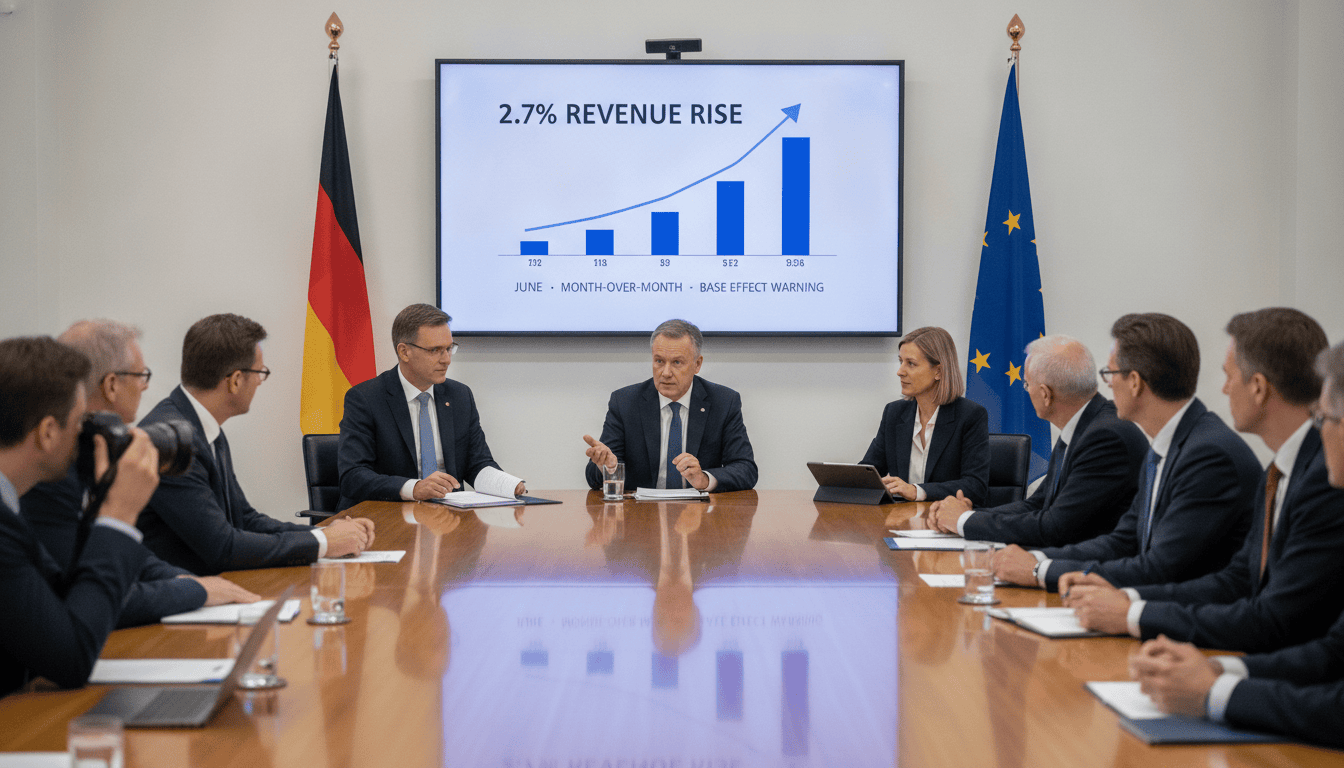
German Mittelstand revenue edges up 2.7% in June, Datev index warns recovery may be overstated
Datev’s Mittelstandsindex shows German Mittelstand revenue rose 2.7% year‑on‑year in June, but analysts warn the gain is distorted by last year’s low base and rising wage costs.
The German Mittelstand registered a 2.7% year‑on‑year increase in revenue for June, according to the Datev Mittelstandsindex, signaling a modest uptick in activity for mid‑sized firms across the country. The index’s authors cautioned that the rise reflects a statistical base effect from a sharp drop in revenue the previous year, and that the broader recovery remains fragile. Wage costs continued to climb, intensifying pressure on company margins even as headline sales improved. Employment metrics also pointed to a continued, if slight, contraction in the sector.
Datev index records June revenue rise
Datev’s Mittelstandsindex, compiled from anonymized VAT prepayments and payroll records, shows the June revenue increase against the same month a year earlier. The figure marks a reversal from May, when the index recorded a 1.2% decline year‑on‑year, underscoring volatility in the short‑term figures.
Datev emphasizes that the index provides an early read on the Mittelstand’s economic trajectory and often leads official statistics, but its authors and external economists advise careful interpretation of month‑to‑month swings. The reported 2.7% uptick must be viewed in the context of last year’s pronounced revenue slump that magnifies current comparisons.
Economists warn the rise may be overstated by base effects
Datev executives and independent analysts warned against overstating the significance of the June gain because of a statistical base effect. A steep revenue fall recorded in the prior-year month means any modest recovery may appear larger when measured year‑on‑year.
Robert Mayr, chair of the Datev cooperative, cautioned that the Mittelstand is only stabilizing in parts and remains far from a broad‑based rebound. Market observers say that without sustained sequential growth, policymakers and businesses should treat the June number as a tentative signal rather than proof of recovery.
Wage inflation accelerates pressure on margins
The wage index included in Datev’s dataset climbed sharply, with payroll costs rising 6.3% year‑on‑year in June. That acceleration of labor costs increases operating pressure for mid‑sized firms, many of which operate on thin margins and limited pricing power.
Rising wages combined with largely stagnant revenue in the trend open a growing gap that firms must manage through productivity gains, price adjustments, or cost containment. Datev data indicate the wage squeeze is broadly felt across company sizes in the Mittelstand, limiting the ability of smaller firms to absorb higher labor expenses.
Sectoral patterns: construction shines while manufacturing and hospitality lag
The June data show divergent sectoral performance within the Mittelstand. Construction was the notable positive, with revenue up 1.2%, while the manufacturing sector recorded a 2.0% decline in sales year‑on‑year.
Service sectors such as hospitality and retail also contracted in June, reflecting softer consumer demand and lingering structural challenges. The declines were concentrated among the smallest firms—those with fewer than ten employees—where recent months have shown the most pronounced revenue weakness.
Company size differences and employment trend
Datev’s breakdown reveals that mid‑sized companies, those with up to 249 employees, have recently posted revenue gains while micro firms have borne the brunt of declines. The distribution suggests larger Mittelstand firms are better positioned to withstand cost shocks or to pass on price increases.
Employment within the Mittelstand edged down by 0.1% according to the same index, continuing a gradual shrinkage that has been observed since 2024. That subtle drop in staffing levels reflects both ongoing adjustments to demand and firms’ efforts to contain labor costs amid rising wages.
Methodology behind the Mittelstandsindex
Datev compiles the Mittelstandsindex from VAT prepayments submitted by more than one million companies and payroll data covering over eight million employees, aggregating and anonymizing records to generate the indicator. Because it draws on near‑real‑time administrative filings, the index often provides an earlier signal of business trends than official statistics.
Datev stresses the confidentiality and statistical processing of the raw inputs, and highlights that the index is intended to show short‑term developments rather than to serve as a detailed sectoral accounting. Analysts say the index is valuable for spotting inflection points but must be combined with other indicators for policy or investment decisions.
The June reading offers a cautiously positive moment for the German Mittelstand, but Datev and outside experts agree the uptick should be interpreted with restraint. Rising labor costs, uneven sector performance, and the ongoing decline in employment suggest the road to a sustained recovery remains uncertain.
