
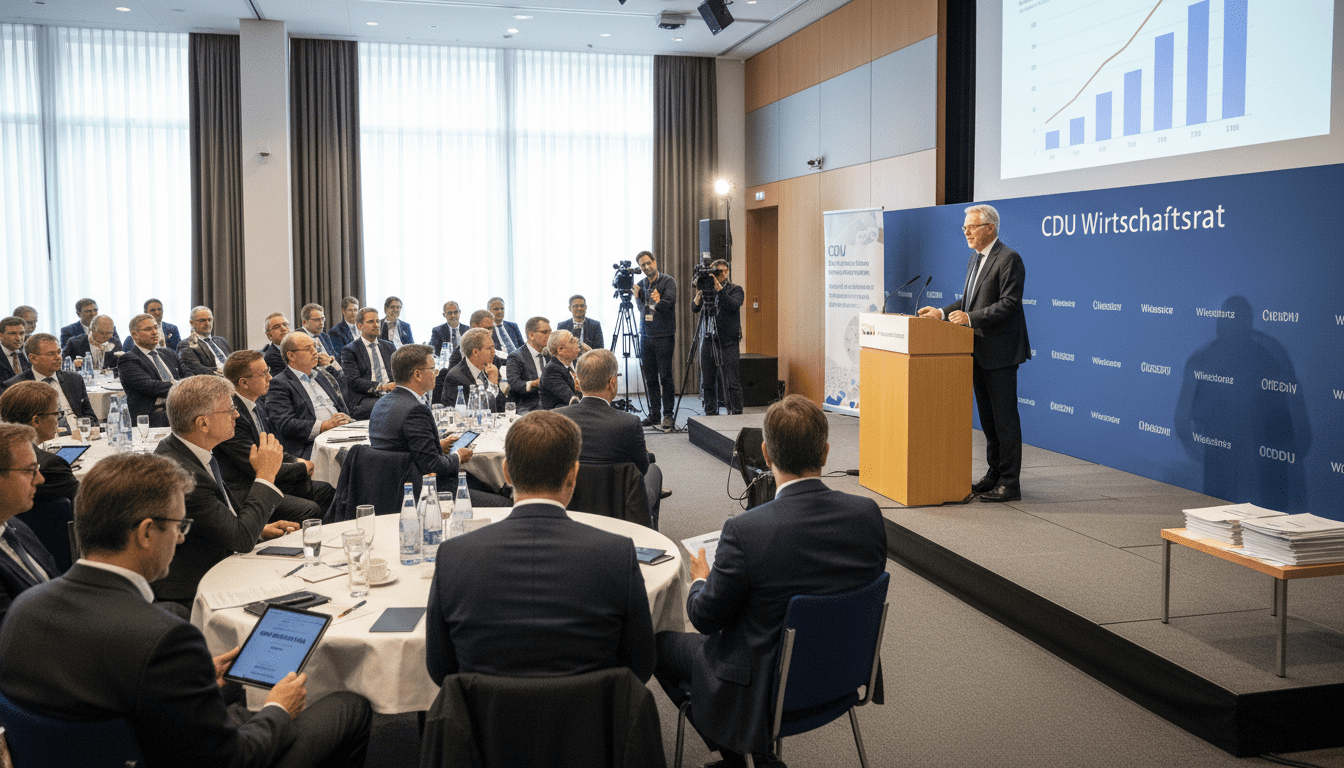
CDU Economic Council survey finds 96% of member firms say coalition reforms are ‘too slow’
CDU Economic Council survey shows 96% of member companies call the coalition’s reform pace ‘too slow’. Businesses urge social-state overhaul, fewer reporting duties and faster permit approvals.
The CDU Economic Council survey of nearly 2,000 member companies finds a sweeping rebuke of the federal government’s reform tempo, with 96 percent of respondents describing action as either “rather too slow” or “significantly too slow.” Conducted in the latter half of March and the first week of April, the poll captures a chorus of business frustration just under a year after the current coalition took office. The results place urgent pressure on Berlin to accelerate changes in social policy, regulatory burden and infrastructure permitting.
Businesses Describe Reform Pace as Unacceptable
The survey’s headline figure — 96 percent critical of the reform pace — frames a broader sense of impatience among corporate respondents. Wolfgang Steiger, secretary-general of the CDU Economic Council, interpreted the data as a clear mandate for the government to act with “courage, determination and consistency.”
Respondents included a wide cross-section of companies and entrepreneurs who see persistent policy inertia on multiple fronts. The timing and size of the sample give the findings weight among business lobby voices that are closely allied with the CDU but organizationally independent.
Social-State Reform Tops the Agenda for Firms
Companies ranked a structural overhaul of the social state among their highest priorities, followed closely by cuts in reporting obligations and swifter planning and approval processes. A large majority said existing proposal packages fall short of the scale needed to secure long-term fiscal sustainability of social programs.
The Social-State Commission’s recommendations, published earlier this year, drew particular criticism for their modest cost-saving approach. Roughly eight in ten surveyed firms judged those proposals insufficient to make the social safety net financially viable over the long term.
Pensions, Energy and Technology Show Divergent Concerns
Respondents singled out pension policy, energy strategy and federal budgeting as areas of acute dissatisfaction. Nearly nine in ten firms endorsed stronger private retirement provision measures or linking statutory retirement age to increases in life expectancy as means to stabilize the pension system.
On energy and climate policy, businesses urged a faster expansion of energy generation and grid infrastructure and called for technology neutrality in regulatory approaches. The auto sector received specific mention, with most companies favoring regulatory frameworks that do not prematurely close technological options.
Political Alignment with CDU Shrinks, AfD Sympathy Falls
Support for the economic profile of CDU and CSU has softened: only 69 percent of members now express satisfaction, a decline of roughly twenty percentage points from a year earlier. That shift brings the Union’s business support roughly in line with the FDP, while sympathy for the SPD remains minimal among the Economic Council’s members.
Interest in the AfD’s economic proposals also fell, with backing dropping from 19 percent to 15 percent year-on-year. Steiger described the decline in AfD support as a welcome development, noting it reduces the appeal of what he called the party’s “unreliable” economic promises.
Findings Mirror Broader Elite Sentiment
The CDU Economic Council’s conclusions echo results from an FAZ Elite Panel published in March, which surveyed 500 top executives across business, politics and administration. Three-quarters of those leaders likewise expressed dissatisfaction with the federal government’s performance, reinforcing the narrative of elite unease about reform momentum.
The elite panel judged Chancellor Friedrich Merz’s performance marginally better than the broader cabinet, but major policy ideas from the CDU’s health minister were not captured in either survey. Business leaders continue to press for clearer, larger-scale policy moves than those offered so far.
Germany’s corporate sector has signaled a narrowing window for political maneuvering if the coalition intends to maintain business confidence. The Economic Council’s members stress that incremental adjustments will not satisfy market expectations for meaningful structural change.
The survey amounts to a pointed economic-policy scorecard for the coalition and a direct appeal from influential business stakeholders for bolder, faster reforms. If Berlin aims to restore confidence among the companies that drive investment and employment, the message from the CDU Economic Council survey is unambiguous: accelerate, simplify and deliver.
