
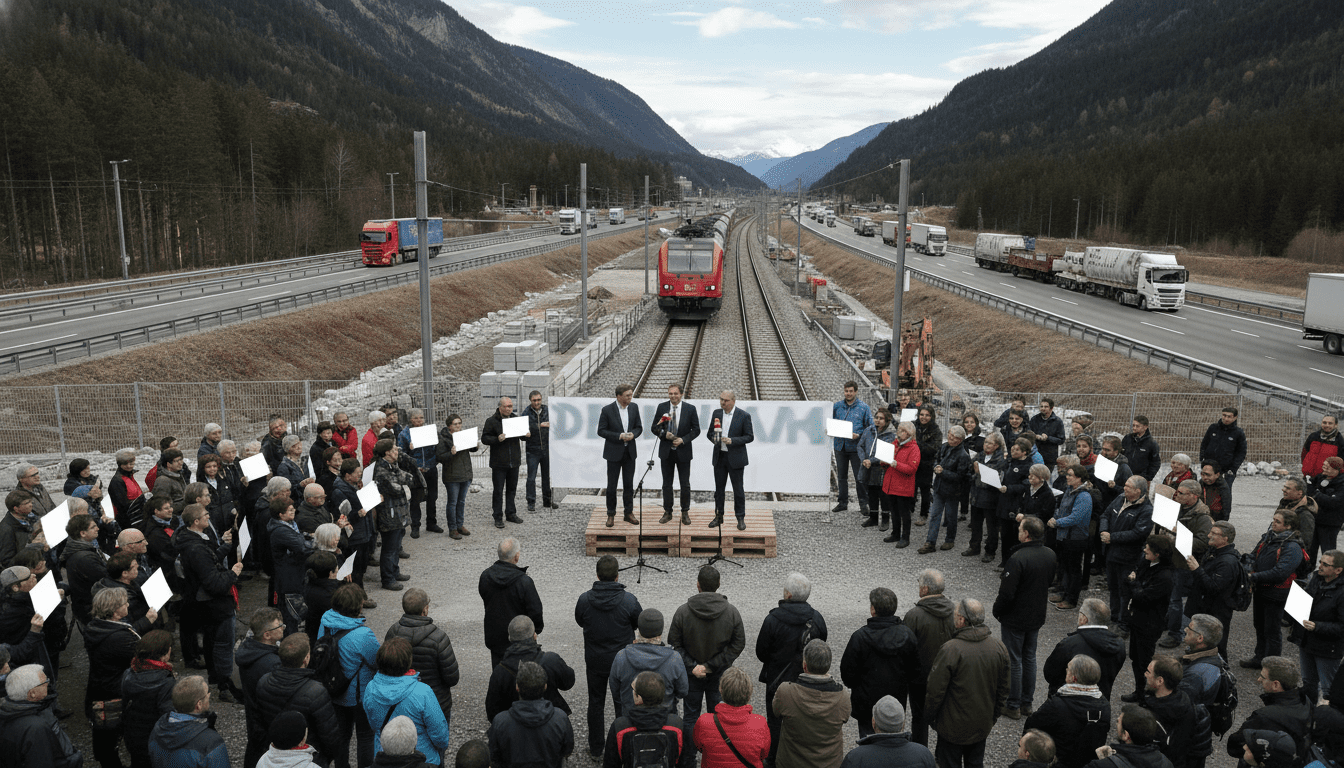
Mayors launch Brenner blockade protest, demand noise barriers and continued truck bans
Mayors from the Wipptal region launched a Brenner blockade protest calling for immediate measures to curb heavy transit traffic, including 13 new noise barriers and the preservation of night, holiday and weekend truck bans. The action, driven by mounting local frustration, also confronts a parallel legal dispute after Italy took the bans to the European Court of Justice. Organizers say the demonstration will hand a formal demands paper to political leaders and set an ultimatum for action before further blockades are considered.
Local officials present written demands
Mayors from Gries am Brenner and neighbouring municipalities compiled a catalogue of measures to hand to state and national authorities during the demonstration. Their demands include construction of 13 new sound walls along the motorway corridor and the strict maintenance of existing truck curfews on nights, holidays and weekends. Officials say the volume of heavy transit traffic has grown intolerable for residents and that the list reflects both immediate fixes and preparatory steps pending longer-term rail solutions.
The demand paper also sets a specific timetable for responses from decision-makers, according to the organisers. If the political response is deemed insufficient by the deadline, local leaders warn of escalated and prolonged protest actions to press their case.
Mayor warns of further blockades if demands are ignored
Gries am Brenner’s mayor described the protests as a last-resort measure born of frustration over unpredictable traffic peaks and declining quality of life. He told reporters that while a single demonstration would not solve systemic transit pressure, it was necessary to force political attention. Local officials are careful in public statements about expected turnout, saying only that attendance above 100 participants would be a significant early success.
Organisers emphasise that future action — potentially including road blockades — remains on the table if authorities and cross-border partners do not respond to the ultimatum. That stance underscores the depth of local anger and the willingness of municipal leaders to sustain pressure until concrete steps are taken.
Legal clash with Italy complicates truck restrictions
The truck bans at the heart of the mayors’ demands are currently contested in court after Italy lodged a complaint at the European Court of Justice. Italian authorities argue that restrictions on trans-Alpine freight movement violate EU rules, prompting legal uncertainty around national and regional traffic controls. The litigation raises the prospect that some curfews could be struck down or require revision if the court finds them incompatible with single-market law.
Local leaders say the pending legal outcome should not be used as a reason to delay mitigation measures for nearby communities. They argue that even if some restrictions are curtailed, complementary steps — such as noise barriers and pricing changes — can still relieve residents while broader legal and infrastructural solutions are pursued.
Brenner Base Tunnel positioned as long-term relief
Residents and officials continue to point to the Brenner Base Tunnel as the principal long-term solution to shift freight from road to rail. Planned to be Europe’s longest rail tunnel at 64 kilometres, the project has been under design and construction for decades; planners forecast large modal shifts once it is fully operational. Projections cited by proponents indicate travel times for passenger and freight services between Innsbruck and Franzensfeste could fall from roughly 80 minutes to about 25 minutes, substantially improving rail competitiveness.
Authorities have set an anticipated opening within several years, a benchmark that underpins calls for interim measures until the tunnel reduces corridor congestion. Meanwhile, residents urge that interim relief cannot wait on a single multi-year infrastructure project and must be delivered through targeted traffic and pricing policies.
Short-term policy proposals to discourage road transit
Alongside structural measures such as noise walls and curfews, local leaders proposed immediate policy shifts aimed at reducing cross-border road freight. These include aligning toll rates from the Schönberg toll plaza with levels comparable to Swiss charges, a move intended to make long-haul road routes less economically attractive. Officials also seek an end to diesel tax privileges in Austria to curb “tank tourism” and the associated additional traffic through valley communities.
Proponents argue that pricing mechanisms, when coordinated across borders, can change freight operators’ route choices in months rather than years. Critics, however, caution that unilateral moves could provoke legal disputes and call for coordinated EU-level approaches combined with investment in rail capacity.
The demonstration organisers will use the event to press these immediate measures alongside their infrastructure requests, framing the combined approach as necessary to protect residents while the Brenner Base Tunnel comes online.
Residents are watching the protest and the authorities’ response closely, aware that the valley’s transport burden affects daily life, local commerce and safety. With Italy’s challenge at the European Court of Justice and a multi-year timetable for rail improvements, mayors say the demonstration seeks to convert years of local strain into concrete short- and long-term policy outcomes.
