
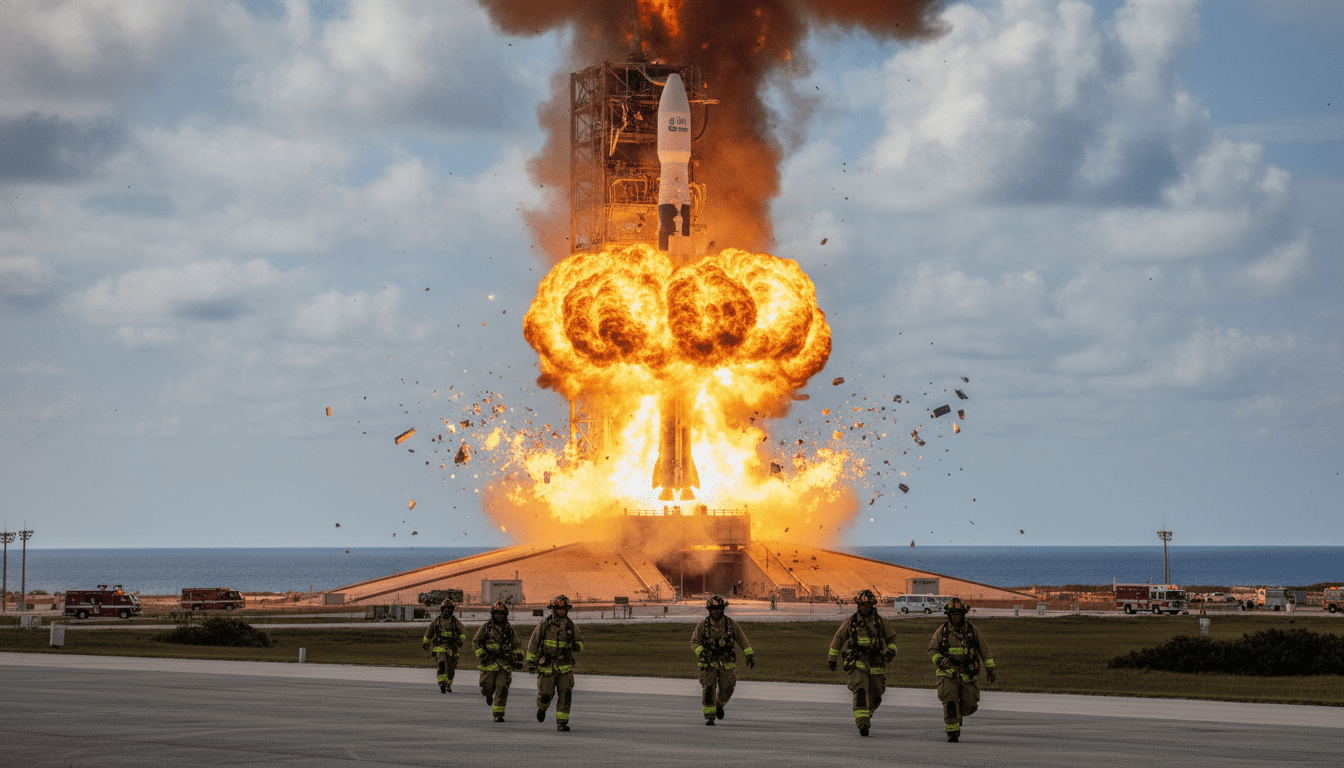
New Glenn explosion rips apart rocket during Cape Canaveral static-fire test
Blue Origin’s New Glenn exploded during a Cape Canaveral static-fire test; personnel are safe and agencies have opened an investigation into the anomaly.
Blue Origin’s New Glenn rocket suffered a catastrophic explosion during a static-fire test at Cape Canaveral, Florida, destroying the vehicle while personnel were confirmed safe. The New Glenn explosion occurred as engineers prepared for an anticipated fourth mission that had been expected to carry heavy commercial payloads in the coming weeks. Company posts and live streams captured the blast, and Blue Origin acknowledged an “anomaly” without immediately providing a technical cause. Federal and space agencies said they would support a thorough investigation into the incident.
What happened during the static-fire test
Blue Origin was performing a static-fire test when the New Glenn explosion occurred, a procedure that typically involves fueling the rocket and briefly firing its engines while it remains restrained on the pad. Observers and live-stream coverage showed a large conflagration and structural breakup, consistent with a fully fueled vehicle losing containment. Blue Origin later confirmed the event and posted that all personnel had been accounted for, while company leadership and first responders reported no injuries. The scale of the destruction makes this one of the most severe rocket failures in recent U.S. launch history.
Company statements and leadership reaction
Jeff Bezos and Blue Origin executives described the day as “very rough” while stressing that teams were safe and locations secured. Bezos wrote that it was too early to determine a root cause and pledged to rebuild what was necessary and return to flight operations. Blue Origin characterized the incident as an anomaly and said engineers were already working to identify contributing factors. The company did not provide a technical timeline for discoveries or remediation at the time of its initial statements.
Agency involvement and regulatory response
NASA’s administrator said the agency would work with partners to support a thorough investigation and to assess impacts on near-term missions, including planned Artemis cooperation. The Federal Aviation Administration confirmed awareness of the explosion and reported no impact to air traffic in the immediate aftermath. U.S. Space Force and other national safety offices were notified, and federal authorities indicated they would coordinate data collection and safety reviews. Regulators and agency partners typically examine telemetry, pad systems, and hardware recoveries as part of formal anomaly inquiries.
Program implications and commercial contracts
The New Glenn explosion is likely to impose a pause on Blue Origin’s launch cadence while the company and regulators determine root causes and corrective actions. Blue Origin had been preparing what it described as a busy manifest, including a multi-launch agreement to carry Amazon’s planned Leo internet satellites. Company statements confirmed that no Amazon Leo satellites were aboard the vehicle for this particular test. The loss will affect timelines for commercial customers, national security mission bids, and Blue Origin’s commitments; the scope of contractual and schedule ramifications will depend on the duration and findings of the investigation.
Recent New Glenn flight history
New Glenn’s development reached operational flights only recently, with a first launch that achieved orbit but ended with the booster’s loss during recovery attempts. Subsequent missions demonstrated major milestones: a successful booster recovery and a second flight that carried twin spacecraft for a NASA mission. On the rocket’s third flight in April, the first stage was reused and landed again, but the upper stage experienced a cryogenic failure that resulted in the loss of a commercial satellite. Regulators had cleared New Glenn for return to flight after that earlier mishap, and the static-fire test was part of preparations for the next scheduled mission.
Local response and safety actions on the Space Coast
Local officials and the district’s congressional representative expressed relief that no injuries were reported and gratitude for emergency crews who secured the site. Cape Canaveral launch range teams and first responders implemented safety protocols and cleared the area for investigative work. Authorities temporarily restricted access around the pad and coordinated environmental and safety assessments. Residents and businesses near the Space Coast were advised to follow official guidance while investigations proceed.
Investigators will analyze telemetry, engine and pad systems, fuel and plumbing data, and any recovered hardware fragments to reconstruct the sequence of events that led to the New Glenn explosion. Independent and federal oversight teams commonly participate in such probes, and the process can take weeks or months depending on complexity and evidence availability. Blue Origin has said it will share findings as they become available and that it intends to repair infrastructure and return to flight when it has confidence in corrective measures.
Plans for upcoming missions and any impacts on NASA’s Artemis activities, Amazon’s satellite deployment schedule, and potential Pentagon launches will be detailed as agencies and customers receive formal assessments. For now, Blue Origin is focused on the technical investigation and safety review while stakeholders await concrete explanations and a timeline for recovery.
