
ASML’s EUV Dominance Tests Europe’s Chip Strategy
ASML’s EUV lithography dominance underpins global chip production; CEO Christophe Fouquet urges Europe to build demand and strengthen its semiconductor ecosystem.
ASML has become indispensable to the modern chip industry, and its name now stands for the extreme ultraviolet technology that enables the smallest and most powerful microchips. The Dutch company employs about 44,500 people and is valued at roughly 645 billion euros, making it Europe’s most valuable firm. CEO Christophe Fouquet has warned that the firm’s market position and Europe’s technological sovereignty depend on maintaining momentum and building a broader domestic demand base.
ASML’s EUV technology and global reach
ASML assembles its EUV systems in cleanroom halls in Veldhoven where travel-bus sized machines are built from roughly 100,000 components. Those systems are shipped to the world’s leading fabs including Samsung, TSMC and Intel so wafers can be patterned layer by layer for chips at nanometer scales. Only a tiny share of machines remain in Europe, reflecting the continent’s limited production of advanced chips despite ASML’s European roots.
How ASML generates extreme ultraviolet light
The core of ASML’s EUV process is artificially produced extreme ultraviolet light, generated when high-powered lasers strike molten tin and create a plasma exceeding 200,000 degrees Celsius. An array of precision mirrors then collects and focuses that radiation to expose wafers with extraordinary fidelity. This physical and optical engineering is central to producing the high-performance chips driving today’s AI and data center workloads.
From Philips joint venture to market leadership
Founded in 1984 as a joint venture between Philips and ASMI, the company survived early setbacks and a near-collapse before finding footing in the 1990s. A profitable lithography platform in 1990 and a dual listing in Amsterdam and New York in 1995 set the stage for decades of growth. The delivery of initial EUV prototypes around 2017 marked the decisive breakthrough that vaulted ASML to global leadership.
A European supply network underpins production
ASML’s machines are produced by a sprawling network of roughly 900 suppliers, about 80 percent of which are European, creating an ecosystem that is difficult to replicate. Key partners include Trumpf which supplies the high power lasers and Carl Zeiss which produces the ultra-precise mirror optics, with ASML holding a 24.9 percent stake in Zeiss SMT that builds exclusively for ASML. The company also commits about 4.5 billion euros annually to research and invests selectively in partners to secure critical technology pathways.
Regulatory and geopolitical constraints on exports
Geopolitical limits have reshaped ASML’s market access, most notably a 2019 restriction that bars the shipment of EUV systems to China and new measures tightened earlier this year. Those export constraints underscore how sensitive the technology is and how quickly supply can be curtailed by regulation. Analysts warn that an abrupt embargo on EUV equipment would ripple through global chip supply chains and slow the deployment of chips crucial to the AI expansion.
Business risks, reorganization and expansion plans
Despite strong demand for EUV systems, ASML announced a reorganization in January that initially signaled up to 1,700 job cuts though the final impact now appears to be smaller. The company expects annual revenue in the 36 to 40 billion euro range and reported a net profit of 2.8 billion euros in the first quarter of 2026. ASML is also expanding capacity and capability with High NA EUV development and new facilities, and it recently entered a cooperation with Tata Electronics for an $11 billion chip factory in India while taking an equity stake in the AI start up Mistral in September 2025.
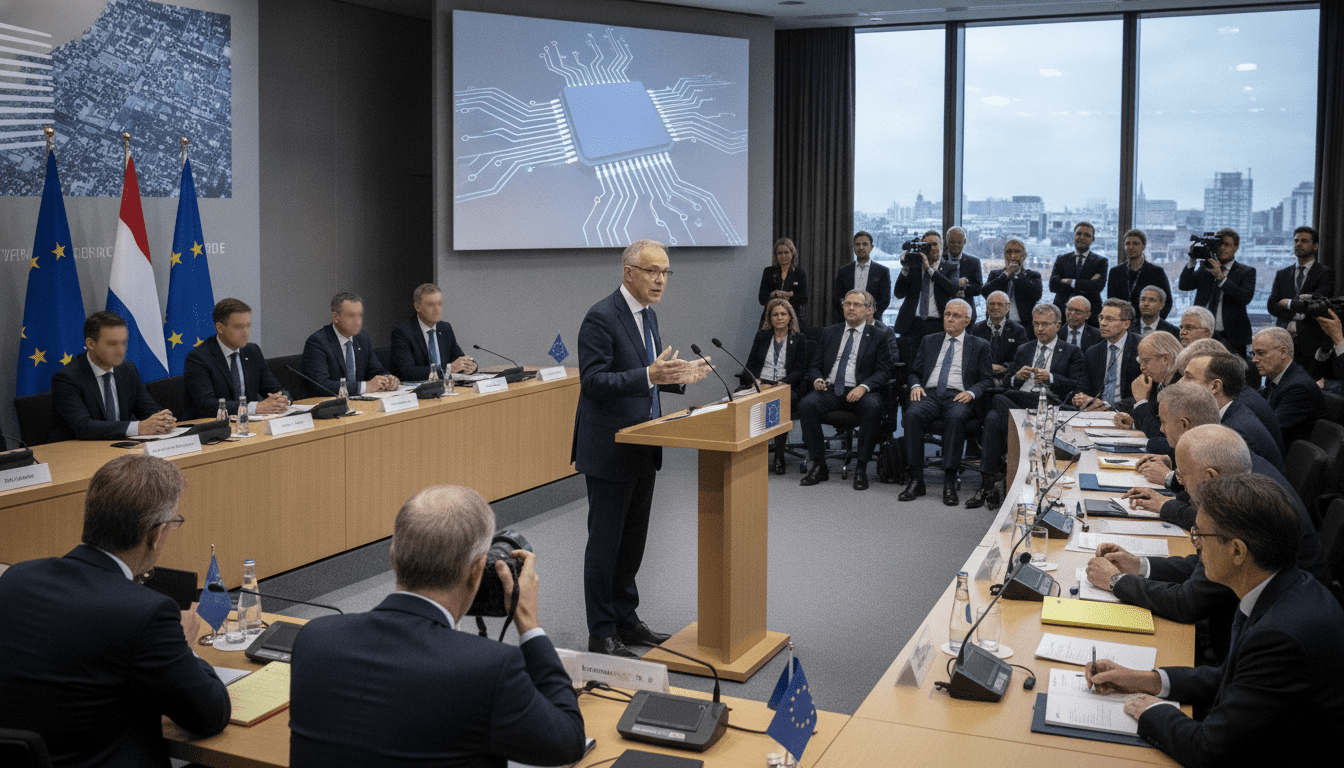
Christophe Fouquet warns that the firm’s greatest vulnerability is less a technical rival than complacency born of success, and he is now pressing European policymakers for a market driven approach to stimulate demand. Fouquet and a group of large companies want Europe to build an end market that would make local chip production and advanced fabs viable. The push aims to translate ASML’s engineering lead into a broader industrial strategy so that Europe does not only supply the tools but also hosts the factories that use them.
