
Dartmouth Conference 1956: How a Summer Workshop Sparked the Age of Artificial Intelligence
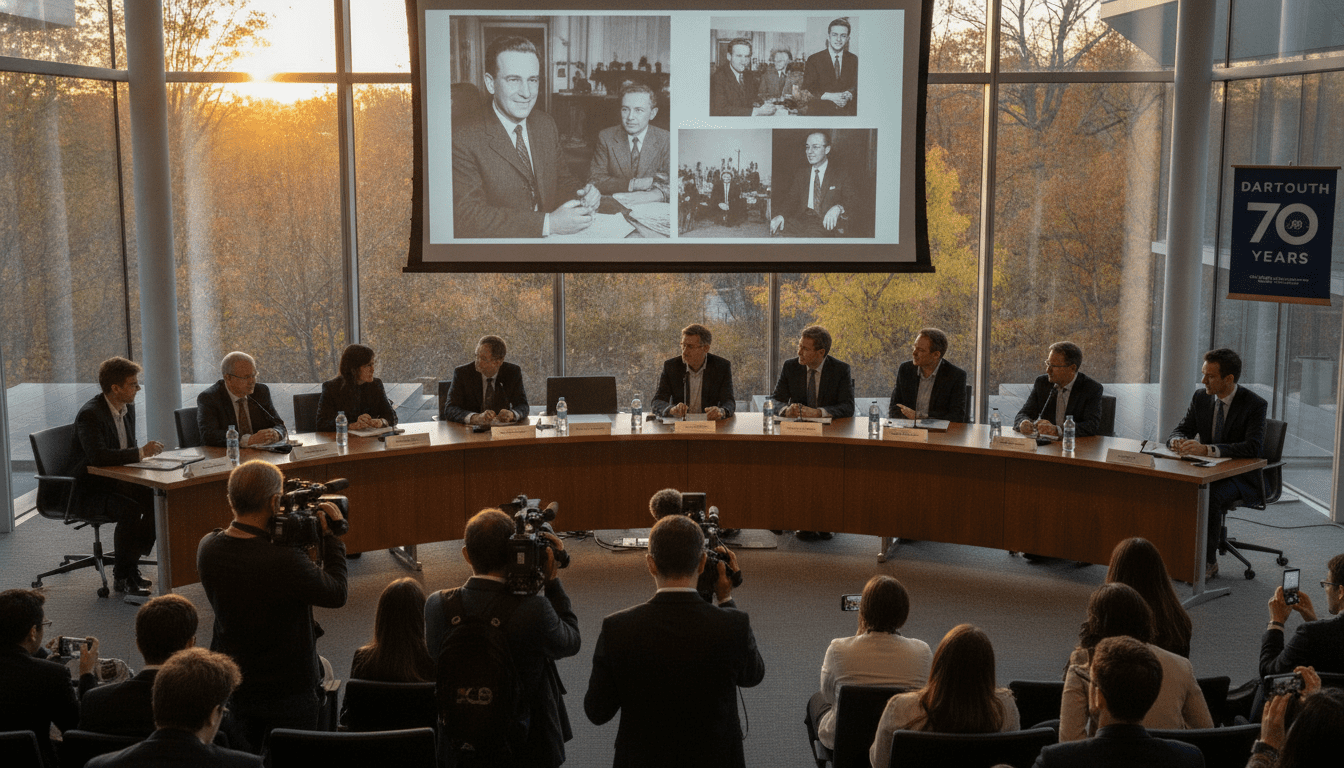
Seventy years after the Dartmouth Conference 1956, historians and technologists mark how a small summer proposal and workshop introduced the term “artificial intelligence” and set the agenda for decades of research and debate.
A summer proposal that named artificial intelligence
In the summer of 1956 a short funding proposal invited scholars to Dartmouth College to study whether “every aspect of learning or any other feature of intelligence” could be described and simulated by machines. The phrase artificial intelligence, coined by John McCarthy and his colleagues, was deployed as a practical rallying cry to secure Rockefeller Foundation support. That modest administrative move proved decisive: a single label helped consolidate diverse research streams into a field that would attract funding, students and university posts.
The Dartmouth workshop and immediate outcomes
The Dartmouth gathering was not a grand conference but a two-month workshop where participants debated ideas more than produced working systems. Attendees exchanged experiments, sketches of machine models and theoretical proposals, yet no ready-made intelligent machine emerged from the summer. What did change was the intellectual bargain: thinking could be modeled, constructed and engineered, and therefore it was a legitimate subject for systematic research and technical development.
Key figures who shaped the agenda
The workshop assembled mathematicians, engineers and emerging computer scientists whose reputations and expertise gave the project weight. John McCarthy introduced the name and later developed the Lisp programming language. Marvin Minsky advanced ideas about perception and robotics. Claude Shannon brought the rigour of information theory, and Nathaniel Rochester supplied practical perspectives from IBM on what early computers could actually do. Other participants, including Allen Newell, Herbert Simon and Arthur Samuel, brought programs and demonstrations that linked symbolic reasoning with machine computation.
Competing paradigms and early tensions
From the outset the field split along methodological lines that still echo today. One camp emphasized symbolic systems: rules, logic and search procedures for manipulating representations. Another emphasized learning and adaptation, inspired by neurophysiological models and early neural networks. Those tensions produced not a single roadmap but a plural discipline in which different techniques—symbolic reasoning, probabilistic methods, and later large-scale neural models—would rise and fall in influence over time.
Hype, disappointment and cycles of funding
Ambitious predictions followed the Dartmouth moment and occasionally outran technical reality. Early neural models like Rosenblatt’s Perceptron provoked optimistic press coverage and military support, but many claims proved premature and led to intermittent “AI winters” when funding dried up. The pattern became familiar: visible breakthroughs would spark investment and expectation, subsequent limitations would temper enthusiasm, and a new generation of ideas would revive interest and capital.
From cybernetics and Turing to modern generative systems
The intellectual roots of the workshop extended beyond Dartmouth to earlier thinkers. Alan Turing’s 1950 essay posed operational tests for machine intelligence, and Norbert Wiener’s cybernetic concepts of feedback and control anticipated learning as iterative adaptation. Those foundations—formal logic, information theory, feedback and learning—are visible in today’s systems, where massive data, optimized model weights and repeated training cycles underpin generative models and large neural networks. The technology is far more powerful than the researchers of 1956 could have imagined, yet many of the same design questions remain central.
Ethical and societal stakes in the present day
As artificial intelligence expands across commerce, public services and defence, debates about values, accountability and distribution of benefit have intensified. Religious leaders, ethicists and policy makers have urged scrutiny of how systems are designed and deployed, noting that technology often mirrors the priorities of its creators and funders. The conversation that began with technical questions in a New Hampshire summer has broadened into social and moral deliberations about fairness, governance and the long-term direction of machine intelligence.
Seventy years on, the Dartmouth Conference 1956 endures as a founding myth and a practical milestone: it named a field, gathered a generation of pioneers, and framed questions that continue to guide research, regulation and public debate. The origins are both inspirational and instructive—reminding us that progress in artificial intelligence has been shaped as much by organizational choices and competing ideas as by raw computational power.
