
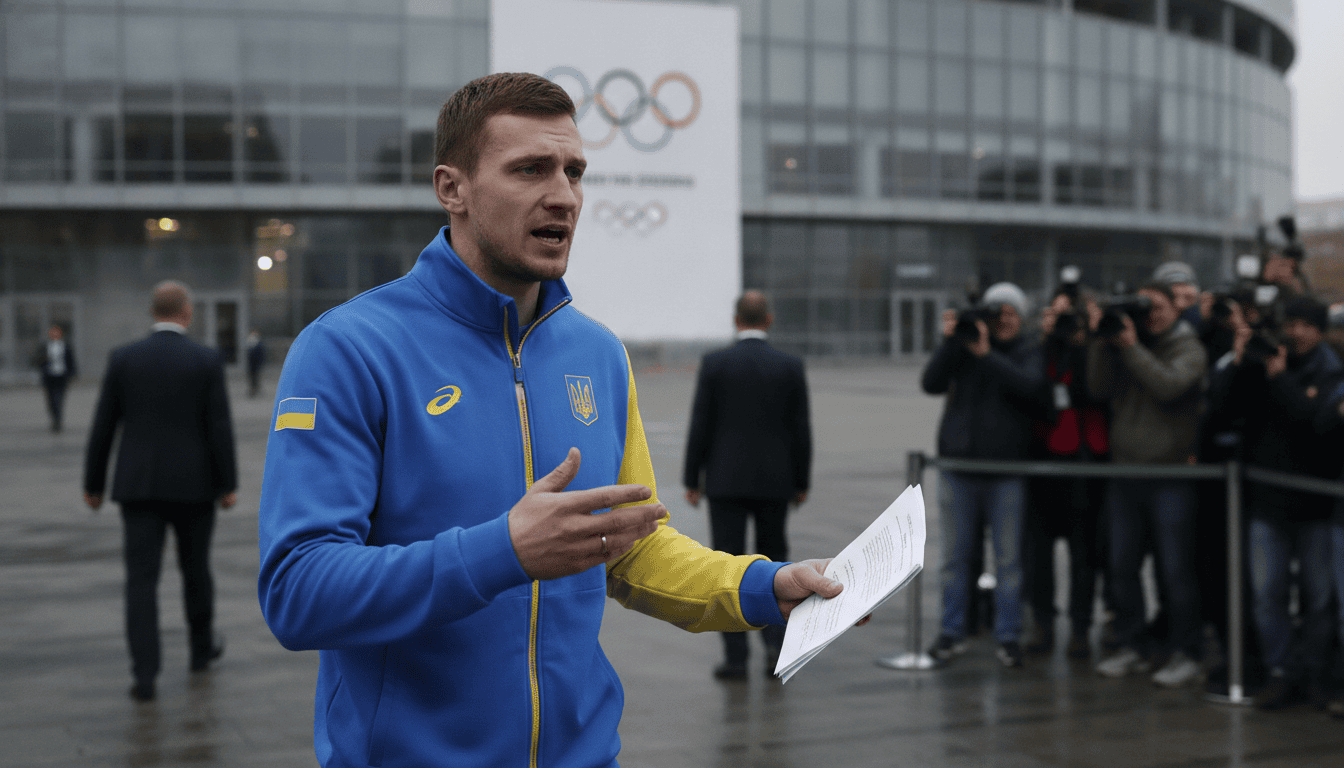
Wladyslaw Heraskewytsch Excluded from Milan–Cortina, Charges IOC ‘On Russia’s Side’
Wladyslaw Heraskewytsch accuses the IOC of siding with Russia after his exclusion from the Milan-Cortina Games over helmet images of killed Ukrainian athletes.
Wladyslaw Heraskewytsch, the skeleton racer barred from the 2026 Winter Olympics in Milan and Cortina, has publicly charged the International Olympic Committee with favoring Russian interests following his disqualification on August 1, 2026. The athlete’s removal came after images of Ukrainian athletes who were killed were displayed on his racing helmet, a move that organizers deemed unacceptable ahead of the Games. Heraskewytsch told reporters he sees the episode as evidence of a wider political compromise in international sport.
Decision to Exclude Heraskewytsch
The Milan–Cortina organizing committee and the IOC moved to exclude Heraskewytsch after reviewing the helmet imagery, citing rules that restrict political statements at the Olympic Games. The decision was made public on August 1, 2026, shortly before the skeleton events were due to begin. Organizers said the images violated the regulations intended to keep the competition free of overt political messaging.
Heraskewytsch’s exclusion was accompanied by immediate debate within the winter sports community, as teammates, national federations, and commentators weighed the appropriateness of the sanction. Some stakeholders argued the images were a form of remembrance for victims of conflict, while others said bringing such imagery into an Olympic setting would politicize the field and violate established codes of conduct.
Athlete’s Accusation: ‘The IOC Stands on the Side of Russia’
In an interview following the ruling, Heraskewytsch accused the IOC of effectively aligning with Russian interests and protecting Russian athletes through uneven application of rules. “The IOC stands on the side of Russia,” he said, framing his exclusion as part of a pattern in which political realities influence sporting decisions. He expressed frustration that disciplinary measures seemed to target him while, he argued, Russian athletes and officials benefited from leniency.
Heraskewytsch’s comments have intensified scrutiny of the IOC’s handling of political tensions tied to the war in Ukraine. His remarks drew attention across national federations, prompting questions about consistency in enforcement and the broader role of the Olympic movement when geopolitical conflicts intersect with elite sport.
Claims About Russian Strategy in Sport
The athlete detailed what he described as a deliberate Russian strategy to use legal and bureaucratic means to protect athletes’ international status while projecting influence in sports governance. He said this approach made genuine neutrality by Russian competitors effectively impossible, because state-linked sporting structures and messaging were deeply intertwined. Heraskewytsch argued that the distinction between personal expression and state-directed symbolism has been blurred in recent years.
Those observations echo a wider conversation among analysts who say sport can be a vector for state soft power. Critics note the difficulty of policing symbolic acts on helmets, uniforms, or podiums when national narratives and personal expressions overlap, and when different international bodies apply rules unevenly.
Debate Over Political Expression and Olympic Rules
The exclusion has reopened debate about the IOC’s political neutrality rules and how they apply to athletes’ expressions of grief, remembrance, or protest. IOC guidelines historically forbid political agitation in competition, but enforcement has often rested on judgment calls by organizers and appeals panels. That discretionary element makes rulings vulnerable to accusations of inconsistency or bias.
Legal and sports governance experts say clear, uniformly applied criteria are essential to preserve fairness and legitimacy. Some federations called for a standardized review mechanism to adjudicate contested displays, while others urged sensitivity to the context of wartime trauma and the moral dimensions of commemoration.
Reaction from German Sporting Circles and Wider Implications
Heraskewytsch also leveled criticism at elements of the German sporting establishment, saying national bodies had not adequately supported athletes caught in politically charged situations. He suggested the German system should be firmer in defending athletes’ rights to express moral positions without immediate exclusion. German federations have yet to issue a unified public response to his remarks.
The controversy may reverberate beyond immediate disciplinary outcomes, prompting national Olympic committees to reassess guidance for athletes and equipment oversight before major competitions. Organizers in Milan and Cortina face the practical challenge of enforcing rules while managing a games environment already strained by geopolitical headlines and heightened public scrutiny.
The exclusion of a competitor and the subsequent allegations of partiality present a test for the Olympic movement’s ability to maintain a neutral sporting stage. As the Games proceed, officials and federations are expected to monitor similar incidents closely and consider whether rulebooks or adjudication processes require revision to reduce subjective decision-making.
The situation surrounding Wladyslaw Heraskewytsch’s exclusion underscores a growing tension between the ideal of political neutrality in sport and the realities athletes face amid modern conflicts. Whether the episode leads to clearer policies or deeper polarization will depend largely on how the IOC, national committees, and international federations respond to calls for consistent, transparent enforcement.
