
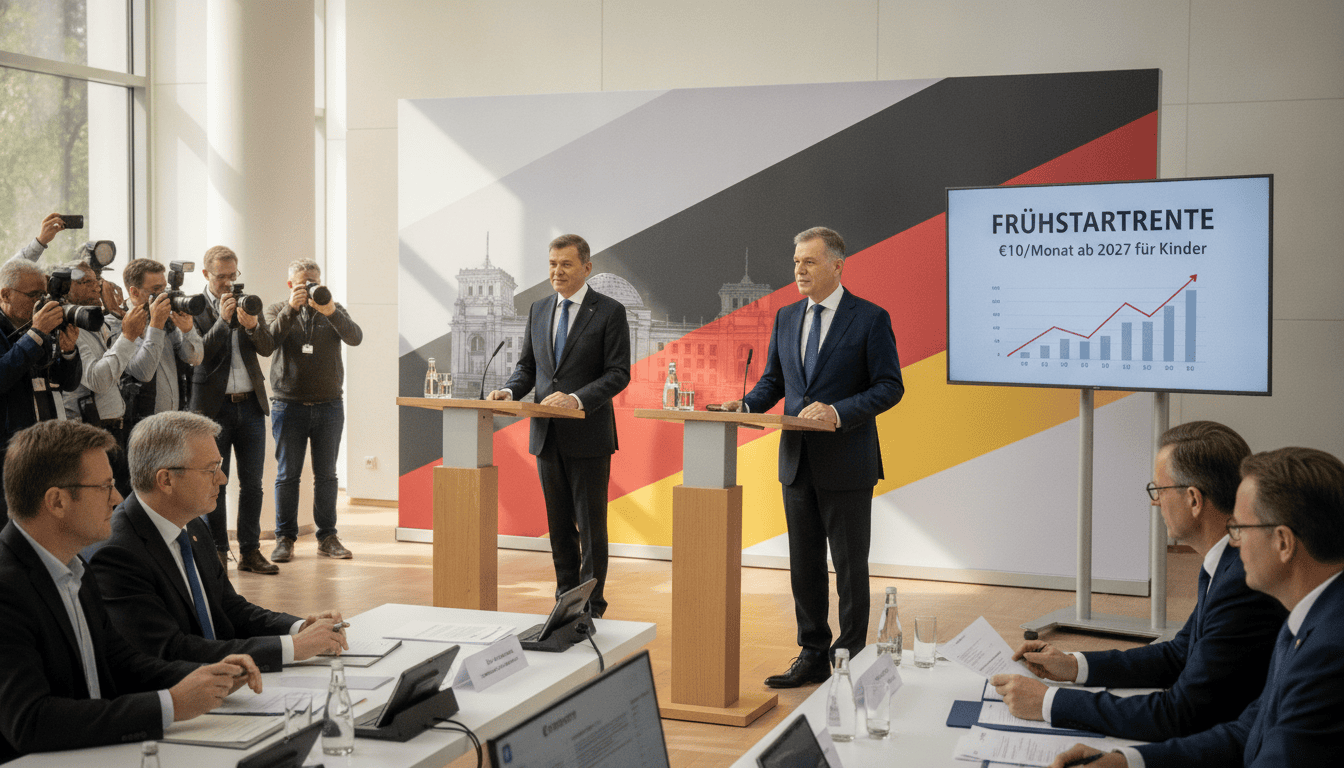
Frühstartrente: Germany to invest €10 monthly for 6–18‑year‑olds from 2027 into equity funds
Frühstartrente: Germany will invest €10 monthly for 6–18‑year‑olds beginning in 2027 into equity funds; models show long-term compound gains, risks and distribution gaps.
The German government’s Frühstartrente plans to place €10 a month into an equity-linked account for every child aged six to 18, with the programme scheduled to begin in 2027 and the funds held tax-free until retirement. Proponents argue the Frühstartrente will harness decades of compound returns to build a base for future pensions, and the scheme is already accompanied by public modelling that highlights how small, early contributions can grow over many decades. The draft law envisages automatic enrolment, a possible Bundesbank fallback for delivery, and wide discretion over product design and provider selection, leaving several operational and distributional questions open.
Policy design and timeline
A central element of the Frühstartrente is the monthly €10 state contribution for children between the ages of six and 18, intended to sit in equity-based investments for roughly 12 years before becoming a starting pot for individual retirement saving. The government proposals seen by analysts foresee the programme launching in 2027 and remaining tax-exempt until funds are paid out as part of later pension arrangements. While the headline figure is modest, officials emphasise the pedagogical goal: to familiarise young people with capital markets and long-term saving dynamics.
Model projections and compound effects
Independent modelling published alongside the proposal shows the dramatic effect of time and assumed returns on final balances: under a mid-range return assumption near 6.1% annually, the state’s €10 monthly contributions alone could amount to roughly €13,000 by late-century payout scenarios. The same models project that parental saving from ages six to 18 — if parents add monthly contributions — can grow to roughly €66,000 over the same horizon, and that a young person who continues to save €50 monthly after age 18 could reach about €92,000. These figures underline the power of compound interest but also depend heavily on assumed long-run returns, which the modelling brackets with more conservative scenarios around 2.9%.
Role of parental top-ups and distributional consequences
The modelling and commentary make clear that parental involvement dramatically shifts outcomes: early parental deposits represent only about 19% of total nominal contributions in some scenarios, yet they account for roughly 39% of final wealth because they compound for a longer period. That asymmetry raises questions about equity. Families with resources or financial literacy can amplify the Frühstartrente into substantial capital, while children from less advantaged households may receive only the baseline €10 monthly and therefore enter adulthood with much smaller balances. Critics warn the policy could widen inequalities in private retirement readiness unless accompanied by targeted outreach or additional top-ups for lower-income families.
Operational uncertainties and market risk
Key implementation details remain unresolved in the draft: which providers will be authorised, what fee caps (if any) will apply, the precise investment mandates for the accounts, and how a Bundesbank fallback would operate if private providers fail to deliver. The state emphasises the absence of a guaranteed return; the accounts will be exposed to market fluctuations and therefore carry the risk of losses in adverse market phases. Consumer advocates have flagged the potential for high fees or unsuitable products to erode long-term returns, particularly given the programme’s passive recipients who may not actively manage or switch products.
Political framing and financial education aims
Politically, the Frühstartrente is pitched both as a social policy and a financial-education initiative: policymakers say it will give children early exposure to investing while also seeding a future personal pension buffer. Supporters argue that early, automatic exposure to capital markets can raise financial literacy and long-term saving habits, and that modest state seed money is a cost-effective way to achieve this. Opponents counter that without strong cost controls, targeted support for disadvantaged families, and a clear educational programme, the policy risks becoming a subsidised wealth accumulation channel for families already able to contribute more.
The proposal’s supporters point to multi-decade timelines — a child starting school now would, under normal retirement ages, not draw on the funds until the 2080s — to illustrate why small, steady sums may compound into meaningful amounts; detractors stress the uncertainty of decades-long market performance and the need for equitable design. Operational questions about provider selection, fee transparency and relief for low-income households will be decisive in determining whether the Frühstartrente functions as equitable seed capital or a program that amplifies existing disparities.
As debates move from concept to legislation, lawmakers will need to balance the pedagogical and redistributive aims of the Frühstartrente with strict consumer protections and clear oversight to limit fees and product risk. The eventual impact on future retirees will hinge on those implementation choices and whether complementary measures are introduced to support households that cannot top up the state contribution.
