
Germany Faces Growing Dependence on China, Merics Warns
Merics director Mikko Huotari warns that Germany’s dependence on China could trigger an industrial crisis, calling for an EU-aligned strategy to safeguard jobs, critical technologies and markets.
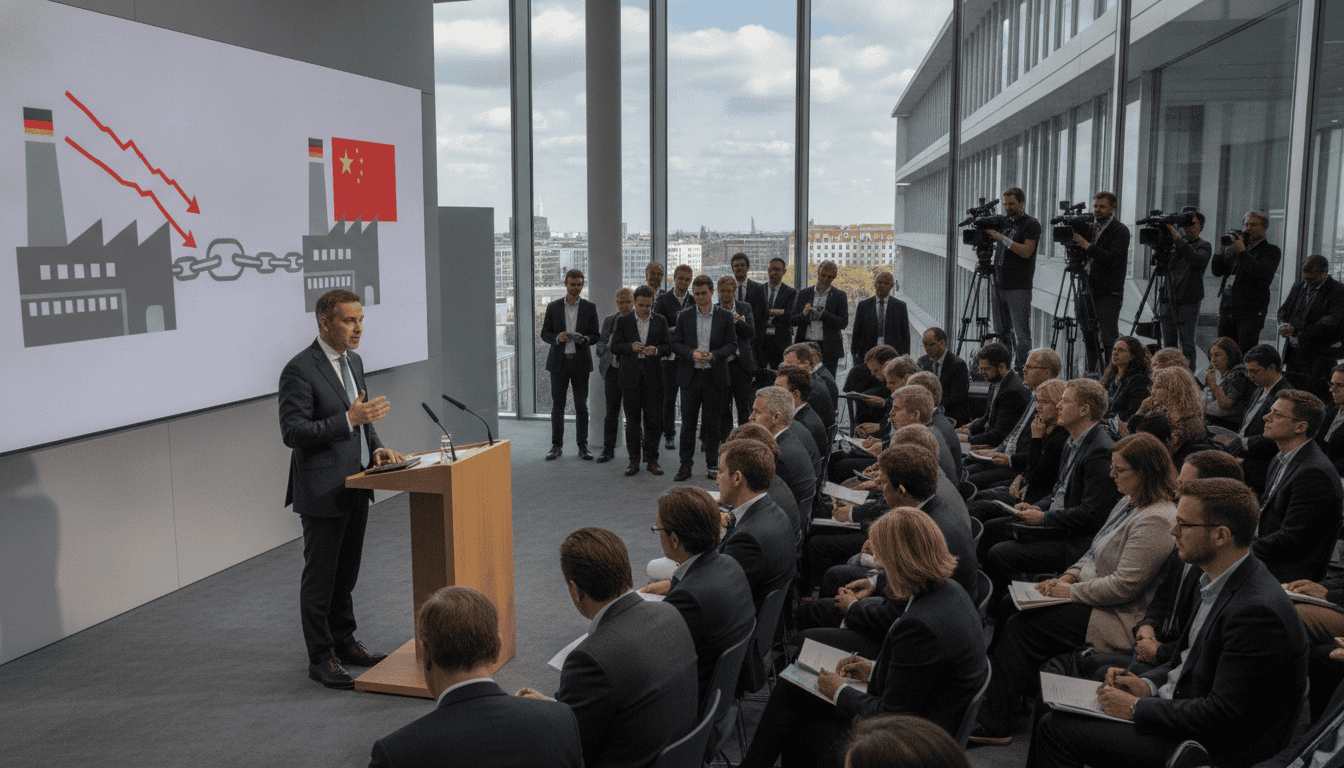
Germany is facing a rapid deterioration in its economic position as its dependence on China deepens, Merics director Mikko Huotari warned, urging an urgent, Europe-wide strategy to protect security-sensitive industries. Huotari, who co-chairs the Bundestag’s China Commission, said Beijing’s industry policy is increasingly geared toward state security and global power projection, a shift that poses specific risks to Germany’s manufacturing base. He argued that without coordinated action on energy costs and trade protections, German industry could confront an existential crisis within a few years.
Merics director calls for an EU-coordinated China strategy
Mikko Huotari told reporters and policymakers that national plans alone will not suffice and that Germany needs an industrial policy aligned with the European Union that explicitly includes security objectives. He described current government steps as insufficient, noting piecemeal measures and diplomatic hedging rather than a clear strategic direction. Huotari emphasized that policy must move faster than the pace at which the threat is evolving to avoid being outmaneuvered by deliberate Chinese industrial planning.
Huotari’s intervention leverages his dual role at Merics and within the Bundestag commission, lending weight to the call for coordinated action across member states. He said the EU must develop concrete tools to protect critical supply chains while preserving open markets where possible. The director stopped short of prescribing specific tariffs or bans, but he insisted that Europe must be prepared to defend its strategic industries.
China’s industrial policy is increasingly securitized
Analysts cited by Huotari argue that Beijing has reshaped industrial policy to prioritize national security and technological self-reliance, using state subsidies, domestic protectionism and export controls as instruments. These measures have sharpened competition in sectors where Germany traditionally leads, including advanced manufacturing, automation and emerging battery technologies. Huotari warned that China now treats access to raw materials and technologies as levers of geopolitical influence, effectively putting “weapons” on the table in commercial disputes.
Export restrictions and targeted controls give China leverage over European firms that rely on specific inputs or components, Huotari said, creating new vulnerabilities across entire value chains. He added that the EU is beginning to respond by expanding its trade policy toolkit, but that countermeasures must be coordinated to avoid fragmentation among member states. The risk of episodic escalations, he noted, remains high given the hardened strategic rivalry.
Job losses are large but capability decline is the greater threat
Germany’s industrial workforce has contracted significantly in recent years, with roughly one in five industrial jobs disappearing over the past decade, according to business surveys and labor statistics. Huotari argued that headline job losses, while severe, are not the sole measure of risk because many firms retain efficiency reserves and could operate with fewer employees. More worrying, he said, is the erosion of critical industrial capabilities—skills, technologies and production know‑how—that cannot easily be rebuilt once lost.
The director pointed to disparities in productivity as signals that structural reform is needed, noting that comparable firms abroad often produce more with fewer people. He cautioned that falling behind in automation, battery manufacturing and artificial intelligence would translate into long-term competitive disadvantages. Protecting and regenerating industrial capabilities will require investment, workforce retraining and policies that reduce operating costs, Huotari said.
Tokyo and Seoul show an alternative policy model
Japan and South Korea were cited as examples of nations that have long pursued explicit technology strategies, identifying priority sectors and securing supply of critical inputs. Those countries have institutionalized planning for strategic industries, including state-supported research, targeted subsidies and measures to diversify access to raw materials. Huotari suggested that Europe could learn from these approaches without mirroring the more coercive aspects of China’s playbook.
Those East Asian models combine industrial foresight with an acceptance of market mechanisms, he said, allowing governments to shape long-term capability development. By contrast, Huotari emphasized, China’s approach is more radical and sometimes distorts markets through aggressive state support. Europe must therefore design responses that strengthen resilience while adhering to democratic norms and competition law.
EU criticism of Beijing and the question of German resolve
The European Commission has issued language more critical of Beijing than in the past, framing China’s behavior as a challenge to the global order and signalling readiness to tighten trade defenses. Huotari noted that EU institutions are expanding instruments intended to respond to unfair practices, and that discussions are ongoing about how to deploy them effectively. The critical question, he said, is whether Germany will be willing to apply robust countermeasures that could disrupt entrenched commercial relationships.
German policymakers face a difficult choice between short-term economic interests and long-term industrial sovereignty, Huotari observed, and voter and industry reactions will shape the country’s trajectory. He urged transparent debate in Berlin and Brussels about the tradeoffs involved and insisted that Europe must not delay decisions that affect the preservation of strategic capabilities. Ongoing diplomatic talks may reduce immediate tensions, but the structural contest over technology and supply chains will persist.
Germany must now decide whether to prioritize resilience over convenience and to craft an EU-aligned industrial strategy that reduces dependence on China while protecting growth. The coming months will test whether political leaders can translate warnings into coordinated policies that secure critical industries, stabilize employment, and preserve the technological base that underpins Germany’s economy.
