
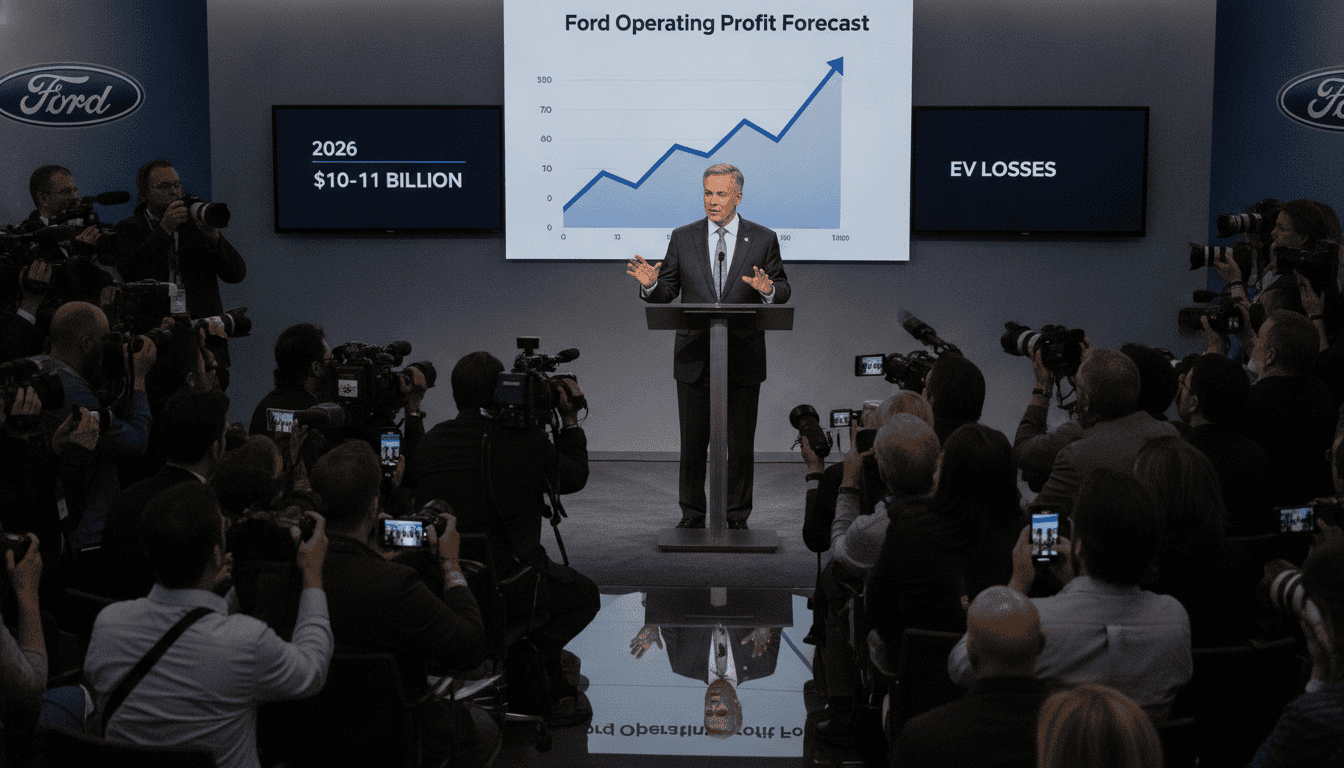
Ford profit forecast rises to $10–11 billion after Q2 beat
Ford raises its 2026 operating profit forecast to $10–11 billion after Q2 adjusted EPS topped estimates; net loss tied to SK On JV and EV-unit setbacks.
Ford raised its 2026 profit forecast on stronger-than-expected second-quarter results, lifting its operating-earnings guidance to $10–11 billion from a prior $8.5–10.5 billion range. The move follows an adjusted quarterly earnings beat and a healthy revenue figure, but the company still reported an overall net loss driven by a one-time joint-venture unwind. Investors reacted positively after hours, sending the stock up roughly seven percent as markets digested both the improved guidance and lingering electric-vehicle losses.
Ford lifts 2026 operating guidance
Ford said its new operating-profit target for 2026 reflects improved performance across core vehicle operations and ongoing cost efficiencies in manufacturing. The company raised the midpoint of its guidance substantially, signaling management confidence in underlying profitability even as transition costs for electrification continue. Ford’s updated outlook now places operating earnings comfortably above last year’s levels if the company meets the upper end of the range.
Adjusted earnings beat expectations in Q2
For the quarter, Ford reported adjusted earnings of $0.42 per share, exceeding analyst expectations that were centered near $0.35 per share. Revenue for the period stood at $48.3 billion, underscoring robust demand in several key segments. Management highlighted that stronger retail activity and higher deliveries in the U.S. helped offset tariff-related costs and mixed results in other markets.
Net loss tied to SK On joint venture unwind
Despite the adjusted profit beat, Ford recorded a total net loss of $1.3 billion for the quarter, a result the company attributed to the dissolution and accounting effects of its joint venture with battery maker SK On. That one-off charge swung the GAAP result negative even as core operating profit rose. Ford emphasized that the charge is non-recurring and separate from the operating trends the company is tracking.
EV and software division posts heavy losses
Ford’s electric-vehicle and software division reported a $919 million loss in the second quarter, a continuation of substantial spending to scale production and develop software capabilities. The automaker said it still expects the EV and software segment to produce a full-year loss of roughly $4 billion as investments continue. Executives framed the losses as part of a multiyear ramp for EVs and integrated vehicle software, rather than an immediate operational failure.
The company signaled plans to manage costs more tightly within the EV business while prioritizing investments in battery capacity and vehicle software that it sees as strategic for future margins. Ford’s finance chief noted improvements in manufacturing efficiency that should temper some near-term pressure, though she acknowledged that EV adoption and pricing dynamics remain risk factors.
U.S. EV sales plunge deep, denting margins
Ford disclosed that U.S. electric-vehicle sales fell sharply in the first half of the year, declining by more than 57 percent from the prior-year period. The steep drop in EV deliveries has weighed on revenue mix and contributed to the large losses reported by the EV unit. Industry analysts point to a combination of softer demand for earlier EV models, aggressive pricing competition, and slower-than-expected incentive-driven uptake in certain segments.
Lower EV volumes have also put pressure on per-unit costs as production runs shrink and fixed costs are spread across fewer vehicles. Ford said it is working to rebalance production schedules and align pricing and incentives to stabilize demand and improve factory utilization.
Investors respond as shares jump after hours
News of the guidance raise and the adjusted earnings beat triggered a roughly seven percent gain in Ford shares during after-hours trading. Market participants appeared to reward the clearer path to stronger operating profits, even as they parsed the implications of the EV losses and the one-time JV charge. Analysts noted that the market reaction suggests investor willingness to look past near-term EV volatility in favor of improving cash generation from core truck and SUV lines.
Traders and portfolio managers remain attentive to upcoming quarterly disclosures and any additional commentary from Ford’s management on margin improvement and EV turnaround plans. The stock move reflected a balance of short-term relief and caution about longer-term execution risks.
Outlook for 2026: risks and levers
Ford’s raised profit forecast depends on sustained demand in its high-margin vehicle categories, continued manufacturing efficiencies, and a trajectory of EV cost reductions that have not yet materialized. The company will need to manage chip supply, logistics costs, and pricing pressures while investing in battery technology and software integration. External factors such as interest rates, consumer spending patterns, and competitive pricing in the EV market will also influence whether Ford can realize the upper end of its guidance.
Management has framed the pivot toward higher operating profit as evidence that Ford can generate stronger returns during the transition to electrification, but the path will require tighter cost control and clearer progress in EV volume and margin improvement.
Ford’s raised guidance and mixed quarterly results leave the company navigating a gauntlet of transition costs and market demands while offering investors a more optimistic estimate of 2026 operating profits. The coming quarters will be closely watched for signs that the EV business can move from a loss-making investment to a durable contributor to Ford’s overall profitability.
