
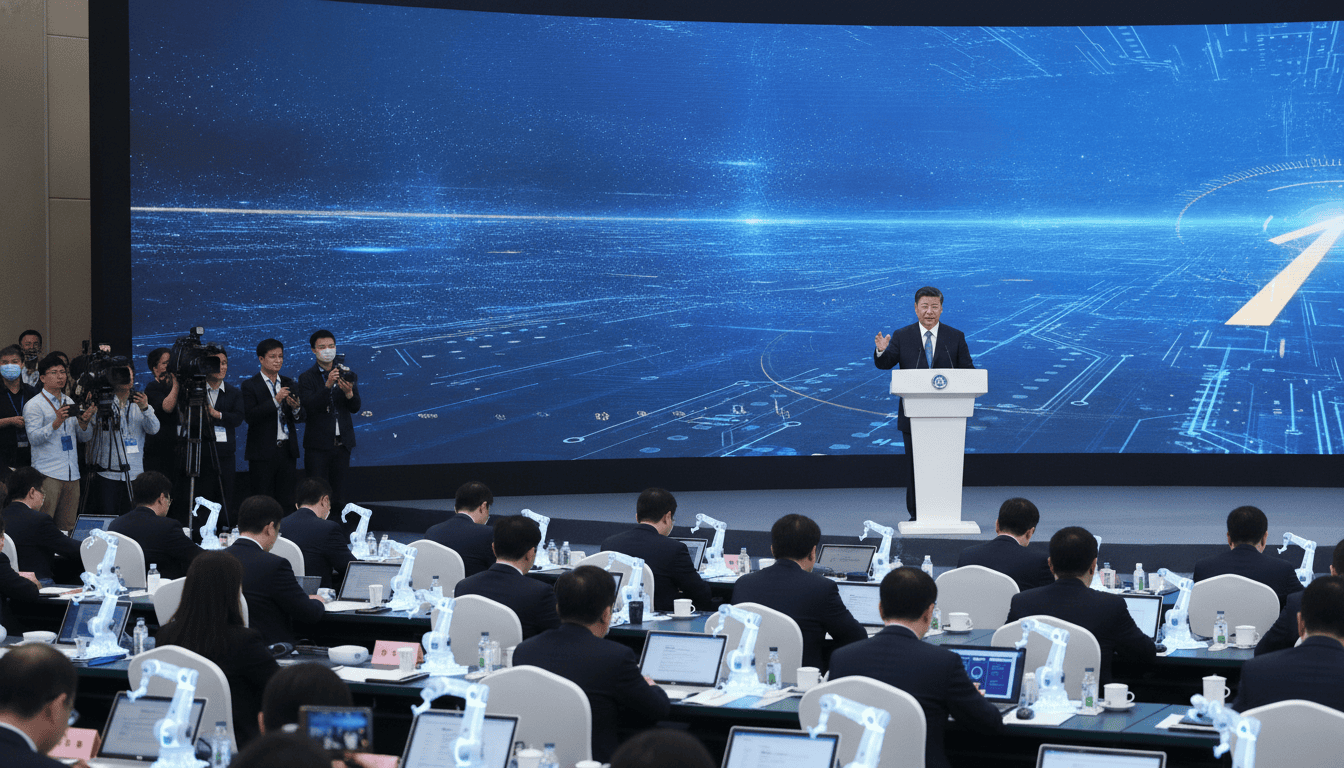
China AI leadership reinforced as Xi backs Moonshot and domestic models ahead of Shanghai conference
China AI leadership gains momentum as Xi Jinping publicly endorsed domestic AI firms ahead of the World AI Conference in Shanghai, highlighting Moonshot and other homegrown models. The endorsement comes as several Chinese startups and tech giants, including Baichuan, Minimax, StepFun, ByteDance’s Doubao, Baidu’s ErnieBot and Tencent’s Huiyuan, intensify development and deployment. Moonshot’s prominence in state discourse underlines Beijing’s push to narrow the gap with leading US AI companies while expanding commercial applications across consumer devices and enterprise services.
Xi signals state support before World AI Conference
Xi Jinping’s remarks, delivered in the run-up to the World AI Conference in Shanghai, framed advanced artificial intelligence as a strategic national priority. State backing for select firms and models is meant to accelerate technological maturity and market adoption, officials and industry observers say. The timing indicates a coordinated effort to showcase domestic capabilities to both international audiences and local investors.
Moonshot among multiple Chinese contenders
Moonshot has emerged publicly as one of the names Beijing highlights, but it is not the only company closing on global peers. Other domestic developers such as Baichuan, Minimax and StepFun have reported rapid model improvements and increasing commercial traction. Investment in these startups, along with interest from large tech groups, signals a broadening base of Chinese AI suppliers.
Major tech groups push model deployment
China’s largest platforms are integrating advanced models into widely used consumer and enterprise services, expanding practical reach. ByteDance’s Doubao, Baidu’s ErnieBot and Tencent’s Huiyuan are examples of platform-level AI tools now embedded in search, content creation and messaging services. That integration creates scale advantages that squared-off startups must navigate as they seek customers and partnerships.
Device makers and everyday AI adoption
Hardware manufacturers are translating model advances into products that bring AI to millions of users, furthering adoption. Companies such as Xiaomi are building AI directly into smartphones and smart-home devices, which helps normalize everyday uses from voice assistants to on-device personalization. This device-level integration supports an ecosystem where models are evaluated not only for raw capability but for product fit and user experience.
Global competition and commercial strategy
Chinese firms are positioning themselves to compete with US companies on both technology and market terms, emphasizing localization and regulatory alignment as advantages. While Western incumbents retain strengths in research, Chinese developers benefit from rapid iteration cycles, extensive deployment data and deep integration with local platforms. Observers caution that competition will increasingly hinge on commercial partnerships, data access, and the ability to scale safe, compliant services.
Policy environment and investment flows
Beijing’s visible support comes alongside targeted funding and favourable industrial policy that aim to accelerate commercialization. State-level endorsements can unlock capital and procurement opportunities, bolstering startups and giving larger firms incentives to scale domestic offerings. At the same time, evolving export controls, data rules and international scrutiny will shape how and where Chinese models expand outside the country.
China AI leadership is now being tested across multiple fronts: technological parity, product integration, and international market access. The coming months, anchored by the Shanghai conference, will reveal whether the firms highlighted by Beijing can sustain momentum, attract global partners, and translate model advances into durable commercial success.
