
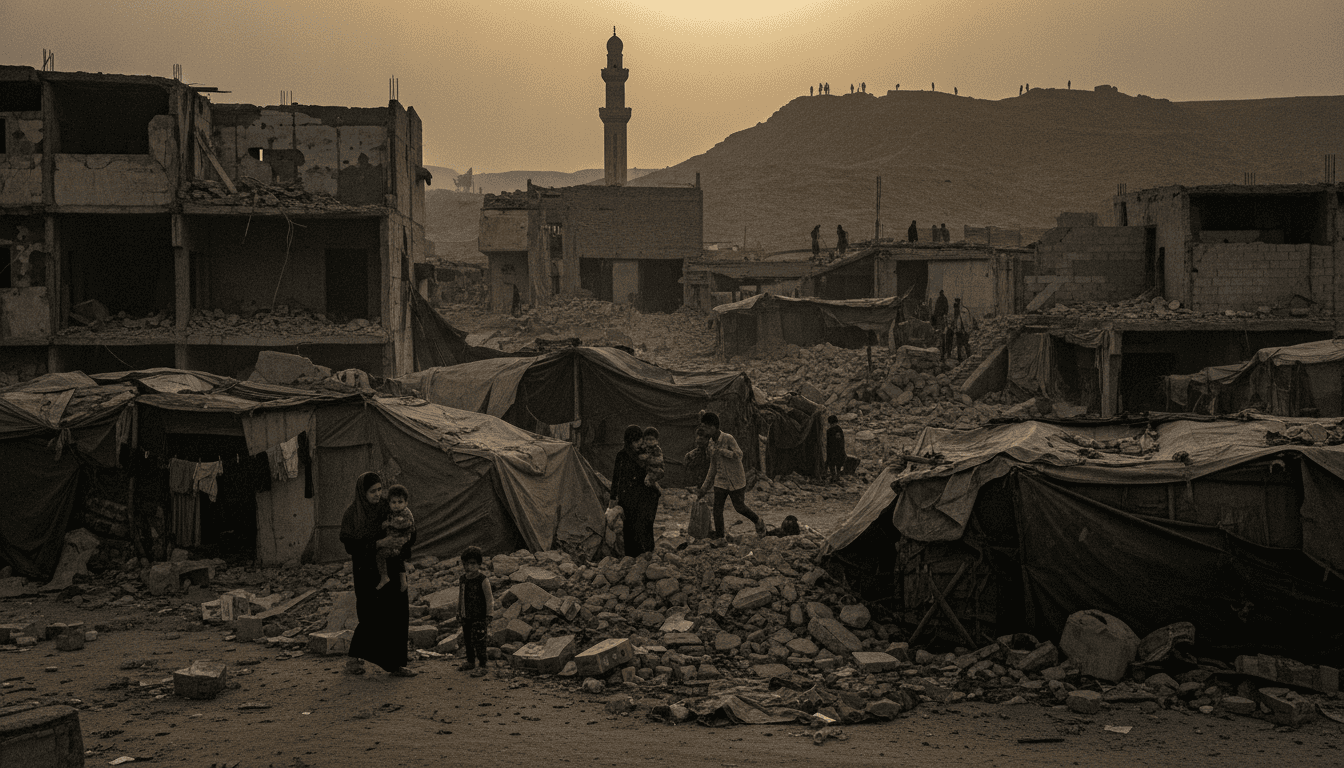
Taiz housing crisis intensifies as families accept front-line homes to escape soaring rents
Families in Taiz face a deep housing crisis as front-line rents plunge and residents trade safety for affordability amid sniper threats and widespread war damage.
Um Yousef’s decision to move her family to a cheap home near Taiz’s front line encapsulates the widening Taiz housing crisis, where poverty and a damaged housing stock force civilians into dangerous neighborhoods. The single mother, unable to pay central-city rents, chose a room near the front line for roughly $13 a month — a fraction of the typical market rate — only to see her 11-year-old son injured by gunfire weeks later. Her experience is echoed across Taiz, where decades of conflict, displacement and unaffordable rents are reshaping who lives where and why.
Front-line housing draws the poorest families
Residents describe a stark market split: safer central areas command higher rents while homes adjacent to active front lines are rented informally or occupied for little to no cost. Many households displaced by fighting or economic collapse cannot afford conventional rents and accept the heightened risk of shelling, snipers and harassment in exchange for shelter. In practice, that means mothers, children and elderly people living within range of combat positions because the alternative is homelessness or overcrowded single rooms.
Local accounts show informal arrangements are common: owners sometimes offer housing free in return for guarding the property, and displaced families share cramped units to reduce cost. These arrangements mask a broader market failure in Taiz, where demand far outstrips supply and incomes have not recovered since major hostilities escalated years ago.
Sniper fire and child casualties reshape daily life
Taiz’s urban frontline, set against a hilly landscape and a commanding mountain ridge, creates vantage points that have been exploited by snipers throughout the conflict. Civilians report sudden, inexplicable shootings when children play outside or people walk between buildings, a reality that has prompted widespread anxiety. Local monitoring projects recorded a disproportionate share of sniper-related civilian casualties in Taiz, including children among the victims, underscoring the lethal exposure residents face.
The threat has driven changes in behavior: families extinguish lights at night in rooms visible from afar, children are kept out of open courtyards, and people restrict movement after dark. Those coping mechanisms reduce immediate risk but cannot remove the underlying hazard of living within small-arms and sniper range.
Scale of damage and the displacement burden
Taiz governorate is among Yemen’s most populous, hosting more than four million people and hundreds of thousands of internally displaced persons, according to local statistics officials. Damage assessments cited by local authorities estimate more than 10,000 houses in Taiz have been partially or completely damaged, with additional properties inaccessible for counting due to insecurity. That destruction, combined with a national displacement crisis affecting millions, has fed a persistent housing shortage.
Reconstruction remains financially out of reach for many homeowners, particularly in areas still deemed insecure. Where repairs are made, they often come through small-scale humanitarian efforts rather than comprehensive rebuilding programs, leaving the majority of damaged properties in limbo.
Local coping: house-sitting and informal protection duties
A common survival strategy in neighbourhoods near the front line is “housesitting,” where residents occupy and guard vacant or damaged homes in return for free accommodation. Men like Mohammed, who traded guarding duties for shelter, say the arrangement is a stopgap that lets families avoid rent but ties them to precarious, frontline locations. For some homeowners who fled, offering properties to acquaintances for free helps keep houses occupied and deters looting, but it also keeps vulnerable families exposed to conflict.
Others with the means to leave still choose to live elsewhere, paying rent away from their own properties to avoid risk. That mismatch — owning a damaged home near the front while renting in a safer area — highlights the complexity of return decisions in the face of security concerns.
Humanitarian repairs offer relief but fall short
Local NGOs and international agencies have launched repair initiatives to rehabilitate partially damaged homes, enabling some families to return to safer neighbourhoods. One community-based organisation has reported rehabilitating several thousand houses across multiple governorates, with the majority of work concentrated in Taiz. These projects provide essential, localized relief and demonstrate what targeted repair programs can accomplish.
However, even cumulative NGO efforts remain a small fraction of total needs. With millions displaced nationwide and thousands of houses damaged in Taiz alone, the scale of reconstruction required to alleviate the Taiz housing crisis far exceeds current funding and logistical capacity.
Rising rents, entrenched poverty and ongoing insecurity form a reinforcing cycle that perpetuates the city’s housing emergency. Until broader stabilization, funding for large-scale reconstruction, and durable solutions for displaced households are in place, many families will continue to weigh affordability against physical safety when choosing where to live.
For now, residents like Um Yousef improvise daily protections, humanitarian groups stretch limited resources to repair roofs and walls, and a generation of children grows up in neighbourhoods where sightlines and shelling patterns dictate how — and where — they can play.
