
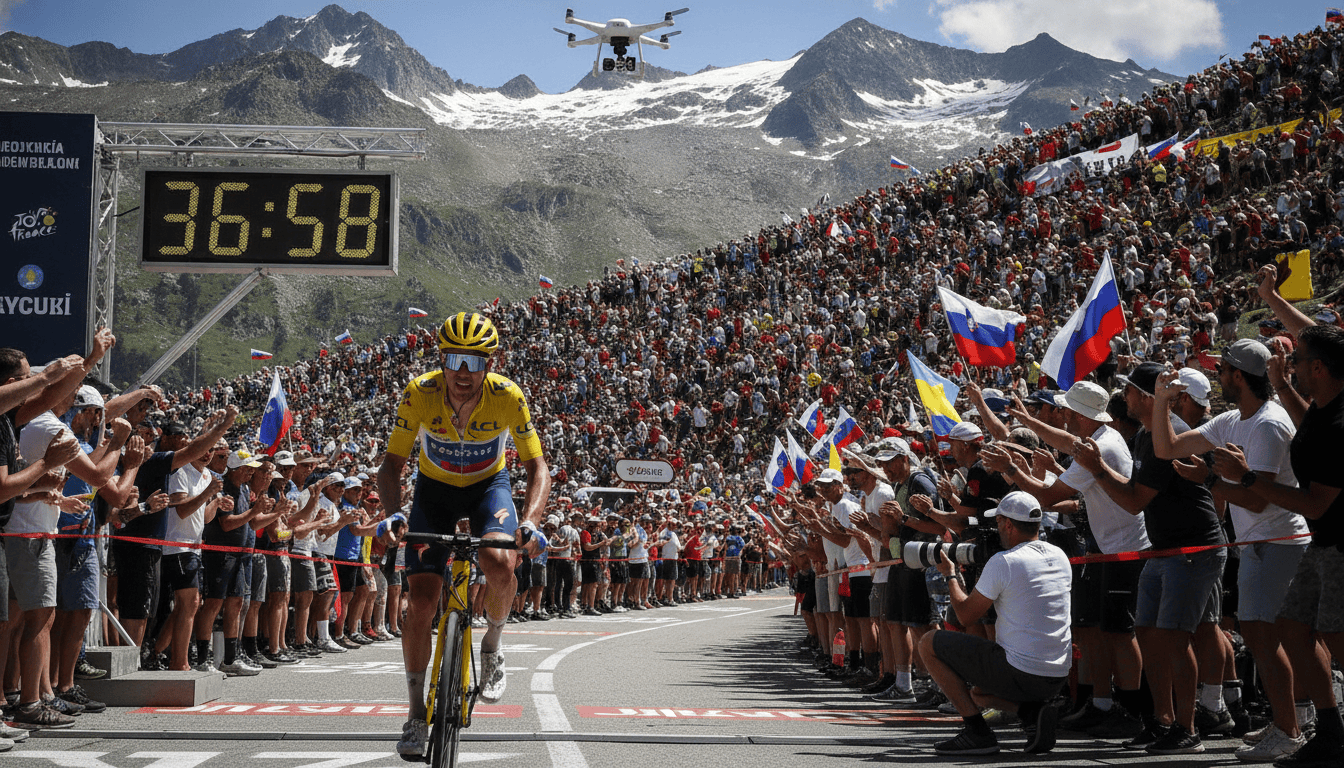
Pogacar Shatters Alpe d’Huez Record in Dominant Tour de France Performance
Tadej Pogacar set a new Alpe d’Huez ascent record of 35:26, taking the stage and extending his Tour de France lead amid a chaotic finale and a crash.
Tadej Pogacar’s lightning-fast climb to the summit of Alpe d’Huez defined Friday’s stage, as the Slovenian star charged past the flamme rouge and erased a long-standing mark on cycling’s most iconic ascent. Pogacar’s performance at Alpe d’Huez was decisive and visible from the roadside, and it left the general classification landscape altered in his favor. The stage also featured dramatic attacks, a high-speed crash involving Einer Rubio and a crowd whose size and fervor bordered on unruly.
Pogacar breaks Pantani’s Alpe d’Huez mark
Pogacar completed the final ascent in 35:26, eclipsing Marco Pantani’s 1995 time by 74 seconds and setting a new benchmark for the climb. The decisive move came inside the last kilometer and a half when Pogacar picked off the remaining escapees one by one. By the time he crossed the line, the record—and the optics of the race—belonged unmistakably to him.
The finishing burst came after Pogacar had stalked the front group during the climb, appearing to reel in rivals with measured surges. He later characterized the record with cool detachment, but the accomplishment will be dissected by rivals and analysts for days. It was the first time Pogacar had claimed victory on Alpe d’Huez.
Carapaz’s repeated attacks fall short
Richard Carapaz refused to yield quietly on the slopes, launching repeated accelerations in attempts to shake Pogacar and seize the prestigious stage. The Ecuadorian’s tenacity animated the climb and forced repeated responses from Pogacar, who methodically neutralized each move. In the closing two kilometers Carapaz was ultimately reeled in and, exhausted on the run to the line, lost contact with second place.
French youngster Lenny Martinez capitalized on Carapaz’s late fatigue to take second on the day, while Carapaz slipped to third. The duel between Carapaz and Pogacar added a strategic edge to an already electric ascent, but it did not change the outcome: Pogacar remained the strongest rider when it mattered most.
Massive crowds and a dangerous roadside incident
An estimated half a million spectators turned the road to Alpe d’Huez into a festival of color and noise, crowding the 21 hairpins and creating both spectacle and risk. Fan costumes and a sea of spectators created a raucous atmosphere that was celebrated for its passion but criticized for its peril. The chaotic environment contributed to a serious incident when Movistar’s Einer Rubio collided head-first with the rear window of a team car stalled in the crowd.
Rubio, the 2023 Giro d’Italia stage winner, was forced to abandon the race after the crash, with his team initially withholding detailed information on the severity of his injuries. The collision sparked renewed calls from riders and team directors for better crowd control and clearer protective measures at high-profile mountain finishes.
General classification: Pogacar’s advantage widens
Pogacar’s stage triumph extended his lead atop the general classification to 7 minutes and 11 seconds over Remco Evenepoel, a margin that further solidifies his grip on the yellow jersey. Evenepoel finished among the top ten on the day and remains the strongest available challenger on paper, but the time gap now places Pogacar in an overwhelmingly favorable position. Only an accident, mechanical calamity or comparable misfortune now appears likely to dislodge him.
Mexican teammate Isaac Del Toro sits third overall at 9:42 down, while French hopeful Paul Seixas — despite the home crowd support — remains fourth at 10:06 off the lead. The standings reflect not just Pogacar’s strength but the dispersal of time among the chasing group, making coordinated efforts to reduce the deficit increasingly difficult.
Stage podium and tactical takeaways
Pogacar crossed the line first, Lenny Martinez claimed second and Richard Carapaz completed the podium in third, a result shaped by aggressive tactics and late-stage attrition. Teams watching the finale will note how Pogacar balanced patience with perfectly timed power, countering attacks without overextending himself. The result also underscored the vulnerability of late solo moves when facing a rider in Pogacar’s form.
The day’s racing produced tactical lessons for contenders: breakaways can be neutralized by a measured chase, and individual brilliance on a key climb can outweigh protracted strategies. For teams targeting the podium, the route forward will require bold, coordinated moves and perhaps a degree of fortune.
What the Alpe d’Huez win means for the Tour
A record-breaking stage win at Alpe d’Huez bolsters Pogacar’s aura and reshapes the psychological battlefield of the race. His dominance converts time into leverage: rivals must now consider riskier tactics and accept that margin-reducing opportunities will be scarce. The result also left French teams without a stage victory at this point, raising the prospect of a rare Tour arrival in Paris without a French stage win.
For the remainder of the race, Pogacar’s combination of climbing power and time advantage forces opponents into an uphill battle—literally and figuratively. With momentum firmly on his side and the record books updated, Pogacar has made his position as the rider to beat even more emphatic.
Tadej Pogacar’s Alpe d’Huez victory was both a performance and a statement, converting a classic climb into a platform for dominance and leaving rivals to confront a rapidly narrowing set of options.
