
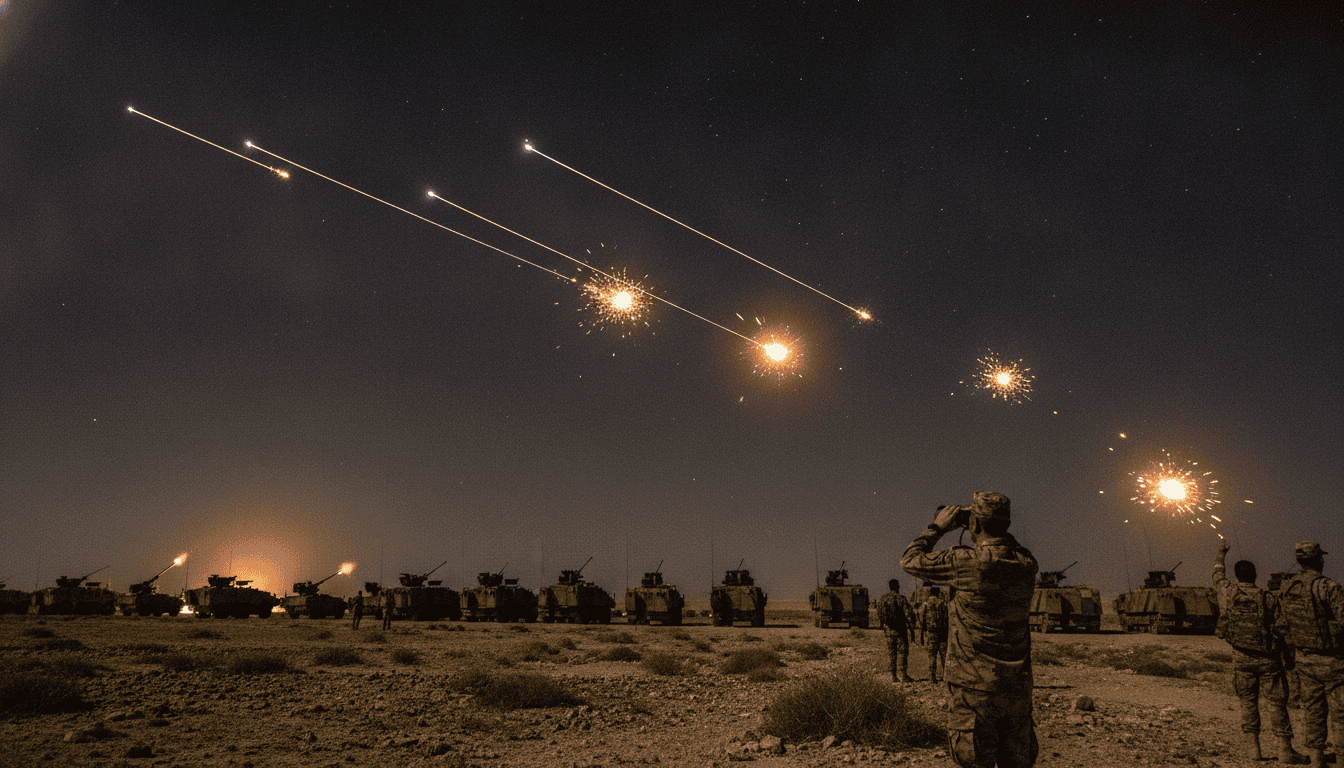
Jordanian army intercepts Iranian drones and missiles, military says
Jordanian army intercepts Iranian drones and missiles, reporting seven missiles and six drones were neutralized with no casualties or damage, the military said.
The Jordanian army said it intercepted seven missiles and six drones it described as Iranian in a statement that reported no casualties or damage. The announcement, which did not specify timing or precise locations, underlined that Jordan’s air-defence forces engaged and neutralized the threats. The phrase “Jordanian army intercepts Iranian drones and missiles” was used in the statement and has been repeated by officials discussing the incident.
Jordanian military statement
The Jordanian Armed Forces issued a brief statement confirming the interception of the weapons and asserting there were no injuries or material damage. The statement identified the intercepted objects as missiles and unmanned aerial vehicles it attributed to Iran, but it did not provide technical details or the name of the systems used.
Military spokespeople did not release imagery or forensic evidence with the initial announcement, and they declined to answer questions about the launch origin or whether debris fell in populated areas. Officials said investigations were continuing and that additional information would be released when available.
Details of the intercepted threats
According to the military, seven missiles and six drones were intercepted during the incident, all described in the statement as Iranian. The report did not indicate whether the intercepts occurred in Jordanian airspace, territorial waters, or international airspace near Jordan.
No information was provided on the types of missiles or drone models involved, and it remains unclear whether the objects were guided long-range munitions, short-range rockets, or smaller unmanned systems. The lack of specifics leaves open questions about the technical profile of the threat and how it was detected and tracked.
Air-defence response and capabilities
Jordan said its air-defence forces were responsible for neutralizing the incoming threats, signaling that the country’s integrated defence systems were operational and responsive. Air-defence units typically rely on layered detection — combining radar, sensors, and command-and-control — to identify and engage aerial threats, though the military did not disclose which assets were used.
The successful interception with no reported casualties or damage will likely be seen by Jordanian authorities as confirmation of their readiness, but the military offered few operational details. Analysts will look for follow-up disclosures about interceptors, engagement ranges, and coordination with allied systems to assess capabilities more fully.
Regional context and security implications
The military’s attribution of the missiles and drones as Iranian places the incident within a broader regional friction that has seen increased use of unmanned systems and missile strikes. While Jordan did not accuse any state of direct aggression beyond its statement, the reference to Iranian origin links the event to existing tensions in the region.
Such incidents heighten risks of miscalculation and escalation, particularly when weapons traverse busy air corridors or border areas. For neighboring countries and international partners, the episode underscores persistent challenges in securing airspace and preventing spillover from wider regional conflicts.
Diplomatic and international considerations
Jordan’s concise public account did not mention consultations with allies or notifications to international bodies, but states commonly brief partners when air-defence incidents occur. The country’s strategic relationships with Western and regional partners mean that intelligence sharing and diplomatic exchanges are likely to follow, even if not publicly acknowledged at this stage.
International responses, where they occur, often focus on confirming facts, urging de-escalation, and calling for restraint from actors that might be involved. The limited public information from Amman leaves diplomatic channels as the most probable venue for clarifying the incident and coordinating any collective response.
The Jordanian army intercepts Iranian drones and missiles, according to its own brief statement, and the lack of casualties or damage will shape both domestic and external reactions as investigators seek to fill gaps in the public record.
