
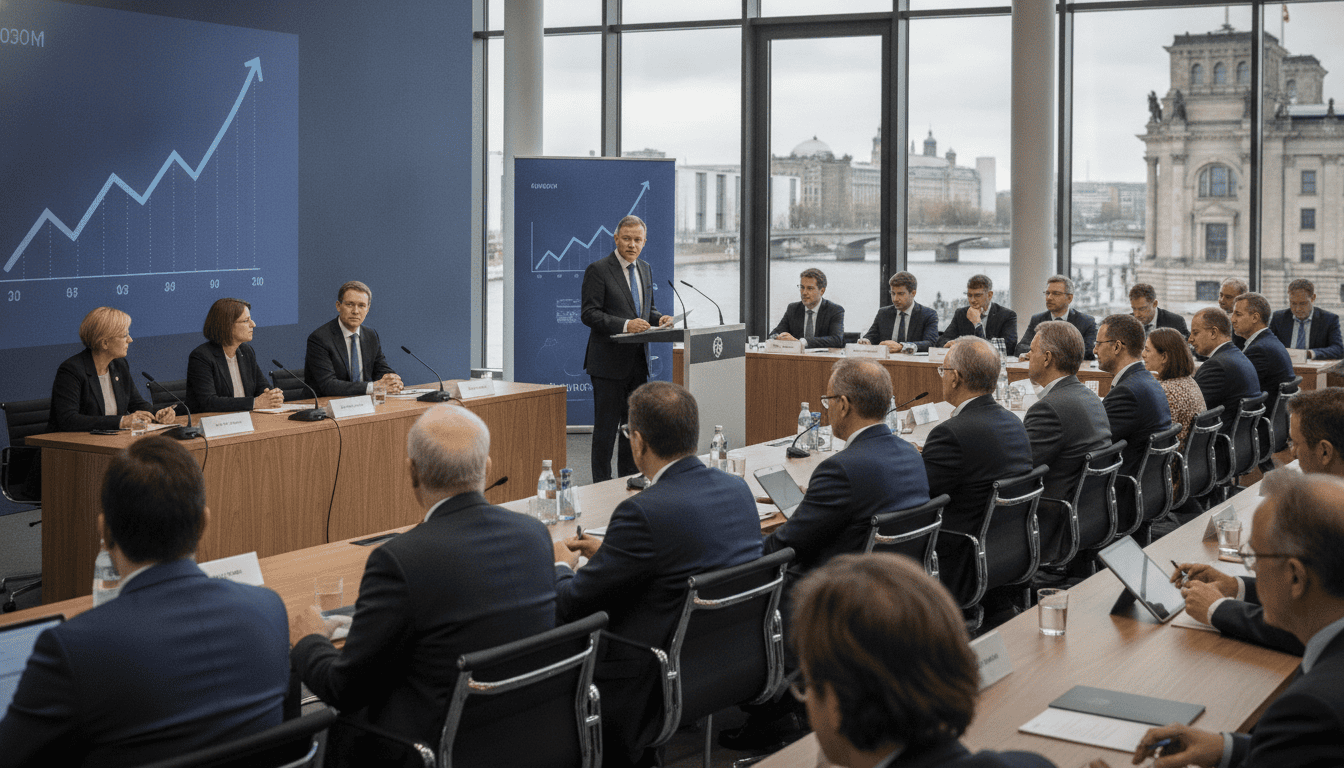
German start-up sector surges as government unveils 150-measure strategy to boost scale-ups
Germany’s start-up sector posted a striking first-half rebound, prompting Chancellor Friedrich Merz and Economics Minister Katherina Reiche to foreground new policy measures aimed at easing financing and cutting red tape. The government points to 3,053 new start-ups between January and June and a 60-page strategy with roughly 150 measures as the foundation for scaling this momentum. Yet investors and analysts warn that later-stage growth financing remains constrained even as headline figures improve.
Government highlights jump in formations
The federal government has put the recent wave of company creations at the center of its economic messaging, citing a significant rise in newly registered start-ups during the first half of the year. Officials framed the numbers as evidence of renewed entrepreneurial energy and used them to justify a concentrated policy push on the sector.
Chancellor Merz and other ministers have described the trend as an encouraging sign for Germany’s innovation capacity, but they have also acknowledged that higher formation rates are only one part of the challenge of building globally competitive firms.
Start-up strategy lists 150 measures to strengthen the ecosystem
Economics Minister Katherina Reiche presented a 60-page start-up strategy that catalogs roughly 150 measures intended to improve financing conditions, simplify spin-offs and reduce bureaucratic hurdles. The plan targets both public and private levers, from regulatory relief to incentives meant to make risk capital more available for scaling companies.
Some high-profile items remain under negotiation or absent from the final text, including a government pledge to enable company formation within 24 hours. Reiche also indicated ongoing talks with the Digital Ministry and said certain labor-law relaxations approved by the coalition would take effect only at higher salary thresholds than start-up lobby groups had sought.
Early-stage funding improves but growth capital lags
Industry observers note that while the German start-up sector has seen healthy inflows into seed and early-stage rounds, the pipeline for larger growth financings has not kept pace. Longstanding structural gaps mean many promising companies struggle to find the sums required to scale internationally.
Investors who built careers around European success stories point to a pullback by some large U.S. funds after the pandemic and to the lack of a domestic, deep-pocketed lead investor able to underwrite nine-figure rounds in euros. That dynamic, they say, concentrates capital on a few winners while leaving a broad middle tier underserved.
Big rounds boost totals even as deal counts fall
Consulting and audit firm EY’s start-up barometer for the first half shows total venture investments rising to about €5.3 billion, up roughly 14 percent year‑on‑year, driven in part by several very large transactions. Capital-intensive companies in areas from fusion energy to aerospace secured triple-digit million rounds and in one case a backing above €1 billion, outcomes that were once rare in Germany.
At the same time, the overall number of financing deals declined, a sign that investors are concentrating resources into fewer, perceived safer bets. Analysts point out that on a GDP-adjusted basis Germany still trails the United States by a wide margin in venture commitments.
State-backed vehicles and pension capital targeted to close gaps
Policy-makers are pressing large domestic pools of institutional capital — insurers, pension schemes and provision funds — as a source of scaleable finance. Reiche cited roughly €2.8 trillion of such capital and proposed a stronger role for the state bank KfW as a co-investor alongside private funds to de‑risk larger rounds.
The strategy also mentions channeling a portion of proposed pension capital into venture investments and using the federal Zukunftsfonds to make direct equity stakes and act as an anchor customer in strategic sectors. Officials argue these steps would crowd in private investors and help close the home‑market funding shortfall.
Private-sector response and a planned growth fund
Senior venture figures are not waiting on policy alone. Two prominent investors have disclosed plans for a dedicated growth capital fund intended to supply the mid‑ to late‑stage cheques the market lacks. They say an anchor investor from the private sector has committed a three‑digit million euro contribution and that the vehicle should be operational by the fourth quarter.
While the target size remains undisclosed, the managers point to a benchmark for European growth funds that often sits in the €600 million to €1 billion range. Backers of the project say such a fund would help sustain the recent formation surge by offering viable scaling pathways.
Momentum is evident across Germany’s innovation landscape, but officials and market participants stress that headline growth and a healthy quantity of new companies do not automatically translate into a robust stable of global champions. Closing the gap between early backing and large growth rounds will require coordinated public incentives, deeper domestic investors and several successful exits to convince international capital to treat Germany as a repeatable source of scale-ups.
