
Krugman: Europe’s economic standing holds up against the United States
Paul Krugman says Europe’s economic standing is stronger than often portrayed; he argues PPP-adjusted GDP per capita narrows the gap with the United States. (157 characters)
Krugman’s May 2026 challenge to the decline narrative
Paul Krugman in May 2026 publicly disputed the widespread claim that Europe is in irreversible economic decline. He argued that the assessment depends on which statistical lens is used and that one common measure — purchasing power parity — paints a different picture. Krugman urged policymakers and commentators to reassess comparisons that rely solely on constant-price GDP growth.
His intervention revived a debate that had accelerated after Mario Draghi’s competitiveness report two years earlier, which many read as a warning about Europe’s economic trajectory. Krugman framed the discussion around living standards rather than headline growth rates, shifting attention to how far incomes actually buy goods and services.
Two measures, two outcomes: constant prices versus PPP
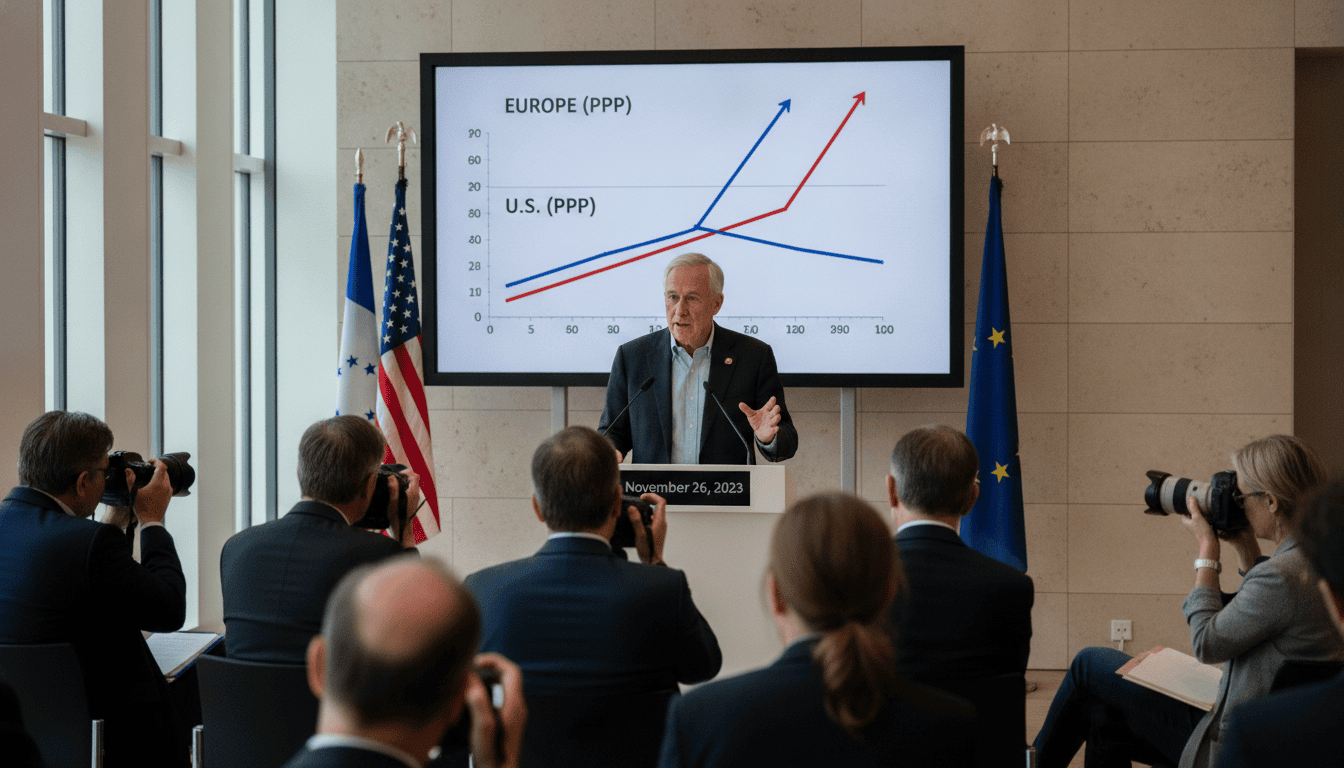
Comparisons using GDP per capita at constant prices show the United States outpacing Europe over recent decades. That metric captures relative output growth after removing price changes and is widely used to gauge economic growth over time.
By contrast, GDP per capita measured at current purchasing power parity prices compares what households can buy in local markets. On this basis, Krugman and other economists find that Europe closes much of the gap with the United States. The divergence between the two approaches underscores that growth and purchasing power tell different stories about citizens’ living standards.
What the metrics mean for living standards
Economists say real purchasing power is often the better guide to household welfare because it reflects local prices and consumption possibilities. If incomes buy more relative goods and services in Europe, then many residents may enjoy a standard of living closer to that of Americans than headlines imply.
However, PPP measures also have limits: they can mask underlying weaknesses in productivity, innovation, or long-term growth potential. Analysts caution that a favourable PPP position does not eliminate the need for policies that boost productivity and investment.
Draghi report and the policy debate
Mario Draghi’s competitiveness report sparked concern by highlighting structural challenges across the European Union, including investment shortfalls and regulatory frictions. That assessment prompted calls for reforms aimed at improving productivity, deepening capital markets, and fostering innovation.
Krugman’s rebuttal did not dismiss the report’s policy priorities but reframed the narrative about decline. He suggested Europe’s comparative strengths in social infrastructure and price levels deserve recognition while still addressing reforms that would support sustainable growth.
Implications for economic policy and politics
How policymakers interpret Europe’s economic standing affects priorities in fiscal, industrial, and social policy. If PPP-adjusted measures gain prominence, political pressure may mount to defend existing social protections and focus on redistributive outcomes. Conversely, a focus on constant-price GDP may intensify reformist agendas aimed at boosting growth rates.
Public debate is likely to reflect both perspectives. Governments must balance near-term living standards with long-term competitiveness, using a mix of investment in skills and technology alongside measures that address price and welfare disparities across member states.
Expert reactions and ongoing data scrutiny
Economists and statisticians note that measurement choices have practical consequences for international comparisons and policy signals. Some welcome Krugman’s emphasis on consumer purchasing power; others urge caution and call for careful interpretation of composite indicators.
The conversation underlines the need for transparent metrics and for policymakers to explain which measures guide their decisions. As new data are released and methodologies evolve, analysts will continue to reassess Europe’s position relative to the United States and other advanced economies.
Europe’s economic standing will remain a contested issue, shaped by evolving data, policy choices, and political priorities. The debate initiated by Krugman’s May 2026 comments shows that measurement matters and that nuanced analysis is essential when assessing living standards and long-term economic prospects.
