
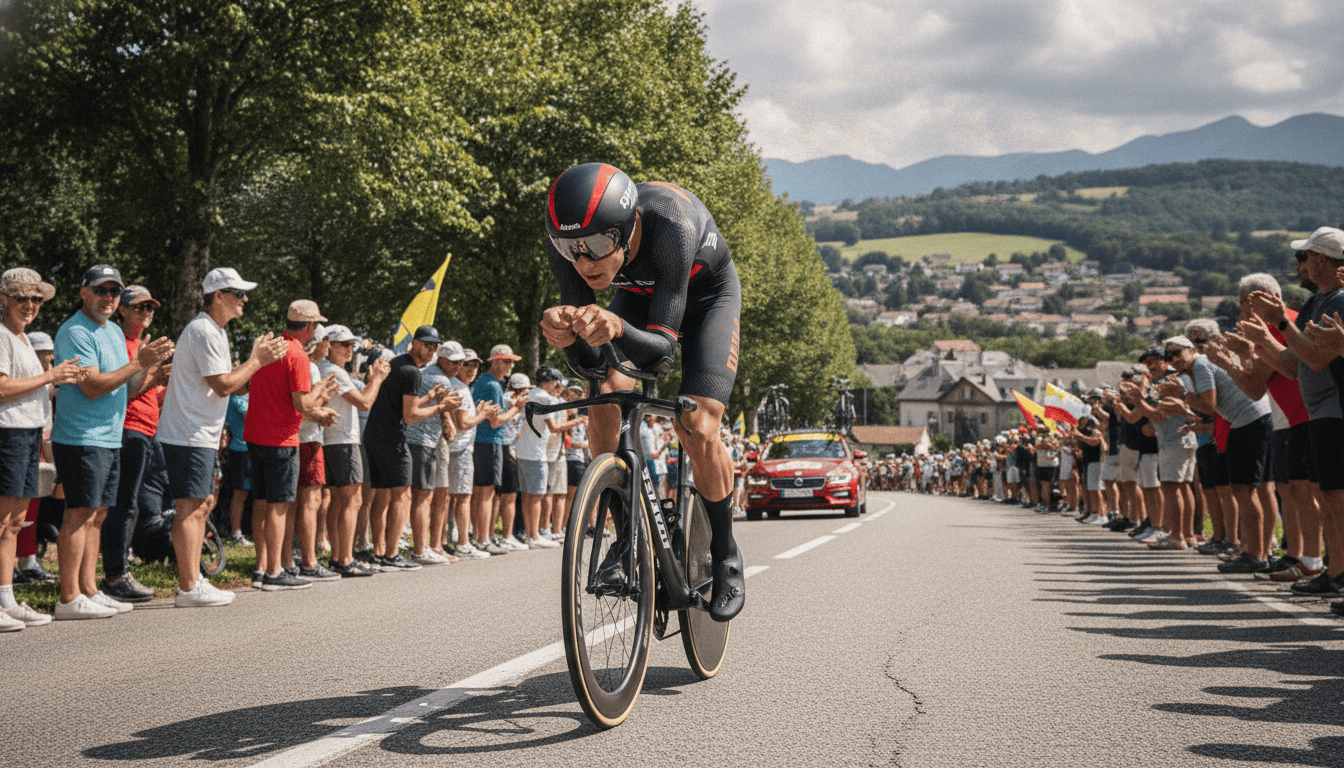
Aerodynamics Drive Tour de France Time Trial Speeds, Experts Say
Aerodynamics reshape Tour de France time-trial speeds: engineers say optimized position, helmets and suits plus simulation models cut drag and lift average pace.
Ingmar Jungnickel, a German-trained mechanical engineer and aerodynamics specialist now based in Salt Lake City, is among the experts spotlighting aerodynamics ahead of the Tour de France individual time trial on Tuesday, July 21, 2026. He leads a small firm developing a simulation-driven AI model that refines a rider’s seating position to reduce drag. The work underscores a shift in performance margins from weight savings to airflow management.
Engineer Behind New Simulation Tools
Ingmar Jungnickel studied mechanical engineering in Dresden and later refined testing methods for competitive cycling in Germany and the United States. He spent years at the FES research institute in Berlin and then led the aerodynamics department at Specialized in California for eight years. His current project combines computational fluid dynamics with machine learning to generate position optimizations from virtual wind-tunnel conditions.
Aerodynamics Dominate Resistance on Flat Stages
On flat terrain, aerodynamic drag accounts for roughly 90 percent of total resistance at professional speeds, with rolling resistance around eight percent and drivetrain losses two to three percent. That balance shifts uphill depending on gradient, but even on moderate climbs at modern race speeds, airflow remains a major determinant of pace. For time trials, small percentage improvements in drag translate to significant speed gains over a course.
Position Beats Weight for Time Trial Gains
Teams and riders increasingly prioritize position over shedding mass, because there is little realistic room to cut several kilograms at the professional level. Frames are regulated and riders are already at physiological limits, so weight reductions typically yield marginal returns of about one percent or less. By contrast, moving from a standard road position to an optimized time-trial tuck can lower aerodynamic drag by roughly 30 percent, delivering far greater performance benefits than weight savings.
Helmets, Suits and Tactical Equipment Changes
Equipment remains important but ranks below position in impact. Modern time-trial helmets have grown broader to protect and mask the arms and shoulders, effectively reducing frontal drag in the tuck. Skin suits now range from mass-market options under €500 to bespoke prototypes that can cost upward of €18,000 when developed for WorldTour teams. Those custom garments are tailored not only to individual riders but to specific speeds and course profiles to squeeze out incremental watts.
Measurement: From Wind Tunnels to AI
Teams employ several methods to quantify and cut drag, from on-road power meters and controlled rider-to-rider comparisons to wind-tunnel testing and CFD modeling. Recent advances layer high-fidelity simulations with machine learning, enabling faster evaluation of thousands of posture and equipment permutations without lengthy tunnel hours. Jungnickel’s approach uses virtual testing to recommend position changes that would be difficult to trial repeatedly on the road or in a tunnel.
Marginal Gains Add Up to Major Speed Increases
The cumulative effect of position, clothing and helmet improvements is reflected in shrinking drag coefficients measured at the top level of the sport. Where a competitive CdA (drag coefficient times frontal area) might have sat near 0.30 in an upright road position, elite time-trial setups now commonly report figures below 0.18, with the very best near 0.16. That reduction in CdA cuts required power substantially; for example, roughly 200 watts at a CdA of 0.20 can sustain about 40 km/h, whereas at 0.30 a rider would need near 300 watts for the same speed.
Riders and teams therefore chase marginal savings measured in single or double-digit watts: ten to twenty watts from helmet choices, twenty watts from optimized suits, and larger gains from posture adjustments. Those seemingly small numbers translate into minutes over long efforts, which can decide time-trial stages and general classification standings.
The coming time trial at the Tour de France on July 21 will be watched closely for how teams deploy these aerodynamic advances. With positions refined in simulation and bespoke equipment tailored to course demands, the event highlights the modern balance of engineering, data and human performance in elite cycling.
