
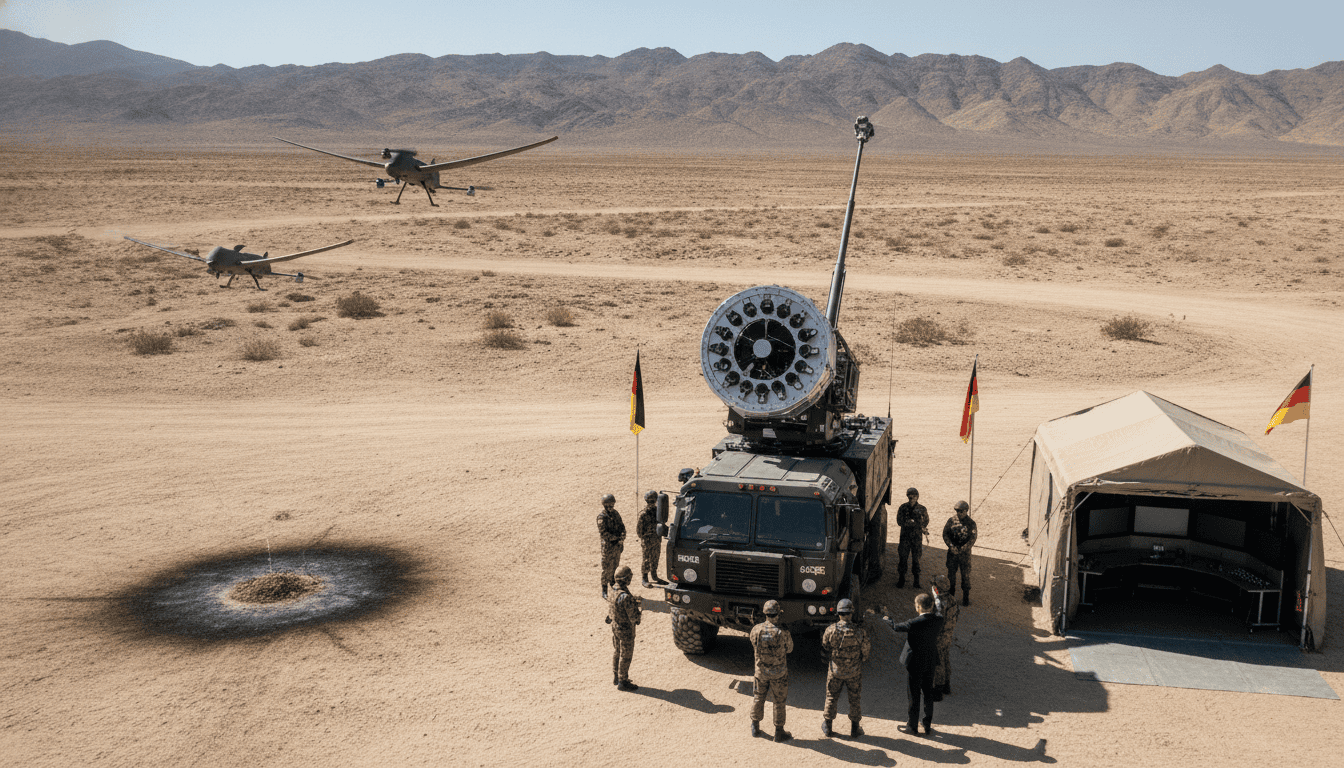
Trumpf Aims to Field Laser Weapon for Drone Defense with Tests Planned by Early 2027
TRUMPF plans a defensive laser weapon to counter drone swarms, aiming for field tests by early 2027 while tackling range, regulatory and power challenges.
The German industrial group TRUMPF has announced an accelerated push to develop a defensive laser weapon intended to neutralize drone swarms, with company executives saying a test-ready prototype should go to a firing range by early 2027. The announcement underscores growing concern about low-cost, autonomous drones on modern battlefields and comes as manufacturers rush to translate laboratory optics and control systems into deployable, military-grade systems. TRUMPF says the programme will concentrate first on short-range engagements — roughly up to one kilometre — where polymer-bodied reconnaissance and FPV attack drones present the most pressing threat.
Project Timeline and Test Objectives
By TRUMPF’s timetable, a truck-mounted laser unit will be ready for comparative live-fire trials at a military or private range in the first months of 2027, company officials said. The programme was started with a multi-year development window and remains on track to meet that deadline, according to the firm’s board member responsible for laser technology. Those trials are intended to validate targeting, tracking and engagement chains under realistic conditions and to demonstrate that a laser-based system can operate reliably alongside radar and command systems.
Technical Challenges: Range, Beam Control and Power
Achieving destructive effect at distance requires precise focus and sustained energy delivery to a moving, often erratic target, which poses a major engineering challenge. TRUMPF engineers emphasise that while energy per shot is inexpensive, the optical power, beam quality and steering precision must scale with engagement distance and the target’s construction. At ranges approaching multiple kilometres and against metal-clad targets, optical power requirements rise steeply; TRUMPF notes that multi-hundred-kilowatt or megawatt-class capabilities would be needed for such scenarios, while many drone threats can be countered with far lower outputs at sub-kilometre ranges.
Operational Concept and Industry Partnerships
The planned system is not a standalone sensor-to-shooter; rather, it is being developed to operate as part of an integrated air-defence cluster. TRUMPF’s concept pairs high-precision lasers with radar and command software supplied by industry partners to identify threats, classify them and hand off precise coordinates for optical tracking. That layered approach intends to limit false engagements, enable human-in-the-loop decisions where required, and allow laser units to focus on kinetic gaps that conventional interceptors or jamming cannot fill.
Regulatory, Safety and Training Hurdles
Beyond hardware, regulators and defence organisations face unresolved questions about safe employment of high-energy laser systems in populated or complex environments. Laser propagation through aerosols and variable atmospheric conditions raises concerns for nearby personnel and infrastructure that must be addressed prior to operational deployment. Training for service personnel, certification processes, and rules of engagement will all need to be adapted before lasers can be routinely fielded, meaning procurement timelines may be shaped as much by policy decisions as by technical maturation.
Cost Profile and Battlefield Role
TRUMPF highlights a clear cost advantage in operating lasers compared with traditional interceptors: once the system is fielded, the marginal energy cost per engagement can be negligible relative to the price of missiles. The company positions laser weapons as a complementary capability that can economically defeat large numbers of low-value threats, such as plastic-bodied FPV drones, while freeing missile inventories for higher-value targets. Development and qualification will still require substantial investment, and TRUMPF acknowledges that meaningful revenue from defensive lasers will take time to materialise.
Laser Applications Beyond Defence
The firm also points to civilian and scientific opportunities for high-power lasers, including potential roles in experimental fusion programmes that would require hundreds to thousands of lasers and long-term industrial-scale production. TRUMPF executives argue that a national commitment would be needed to build fusion test facilities and supply chains at scale, and that industry would respond to clear, sustained public mandates. Those ambitions show how advances driven by defence requirements can translate into broader technological and industrial capabilities over time.
Hagen Zimer, a physicist who oversees TRUMPF’s laser division, framed the push as an extension of decades of industrial expertise in optics, control electronics and materials processing applied to a new operational problem set. The company plans to pursue measured, integrated progress: closing the immediate one-kilometre capability gap first, validating systems in partnership with sensors and command providers, and addressing regulatory and safety issues before wider deployment.
