
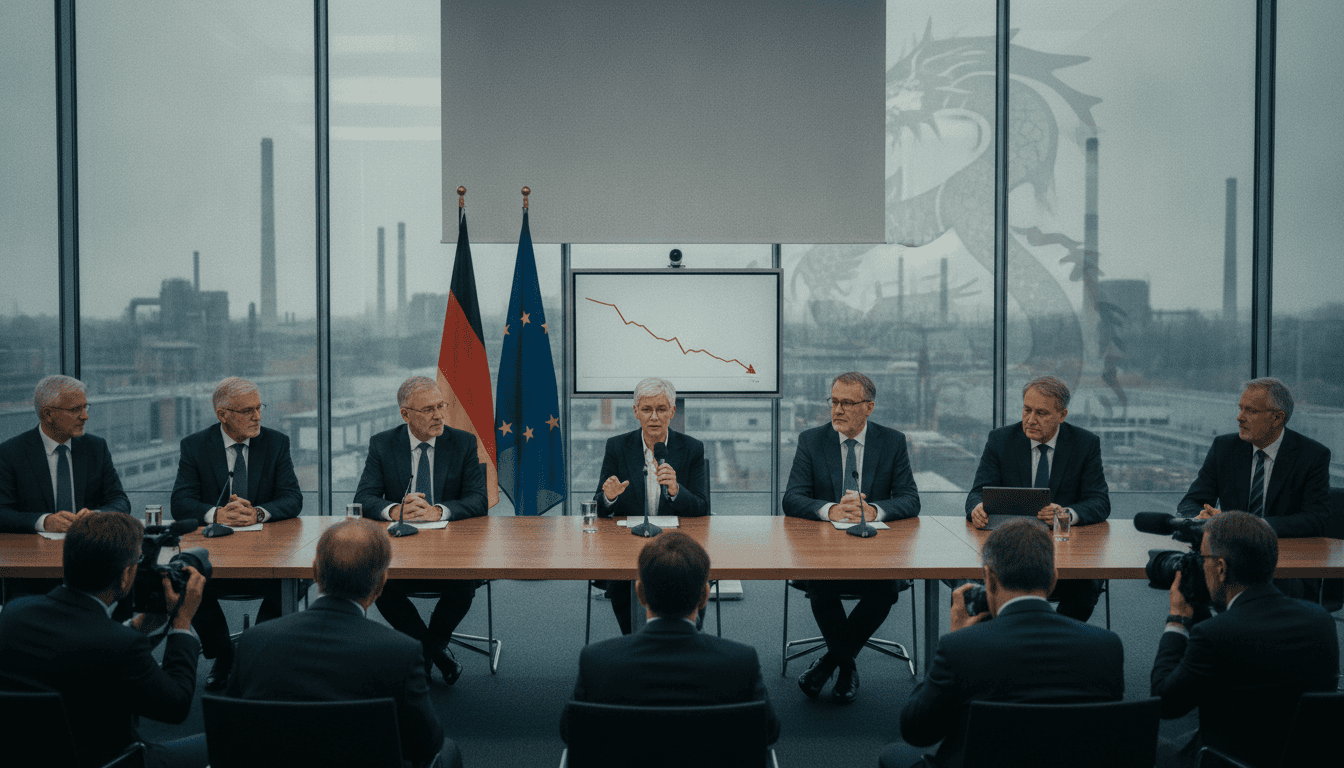
Germany confronts a new “China shock” as competition from Chinese manufacturers intensifies, testing the resilience of its export-led industries and prompting debate over jobs, trade deficits and policy responses.
Germany confronts a new “China shock” as competition from Chinese manufacturers intensifies, testing the resilience of its export-led industries and prompting debate over jobs, trade deficits and policy responses. Economists and institutes in Germany and Europe now weigh whether the current pressure is a temporary disruption or a long-term structural challenge. The discussion centers on how much of recent job losses and market share declines are the result of Chinese competition versus domestic weaknesses.
Germany weathered the first China shock
Germany’s industrial model proved unusually resilient during the early wave of Chinese export growth, according to leading German economists. Strong sectors such as machinery, advanced electronics and the automotive supply chain benefited from selling capital goods to China and from integration with Eastern European production. That experience has shaped the current discourse: policymakers and analysts note past gains while warning that the nature of competition has changed.
Industries under strain in China‑Shock 2.0
The current phase—dubbed by observers as “China shock 2.0”—is defined by Chinese firms moving up the value chain and competing directly in areas previously dominated by German exporters. Solar panels, batteries, electric vehicles and high-end machinery are increasingly produced in China and sold not only domestically but on third markets with competitive pricing. Several German industrial regions, especially those dependent on automotive suppliers and precision engineering, report heightened pressure on margins and market shares.
Estimates point to hundreds of thousands of lost jobs
Industry analysts and think tanks offer differing estimates of employment effects, but several assessments put the scale of job displacement in the hundreds of thousands since 2019. One employer-linked institute estimates Chinese competition cost Germany roughly 400,000 manufacturing positions in recent years, while aggregate data show a comparable decline in manufacturing employment between 2019 and 2025. These figures have fueled political concern and intensified calls for targeted policy responses at both national and EU levels.
Economists split on causes and remedies
Economists remain divided over how much blame to assign to Chinese competition versus domestic cost and productivity disadvantages. Some point to structural factors in Europe—higher energy and labor costs, regulatory burdens and post‑pandemic supply disruptions—that have widened a cost gap with China. Others emphasize market distortions such as subsidies and currency management that amplify Chinese firms’ price competitiveness. This debate informs sharply different policy proposals, ranging from supply‑side reforms to protective measures calibrated against specific distortions.
Trade statistics reveal complex interdependence
A closer look at trade flows complicates the narrative of unilateral Chinese gains. Much of Europe’s imports from China consists of intermediate goods and components that feed into German and EU manufacturing chains, delivering cost advantages to domestic producers. At the same time, Germany continues to register surpluses in sectors such as battery‑electric vehicles in some markets, underscoring ongoing strengths amid the disruption. Analysts caution that headline deficits with China do not necessarily equate to net economic loss when global value chains and export dynamics are accounted for.
EU deliberations broaden policy options
The European Commission and member states are actively considering a range of policy tools to address competitive challenges from China. Proposals under discussion include negotiated remedies on subsidies and forced technology transfer, targeted anti‑subsidy measures, and temporary adjustment levies consistent with World Trade Organization rules. At the same time, voices within the academic and policy community urge coordinated reform efforts to boost European competitiveness rather than relying solely on protectionist instruments. How Brussels and Berlin balance defensiveness with reforms will shape the region’s industrial trajectory.
Germany’s experience with the first wave of Chinese competition demonstrates both the potential costs of global integration and the benefits of industrial specialisation, but the current phase raises new questions. Policymakers face the dual task of defending firms from unfair practices while accelerating domestic reforms to reduce structural disadvantages. The outcome of this debate will determine whether Europe adapts to a more competitive global manufacturing landscape or succumbs to a longer period of industrial contraction.
