
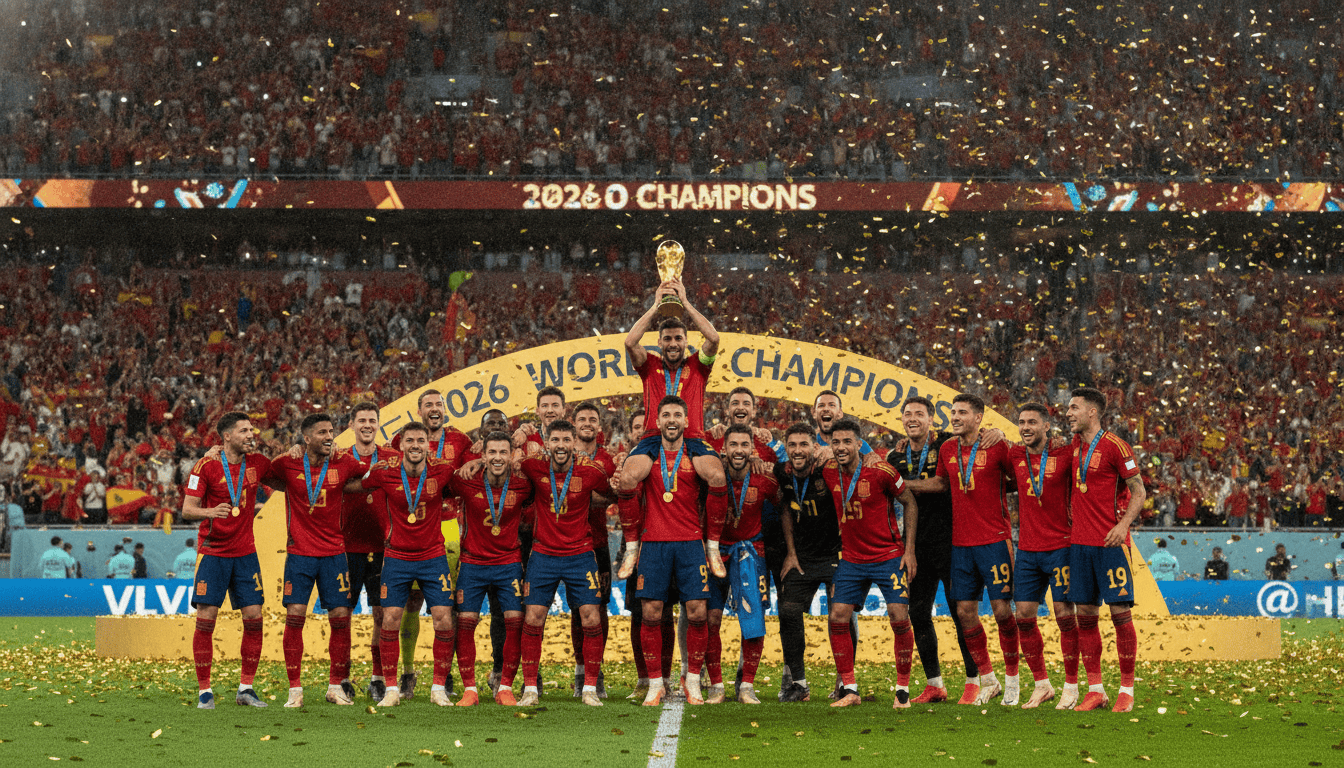
Spain World Cup Triumph: Rodri’s Record and Spain’s Collective Mastery Secure Second Title
Spain World Cup triumph in the United States capped a generation’s rise, with Rodri named best player as Simón’s defence, Cubarsí and Torres sealed Spain’s second global title.
Spain lifted the World Cup after a disciplined, possession-led campaign that culminated in a narrow final victory in the United States. The Spain World Cup win was defined by collective control, defensive resilience and decisive moments from both established leaders and emergent talents. Captain Rodri received the tournament’s best player award while Unai Simón and Pau Cubarsí anchored a defence that conceded only a single goal en route to the trophy.
A Golden Finale on American Soil
Spain’s final match became a study in patience and precision as the team converted sustained dominance into the one goal that decided the title. The winning strike arrived after sustained pressure and a well-timed delivery that allowed a substitute to finish with power. Public attention lingered not on any single personality but on the squad as a whole, a hallmark of Spain’s tournament approach.
The victory delivers Spain a second World Cup crown, echoing the team’s 2010 triumph but reflecting a new generation and tactical maturity. The tournament’s closing images favored communal celebration and the players’ shared sense of achievement over individual dramatics.
Rodri’s Record-Breaking Influence
Rodri combined volume and intention, completing the most passes of any player in the tournament and covering remarkable ground after returning from a serious knee injury. His control of tempo and defensive transitions allowed Spain to sustain possession without losing incisiveness in the final third. Tournament organizers recognized his influence by awarding him the best player trophy.
Beyond raw statistics, Rodri’s performances provided a structural backbone that allowed creative teammates freedom to influence the game. His mobility and decision-making under pressure redefined expectations for a central midfielder returning from injury in a major tournament.
Simón and Cubarsí Forge Defensive Foundation
Goalkeeper Unai Simón delivered a campaign of exceptional consistency, helping Spain to a historic defensive record that saw the side concede only once across the tournament. Simón’s reading of the game and timing on crosses reduced high-risk moments and underpinned Spain’s confidence to play out from the back. His form earned him recognition as the tournament’s top goalkeeper.
At 19, Pau Cubarsí emerged as a defensive linchpin, pairing youthful composure with precision passing that kept Spain’s build play fluid. Cubarsí’s accuracy on the ball and spatial awareness allowed him to operate like a veteran, and his performance signalled the depth of Spain’s next-generation talent pool.
Ferran Torres and the Decisive Moment
Ferran Torres, who endured early criticism during the group stage, produced the decisive finish in the final after being introduced as a substitute. The striker’s volleyed goal rewarded Spain’s sustained pressure and ended the match as a moment of theatrical closure for the team. Torres, restrained in celebration, emphasized the collective nature of the triumph rather than personal glory.
His contribution underlined a narrative of resilience: a player who weathered public scrutiny and returned to make the decisive impact in the most critical match. The goal also highlighted Spain’s bench depth and the value of tactical substitutions in knockout football.
Luis de la Fuente’s Long-Term Project
Head coach Luis de la Fuente, who has overseen player development since his early work in Spain’s youth system, framed the victory as the culmination of a multi-year process. Many members of the squad had progressed through Spain’s national youth teams and arrived at the senior side with shared tactical concepts and complementary skills. De la Fuente stressed that the title reflected both individual growth and collective continuity.
His methodical approach blended a commitment to Spain’s possession identity with adaptations to modern physical demands, producing a team capable of controlling games while remaining effective on transitions. The coaching staff’s continuity and trust in younger players proved decisive in tight moments.
Future Calendar and International Ambitions
Spain’s immediate competitive horizon includes the upcoming Nations League campaign, which the coach identified as the next target after the World Cup celebration. Players in the core squad are still in their prime and will have opportunities to add further international honours, including continental tournaments and the next World Cup cycle. The team’s blend of experience and youth positions it well for sustained success.
Beyond trophies, the victory raises expectations for Spain to maintain its identity and to manage the transition of veteran leaders while integrating rising stars into a stable tactical framework. The federation now faces the challenge of preserving the cohesion that delivered football’s highest prize.
Spain’s World Cup triumph was less a single heroic act than a concerted artistic effort: a team shaped by years of shared philosophy, fortified by defensive discipline and punctuated by a decisive attacking moment. The result cements this generation’s place in Spain’s footballing history and sets a clear agenda for what the team can still achieve.
