
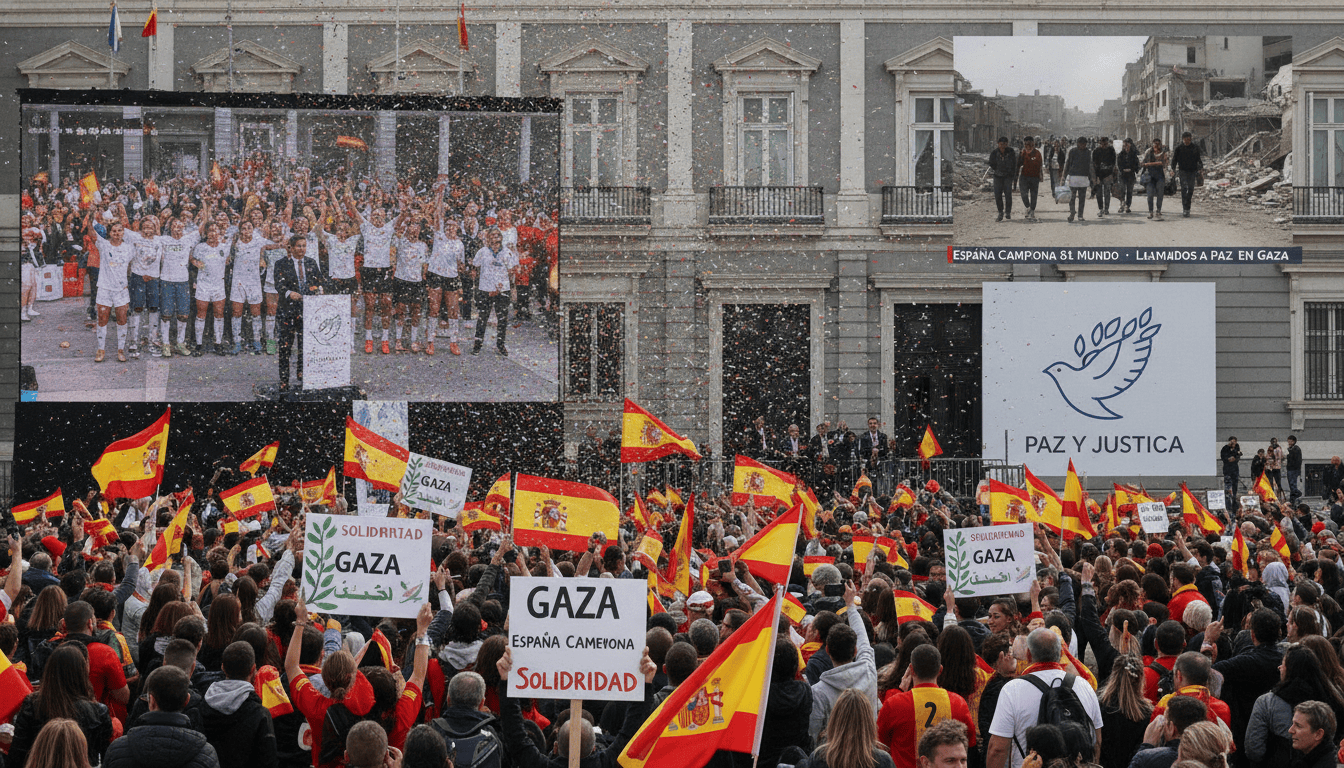
Spain World Cup victory viewed through Gaza conflict reshapes fan allegiances
Spain World Cup win reverberated beyond sport, as players’ gestures and Spain’s Gaza stance reshaped fan loyalties and exposed global political alignments.
Spain clinched the World Cup title on July 19, 2026, defeating Argentina in the final, a result many viewers immediately read through the prism of the Gaza war. The Spain World Cup triumph took on a political dimension for audiences who saw national teams as symbols as much as sporting representatives.
Spain clinches World Cup in dramatic final
Spain’s squad secured the trophy after a tense match that drew global attention for both its football and its context. Celebrations on the pitch were marked by the presence of young stars who have become prominent figures in world football.
Hundreds of thousands tuned into broadcasts and social media feeds that blended images of sporting jubilation with scenes of political symbolism. For a portion of the global audience, those images made the match feel freighted with meaning beyond goals and tactics.
Spanish government’s stance on Gaza informed public reaction
In recent months, Spain’s government under Prime Minister Pedro Sánchez has taken a publicly distinct position on Gaza, recognizing the State of Palestine and using language that drew international notice. Madrid also advanced measures to restrict arms transfers, positions that have been interpreted by some observers as moral leadership on the crisis.
Those political choices shaped how some supporters perceived Spain’s team, turning sporting allegiance into an expression of solidarity for viewers who attach moral significance to state conduct. Analysts say that when governments take visible stands on humanitarian crises, citizens often project those stances onto national symbols such as football teams.
Lamine Yamal’s flag gesture reverberated widely
Lamine Yamal, a Barcelona and Spain player widely celebrated for his talent, became a focal point when footage of him waving a Palestinian flag during Barcelona’s LaLiga victory parade circulated this year. The brief public gesture was small in scale but large in symbolic effect for many who follow the conflict closely.
Artists and communities in the occupied territories and the diaspora amplified that image; murals and tributes appeared in several locations, turning a single moment of celebration into a broader cultural reference. For numerous fans, Yamal’s visible solidarity added an ethical dimension to Spain’s success on the international stage.
Messi image and Argentine leadership shaped optics for some viewers
Images of Argentina’s captain Lionel Messi visiting the Western Wall in East Jerusalem during a 2013 club trip resurfaced during the tournament and were reassessed through the lens of current events. While the photographs predate the present crisis, they acquired renewed significance for viewers attuned to symbols and place.
The political posture of Argentina’s president, Javier Milei, who has publicly aligned with pro-Israel rhetoric and expressed warm ties to former US President Donald Trump, also influenced perceptions. For some spectators, national leadership and preexisting imagery combined to make the final more than a contest between two footballing powers.
United Nations vote highlighted unexpected international alignments
A March United Nations General Assembly resolution addressing historical transatlantic enslavement and reparatory justice produced an atypical alignment: 123 countries voted in favor, 52 abstained, and only three voted against the measure. The United States, Israel and Argentina were recorded as opposing the resolution, a grouping that drew comment in diplomatic and civil society circles.
Observers pointed to that vote as one of several data points linking countries’ foreign-policy choices with how international publics interpret cultural events. For many, flag displays and government votes are read together when assessing national moral posture.
Sporting events became platforms for moral and political expression
The World Cup final demonstrated how global sporting events can serve as an arena for political expression, with gestures and government actions shaping audience response. Support for a team can reflect admiration for style and skill, but it can also signify alignment with broader ethical or political positions.
Organizers and players repeatedly caution against conflating sport with policy, and analysts warn that symbolic displays are not a substitute for humanitarian assistance or political resolution. Nonetheless, for large segments of the public, the Spain World Cup victory was interpreted as a statement as much as a sporting success.
Spain’s win will not change the realities facing civilians in Gaza, nor will it resolve disputes at the UN or between states. Still, the final underscored how contemporary conflicts alter the cultural lenses through which international audiences watch sport, and how a single match can become a mirror of wider political currents.
