
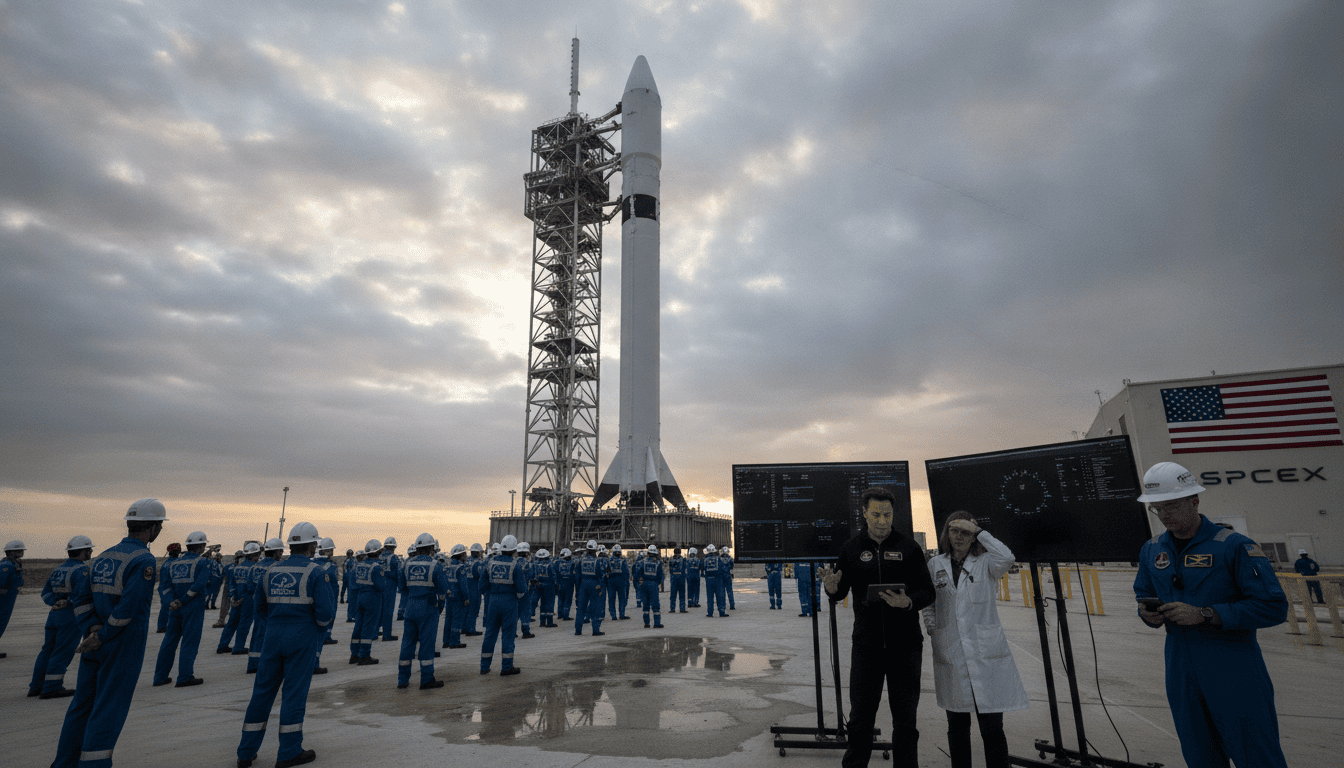
SpaceX Starship Test Flight Aborted at Last Second After Engine Failures
SpaceX aborted a Starship test flight at the last second after several engines failed to ignite, triggering an automatic hold and postponing the planned 13th test. The SpaceX Starship test flight abort was confirmed by CEO Elon Musk on X and discussed live by company officials, who said a follow-up attempt could come within days. The interruption raises fresh questions about reliability as SpaceX balances technical fixes and market pressures.
Launch abort halts 124‑metre vehicle ahead of scheduled 13th test
The 124‑metre Starship stack was prepared for what SpaceX described as its 13th integrated test launch when ground systems registered a fault and an automated abort sequence was executed. Video of the countdown showed ignition attempts but company officials later said not all engines lit, prompting a controlled shutdown rather than a live launch.
SpaceX did not proceed with fuel bleed or lift‑off and declared the attempt scrubbed shortly before ignition would have led to flight. The decision avoided the risks of a partial ascent and preserved the vehicle for diagnostic work, according to the company’s livestream commentary.
Company officials describe engine failures and an internal review
Elon Musk posted on X that “some of the engines did not start,” which initiated the abort, and SpaceX livestreamed remarks from spokesperson Dan Huot explaining that engineers will investigate the trigger. Huot said the team would “take some time to look into what caused this start interruption during booster ignition and then decide how to proceed.”
SpaceX said it would perform a methodical review of ground command logs, engine telemetry and hardware states before committing to a new launch window. The company signaled confidence in a relatively quick turnaround, indicating a next attempt “hopefully in a few days,” but emphasized that safety and verification would determine timing.
May flight success prompted updates but left unresolved issues
SpaceX’s most recent upgrade of the Starship design achieved its first successful flight in May, though that mission encountered a motor malfunction that prevented the vehicle from reaching its planned orbit. Following that flight, engineers implemented “multiple changes to hardware and software,” the company said, seeking to address propulsion sequencing and guidance anomalies.
Despite those revisions, the latest abort shows that integrating fixes across dozens of engines and complex ground systems remains a technical challenge. Engineers will be looking specifically at ignition sequencing, plumbing and controller firmware as potential sources of the misfire.
Financial backdrop: IPO windfall followed by share setbacks
The abort comes amid heightened scrutiny of SpaceX after the company’s June public listing, which raised roughly $75 billion by selling about 555.6 million shares at $135 each. The offering vaulted the firm into the public markets and briefly pushed Elon Musk’s net worth past the trillion‑dollar mark, making him the world’s first person reported to reach that threshold.
Market volatility followed the debut, however, and the stock has since slipped below its initial price, erasing some of that milestone and reducing Musk’s estimated wealth to roughly $838 billion, according to published wealth trackers. Investors will be watching whether technical setbacks at the launchpad affect confidence in SpaceX’s growth trajectory.
Program stakes for NASA lunar plans and commercial ambitions
Starship is central to SpaceX’s long‑term plans and to NASA’s goal of returning astronauts to the lunar surface, with a target for a crewed landing before the end of 2028. NASA has been working with commercial partners to secure transport and landing capabilities, making Starship’s development timeline consequential for mission planning and schedule risk.
Delays or repeated technical interruptions could compress NASA’s margin for schedule flexibility and complicate coordination with mission payloads and astronauts. At the same time, SpaceX’s iterative testing approach — flying, diagnosing and fixing — remains the company’s chosen path to reach operational reliability.
The abort also matters to commercial customers and international partners that are assessing Starship for heavy‑lift launches and orbital infrastructure work. A dependable ignition sequence across many engines is critical for routine operations and for the economic case that underpins future contracts.
SpaceX engineers will now move through a structured troubleshooting process, examining telemetry from the ground and vehicle systems to isolate why engines failed to light during the critical ignition window. The company’s stated plan to take “some time” for analysis suggests teams will prioritize root‑cause identification over schedule pressure before approving a new launch attempt.
Operationally, the launch complex and vehicle will be inspected for residual effects of the aborted ignition, and any necessary repairs or software patches will be tested in staged runs. If the next attempt is scheduled in the coming days, as Musk suggested, teams will need to complete those checks on an accelerated timetable while ensuring no step is skipped.
Analysts say the episode underscores the inherent complexity of developing a large, fully reusable vehicle with dozens of coordinated engines, and it offers another test of SpaceX’s ability to balance rapid iteration with the conservatism required for crewed missions. How quickly and decisively the company identifies and addresses the ignition fault will shape both technical confidence and investor sentiment in the weeks ahead.
