
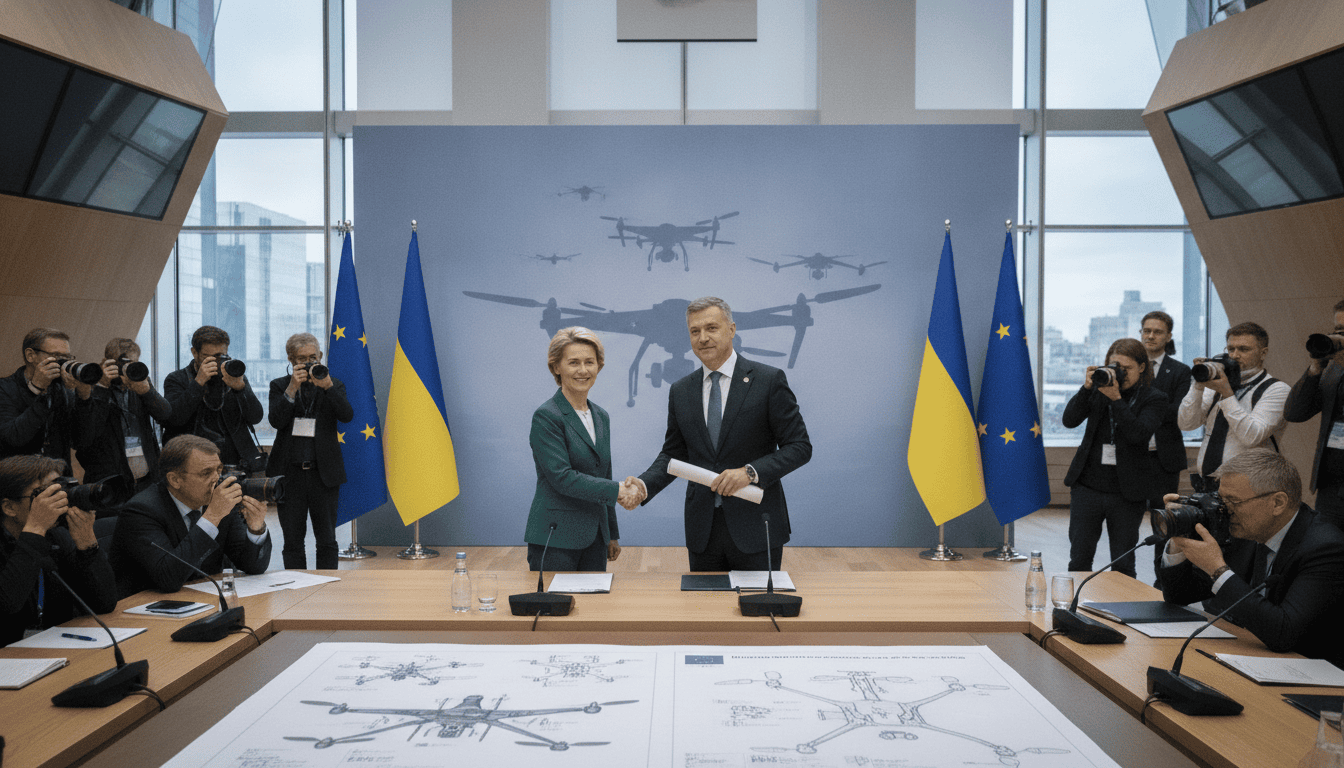
EU-Ukraine drone deal: Brussels and Kyiv to co-produce combat drones
EU-Ukraine drone deal aims to mass-produce combat drones, pairing Ukraine’s battlefield drone expertise with Europe’s industrial capacity and secure factories.
EU and Ukraine announce joint drone-production partnership
The European Union and Ukraine have agreed a partnership to jointly produce combat drones, officials said during EU Commission President Ursula von der Leyen’s visit to Kyiv. The EU-Ukraine drone deal is intended to combine Kyiv’s operational knowledge of unmanned systems with Europe’s technological and manufacturing strengths. Von der Leyen framed the move as a response to recent attacks and a wider need to ensure ready access to proven drone systems for European security.
The announcement came as several Southeast European leaders convened in Kyiv to deepen security and defense cooperation, according to Ukraine’s foreign ministry. Ukrainian officials described the initiative as both a strategic and industrial effort to boost deterrence and sustain Kyiv’s capacity to field and counter unmanned systems.
Von der Leyen highlights battlefield expertise and industrial strengths
Von der Leyen emphasized that Ukraine has accumulated unique, frontline experience in deploying drones and in developing counter-drone tactics and systems. She argued that European industry can provide large-scale, secure production facilities and technological upgrades that would accelerate manufacturing. The president said the aim is to move from ad hoc procurement to reliable, high-volume production to meet operational demands.
European officials noted that the partnership would let the bloc absorb lessons from Ukrainian field testing while safeguarding supply chains within EU territory. They framed the arrangement as a way to translate combat-proven designs into standardized, certified products manufactured under EU quality and oversight regimes.
Production scale-up and protected factories planned
According to EU statements, the deal envisions expanding production capacity in secure sites inside EU member states to reduce vulnerability and ensure continuity. Officials argue that dispersed, protected factories in Europe would lower the risk of disruption and provide export-compliant manufacturing for allied deliveries. Investment incentives and industrial coordination are expected to be used to spur increased output across participating companies.
The plan reportedly includes technology transfer, joint research on endurance and payload, and coordinated testing regimes to speed up mass production. Leaders stressed that accelerating output is crucial given the pace of modern conflicts and the increasing role of unmanned systems on multiple battlefields.
Security, certification and export-control challenges
Implementing a cross-border drone-production program will require resolving complex security, legal and regulatory issues, officials acknowledged. Export controls, end-user certification, and rules on sensitive components such as sensors or specialized munitions must be harmonized to prevent unintended transfers. EU governments will also need to reconcile national procurement rules and industrial-security standards to allow joint production to proceed smoothly.
Analysts warn that scaling production while protecting intellectual property and controlling dual-use technologies is technically demanding. The successful roll-out will depend on clear governance, shared oversight mechanisms, and robust cybersecurity measures for design and manufacturing processes.
Regional summit expands defense and political cooperation
The drone announcement coincided with a summit in Kyiv attended by several heads of state and government from Southeast Europe, reflecting broader efforts to deepen strategic ties. Ukraine’s foreign minister described the meetings as aimed at strengthening political alignment and defense cooperation across the region. Participants discussed logistics, intelligence-sharing, and joint procurement as part of the wider push to boost allied resilience.
Regional leaders also signaled interest in aligning national industries with the new production effort, offering capacity and expertise that could complement EU manufacturing sites. The gatherings underscored how the EU-Ukraine drone deal is being integrated into a larger agenda of security collaboration and defense-industrial consolidation.
Strategic and diplomatic implications for Europe and beyond
The joint production initiative is likely to have both military and diplomatic consequences by reshaping supply chains and establishing new industrial partnerships. Officials say mass-producing battle-tested drones inside the EU could shorten delivery times for partners and reduce dependence on distant suppliers. At the same time, nations opposed to the measure may see the acceleration of unmanned systems production as a provocative step, potentially intensifying regional rhetoric.
European policymakers will have to balance the strategic benefits of a robust production base with the political costs of expanded arms manufacturing. The deal also raises questions about long-term integration of Ukrainian defense firms into European supply networks and how the partnership will be governed on export and operational use.
The coming months are expected to reveal concrete timelines, funding mechanisms and the list of participating industrial actors as Brussels and Kyiv move from announcement to implementation.
