
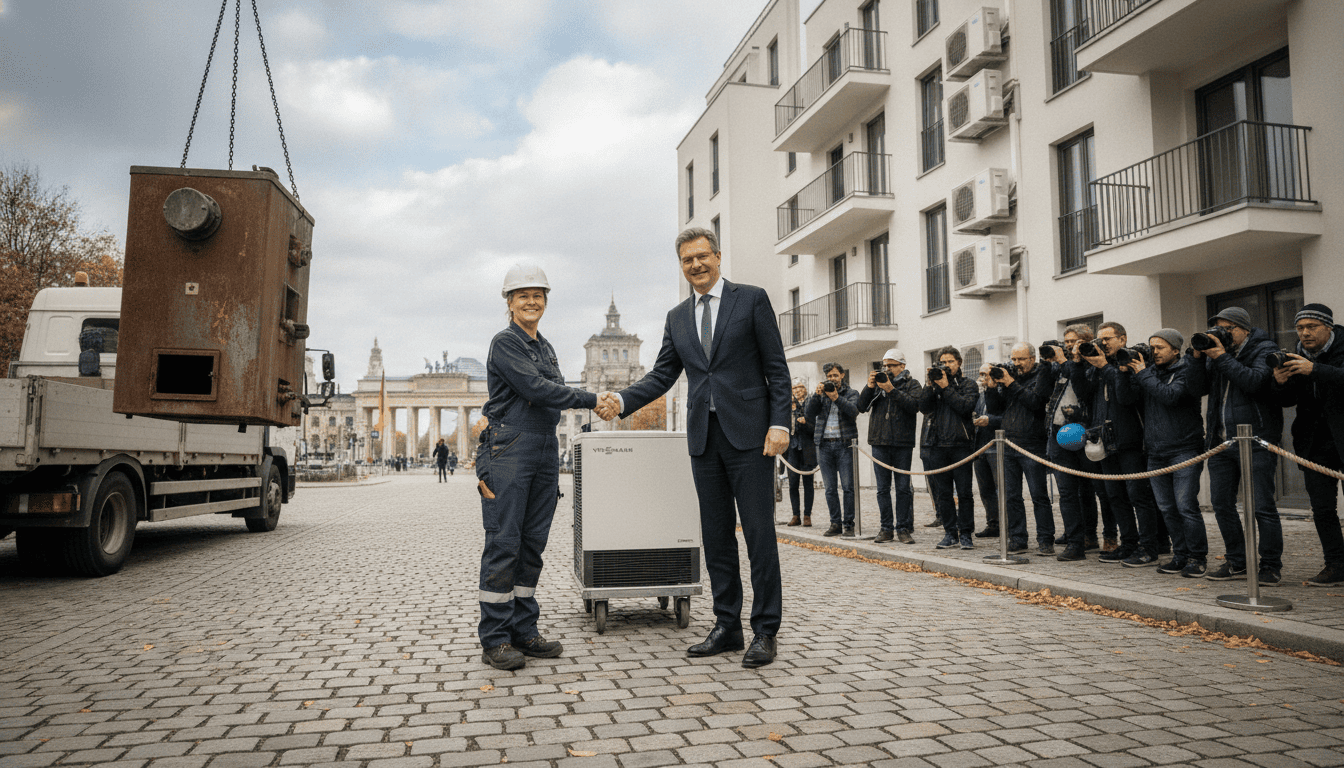
Heat pumps become Germany’s top choice for home heating in 2025
Heat pumps became the most-installed residential heating system in Germany in 2025, driven by lower running costs and strong uptake in new buildings even as subsidies are scaled back.
Strong national shift toward heat pumps
Heat pumps emerged as the leading heating technology in German homes in 2025, according to an analysis by the Institute of the German Economy (IW).
The IW found that 3.4 percent of owner-occupied households replaced their heating system in 2025, with 1.9 percent of households choosing heat pumps — a level similar to 2024.
At the same time, installation rates for conventional boiler systems fell sharply from about 3 percent to 1.4 percent, while new district‑heating connections remained negligible at 0.1 percent.
Data sources and survey framework
The findings are drawn from the Kopernikus project Ariadne, a federal research initiative to which the IW contributed and which surveys roughly 15,000 households each year.
Ariadne’s annual household polling has tracked heating choices since 2021 and was used as the primary basis for the 2025 comparison.
Complementing the survey, Germany’s federal statistics office reported that three out of four newly completed residential buildings in 2025 were primarily heated with heat pumps.
New construction accelerates the transition
The Federal Statistical Office recorded that 73.6 percent of the roughly 58,900 residential buildings finished in 2025 rely mainly on heat pumps for space heating.
That share has more than doubled over the last decade, making new construction a major driver of the technology’s nationwide expansion.
Builders and developers are increasingly specifying heat pump systems at the design stage, reducing retrofit hurdles for homeowners.
Homeowner incentives: lower bills and summer cooling
Experts point to immediate economic benefits and added functionality as key reasons homeowners choose heat pumps.
IW analyst Ralph Henger noted that households with heat pumps currently face lower heating bills, and many modern units also provide summer cooling — eliminating the need for a separate air‑conditioning installation.
These practical advantages, combined with rising familiarity among buyers and installers, underpin expectations that heat pumps will remain the top choice in 2026.
Funding changes may slow some replacements
Policy shifts add complexity for prospective buyers: federal subsidies that once covered large portions of conversion costs are being reduced in the coming years.
Previously, the replacement of fossil systems could be supported with grants covering up to 70 percent of eligible investment costs, with a maximum subsidy of about €21,000.
According to federal planning, these maximum amounts will be wound down stepwise through 2030 as the government seeks to curb spending, a measure that could affect the pace of future swaps.
Market outlook and industry constraints
Despite growing preference for heat pumps, the overall number of new heating systems installed fell in 2025: the annual installation rate for residential heaters dropped from roughly 5 percent to 3.4 percent.
Industry observers warn that weaker subsidy support, constrained installer capacity, and supply‑chain pressures could slow retrofits even as new builds proceed apace.
Nevertheless, manufacturers and many service providers are scaling production and training to meet rising demand, betting that cost savings and regulatory pressures will sustain long‑term growth.
Germany’s shift toward heat pumps represents a significant structural change in the residential heating market and a tangible step in the country’s energy transition.
Households weighing a replacement will need to balance the up‑front investment, evolving subsidy levels, and operational savings over time, while policymakers and the industry consider how to maintain installation capacity and affordability as the market grows.
