
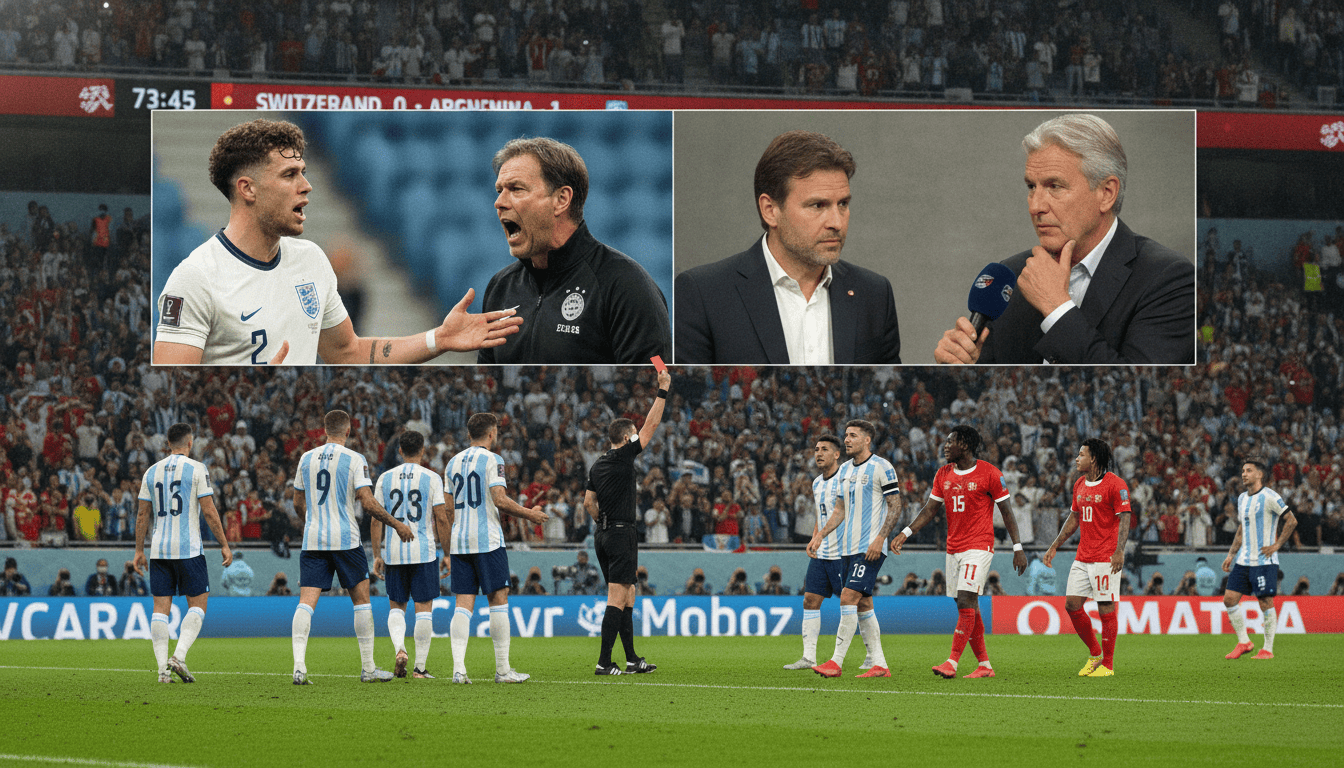
Breel Embolo red card disrupts Switzerland against Argentina as coach criticises referee; Bellingham dismisses Tuchel’s critique
Breel Embolo red card disrupted Switzerland’s match against Argentina, leaving the Swiss side struggling to regain its rhythm and prompting sharp criticism of the officiating from the national coach. The dismissal proved pivotal in a fixture that had been tightly contested until the controversial decision. Elsewhere, England midfielder Jude Bellingham publicly rejected criticism from Thomas Tuchel, adding a separate flashpoint to this day’s World Cup coverage.
Embolo dismissal alters Switzerland’s rhythm against Argentina
The sending-off of Breel Embolo came at a moment when Switzerland had just begun to impose itself and looked capable of challenging Argentina’s control of the game. Play broke up around the decision, and Swiss players appeared unsettled as they adjusted to defending with one fewer outfield player. The momentum swung noticeably in Argentina’s favour after the incident, changing the tactical balance and forcing Switzerland to reconfigure its approach.
Match footage and reaction from both benches underlined how much the red card shaped subsequent phases of play. Swiss attacking patterns contracted and the team sacrificed forward thrusts to shore up midfield and defensive cover. Argentina exploited the numerical advantage with longer possession spells and more sustained pressure in advanced positions.
Swiss coach says referee error left team penalised
The coach of the Swiss national team expressed strong displeasure with the officiating after the match, saying he felt punished by what he described as an incorrect decision. He argued that the dismissal did not reflect the spirit of the incident and that the call had a decisive effect on the game’s outcome. That rebuke crystallised wider frustrations among players and supporters who felt the decision was disproportionate.
Officials and tournament refereeing bodies have protocols for post-match review, and the coach indicated he expected those channels to be used to scrutinise the call. While disciplinary processes can be slow, the coach framed the complaint as part of a broader concern about consistency in crucial moments. Such public recriminations can increase scrutiny on match referees and the procedures that govern late-game interventions.
On-field dynamics and tactical fallout
With one player down, Switzerland shifted to a more compact shape, prioritising defensive solidity over attacking intent. Substitutions were used to shore up the midfield and protect the back line, with the emphasis on denying space rather than progressing the ball through central channels. The tactical reset limited Switzerland’s ability to threaten on the break and reduced the frequency of clear-cut chances.
Argentina, conversely, adjusted to exploit the extra space, often circulating the ball through deeper build-up to draw defenders out of position. The contest became more attritional, and set pieces assumed greater importance for both sides as direct routes to influence the scoreboard. Coaches on both benches made calculated decisions to manage tempo and fatigue in the altered match environment.
Bellingham rejects Thomas Tuchel’s criticism
Separately, England international Jude Bellingham responded to criticism from Thomas Tuchel by refusing to engage with the negative framing. Bellingham said he would focus on his performance and responsibilities rather than enter into a running debate with the coach. The exchange has drawn attention because it involved a high-profile player and one of club football’s most visible managers.
Observers noted that the disagreement highlights tensions between managerial expectations and player autonomy at the highest level. Bellingham’s stance underscores a growing trend of elite players asserting control over their public narratives, particularly when national team duties and club relationships intersect. The episode also raises questions about how internal critique is managed publicly during a major tournament.
Implications for Switzerland’s tournament hopes
The immediate sporting consequence for Switzerland is a more complicated route through the remainder of the competition, with squad management now constrained by suspension considerations and the psychological effect of the red card. The team will need to adapt its planning for upcoming fixtures and consider whether tactical conservatism or renewed attacking intent best serves its progression. The coach faces a short turnaround to restore confidence and refine a strategy that minimises the risk of further losses.
From a disciplinary perspective, the red card invites review by tournament authorities and could influence decisions on appeals or retrospective action. For supporters and the wider football community, the incident has already become a talking point about refereeing standards and the role of match officials in decisive moments. How the governing body responds will be watched closely by national federations and clubs alike.
The sequence of events — a game reshaped by a single dismissal and an unrelated but high-profile disagreement between player and manager — captures the volatility of tournament football and the narrow margins that separate equilibrium from controversy.
