
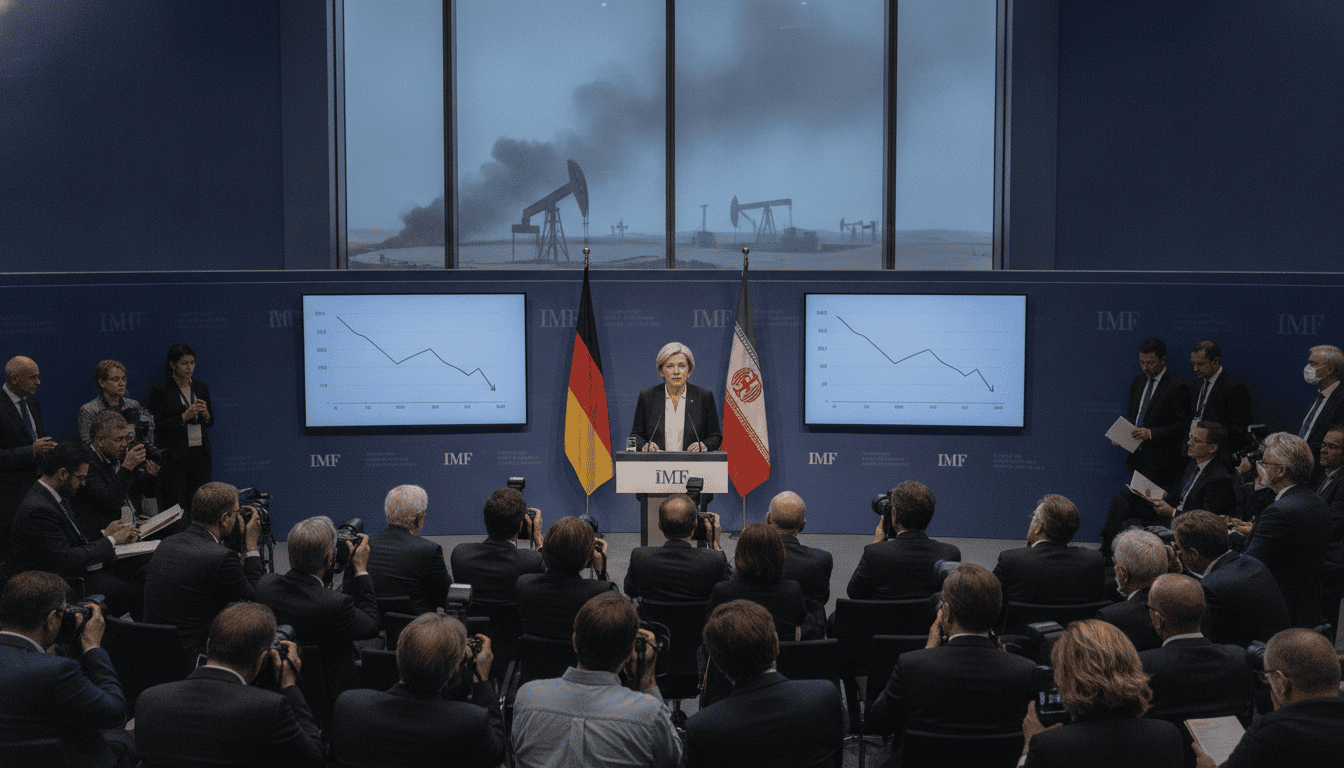
IMF downgrades Germany growth forecast to 0.7% for 2026 amid Iran conflict and energy shock
IMF downgrades Germany growth forecast to 0.7% for 2026, citing the Iran conflict and higher energy costs; 2027 outlook trimmed to 1.0%, raising policy concerns.
The IMF downgrades Germany growth forecast for 2026 to 0.7%, citing spillovers from the Iran conflict and elevated energy prices that have weakened demand and strained business sentiment. The fund said its outlook for 2027 has also been trimmed to 1.0%, leaving Europe’s largest economy on a slower path than previously projected. The revision narrows the margin for policy error in Berlin as inflation and external risks continue to shape the short-term outlook.
IMF cuts 2026 and 2027 projections
The International Monetary Fund reduced its headline projection for German GDP growth in 2026 to 0.7 percent, a 0.1 percentage-point downgrade from the April estimate. For 2027 the IMF now expects growth of 1.0 percent, down 0.2 percentage points from its earlier forecast. The fund highlighted that the adjustments reflect both direct economic channels from the conflict and second-round effects on energy and trade.
The IMF said the downgrade implies a weaker trajectory through the end of 2027 than previously anticipated, with lower headline demand and a slower recovery in investment. Those effects are concentrated in sectors sensitive to energy costs and external demand, the fund indicated. The revision tightens the outlook for labor markets and public finances compared with earlier expectations.
Energy prices and the Iran conflict behind the revision
The IMF linked the downgrade primarily to higher energy prices and heightened geopolitical uncertainty stemming from the conflict involving Iran. Rising energy costs have raised firms’ operating expenses and squeezed household purchasing power, reducing consumption and slowing industrial activity. Volatility in global energy markets has also prompted firms to delay investment decisions pending clearer price signals.
Analysts note that energy-related shocks can transmit quickly through Germany’s export-oriented manufacturing base, amplifying the impact on GDP. The IMF’s assessment underscores how a concentrated external shock can offset gains from domestic demand or fiscal support. The fund warned that further escalation in the region would pose additional downside risks to growth.
How the IMF view compares with German authorities
The IMF’s forecast sits above some domestic estimates for 2026 but signals a modest slowdown relative to earlier international projections. The German federal government and its advisory Council of Economic Experts — the “Wirtschaftsweisen” — have both signaled expectations of around 0.5 percent real growth for 2026. The Bundesbank likewise projects calendar-adjusted growth of approximately 0.5 percent for the year.
By contrast, the IMF’s 0.7 percent projection remains slightly more optimistic for 2026 but represents a clear weakening from spring forecasts. For policymakers, the discrepancy highlights differing assumptions about the persistence of external shocks and the speed of domestic rebound. The range of forecasts points to pronounced uncertainty in near-term planning for businesses and fiscal authorities.
Recent growth context and labor-market implications
Germany returned to positive growth in 2025 with a modest 0.2 percent expansion after two years without growth, but momentum has remained fragile. The IMF’s downgrade suggests that the economy will face a slow and uneven recovery, with potential implications for hiring and wage dynamics. Slower activity could keep unemployment pressures contained but may weigh on income growth and tax receipts.
Companies in energy-intensive industries and exporters are likely to be most exposed if higher energy costs persist, while services and domestic-oriented sectors may provide some offset. The IMF stressed that targeted policies to support vulnerable households and firms, combined with measures to boost productivity, would be important to sustain a durable recovery.
Policy choices and downside risk scenario
The IMF’s revised outlook tightens the policy trade-offs confronting Berlin as it balances fiscal support, structural reform, and price stability. With growth weaker than earlier expected, calls for fiscal buffers and investment in green energy and efficiency measures may gain traction to reduce future energy exposure. At the same time, monetary and fiscal authorities will need to guard against reigniting inflationary pressures if stimulus is too strong.
The fund also flagged significant downside risks, including further geopolitical escalation, prolonged energy market disruption, and a sharper slowdown in global demand. In such scenarios, German growth could undershoot even the newly reduced projections, underscoring the importance of contingency planning and targeted mitigation strategies.
Germany faces a period of subdued growth as external shocks weigh on demand and investment. The IMF downgrades Germany growth forecast to 0.7 percent for 2026 and 1.0 percent for 2027 reflect those pressures and raise questions about policy responses in the months ahead.
