
Cristiano Ronaldo retirement remains uncertain after Portugal’s World Cup exit
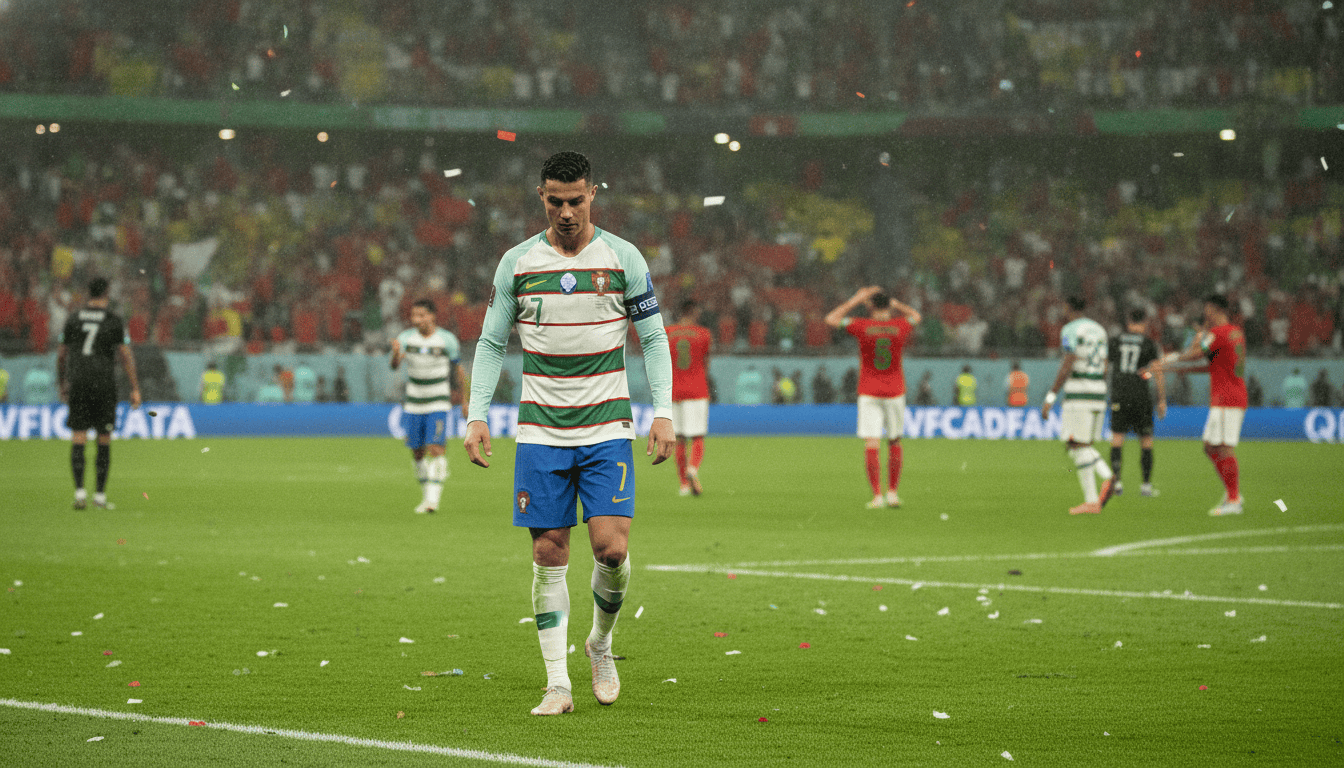
Cristiano Ronaldo retirement remains uncertain after Portugal’s dramatic World Cup exit in Arlington, where a stoppage-time goal ended the campaign and left the captain in tears.
Portugal’s World Cup journey ended in heartbreaking fashion when Mikel Merino scored in stoppage time at AT&T Stadium in Arlington, Texas, and Cristiano Ronaldo left the pitch openly emotional. Ronaldo told reporters on the pitch that it “was my last World Cup, yes,” but quickly qualified the remark and said he would think carefully before deciding his future. The moment has reignited global debate over a potential Cristiano Ronaldo retirement from international football and what it means for Portugal’s next cycle.
Emotional exit and public uncertainty
Ronaldo was visibly moved after the defeat, wiping tears and retreating quickly into the stadium tunnel as cameras followed him, a scene watched worldwide. His brief confirmation that the tournament was likely his last was immediately softened by hedged language, leaving fans and pundits to interpret whether this was farewell or a pause. The image of a legendary player struggling with the end of a tournament has intensified questions about timing and motive behind any imminent decision.
The captain insisted he would not act on impulse and would take time to reflect, a line he repeated to reporters while avoiding a definitive retirement announcement. That stance preserves the option of returning, but it also leaves the national team to confront the prospect of planning without a final, firm signal from its most prominent figure. For Portugal’s management and younger players, the ambiguity complicates short-term selection and long-term strategy.
Age, records and the 2030 World Cup calculus
Part of the public speculation has focused on whether Ronaldo might chase records at the 2030 World Cup, a tournament granted to a multinational consortium including Spain, Portugal and Morocco alongside South American hosts. Statistical tidbits have been widely circulated: Ronaldo would be in his mid-40s in 2030 and could, on paper, surpass Essam El-Hadary’s mark as the oldest World Cup player if he appeared in the final. Those calculations are fueling a narrative that retirement could be delayed by ambition rather than national interest.
Yet the arithmetic does not settle the sporting question. Even if age records remain attainable on the calendar, performance metrics do not lie: Ronaldo’s involvement in the game was limited during the decisive match, and observers noted a drop in his influence on play compared with earlier stages of his career. That contrast between historic résumé and present form is central to the debate about whether Ronaldo should continue to occupy a starting role for Portugal.
On-field impact and career totals under review
Ronaldo’s international ledger — hundreds of caps and well over a hundred goals — anchors his legacy, but the final chapters will be judged by both statistics and contemporaneous influence. In the recent match he registered far fewer touches than teammates and even fewer meaningful contributions in the attacking third. Club obligations, including a contract with Al-Nassr reportedly running until mid-2027, add another layer to his decision calculus.
For selectors and analysts, the core question is whether Ronaldo’s presence elevates the team or limits tactical flexibility. Portugal’s attack roster contains multiple high-potential forwards and creators, and critics argue that reliance on a single global star can mask underlying balance problems. The numbers will be dissected in coming weeks as the federation and coaching staff assess options for transition.
Young talent waiting for a clearer path
Portugal’s squad includes a crop of players entering their prime — Vitinha, Rafael Leão, João Félix, Francisco Conceição and João Neves among them — and many voices inside and outside the camp suggest the national side could benefit from a clearer generational handover. Gonçalo Ramos, a striker widely seen as a long-term focal point, was not given the starting berth in the crucial match, a selection that reignited debate about how best to integrate younger attackers alongside or instead of Ronaldo.
Coaches and teammates have acknowledged that roster choices in high-stakes games are difficult when a global figure remains available for selection. Several younger players will press their cases for a larger role, and the federation faces a balancing act: manage the transition respectfully while ensuring competitive continuity at upcoming qualifiers and tournaments. How quickly that balance shifts will depend in part on whether Ronaldo formalizes any change to his international status.
Managerial consequences and federation reaction
The defeat also marked the end of a managerial cycle. Roberto Martínez, whose short-term contract ended with the team’s elimination, said publicly that continuing without silverware would be hard to justify and called the exit the close of a particular era. Portuguese football authorities offered a terse initial response focused on results rather than singling out the coach, and federation president Pedro Proença signaled disappointment that the output did not match the squad’s perceived quality.
Names have already surfaced as potential successors, with domestic and regional candidates under discussion, and pundits suggest a new coach could accelerate a transition away from dependence on a single star. Spain’s coach, cited for his post-match remarks about collective focus and the need to avoid fixating on a single point of play, encapsulated a tactical philosophy some in Portugal might seek to emulate. The federation will have to weigh patience against momentum as it plans for qualifiers and the next major championships.
Portugal now faces decisions that will define the next chapter of its national team, and the looming question of Cristiano Ronaldo retirement remains a focal point for fans, media and administrators. For now, Ronaldo’s promise to deliberate and avoid an impulsive choice preserves the suspense, leaving both his personal legacy and Portugal’s tactical future in a state of transition.
