
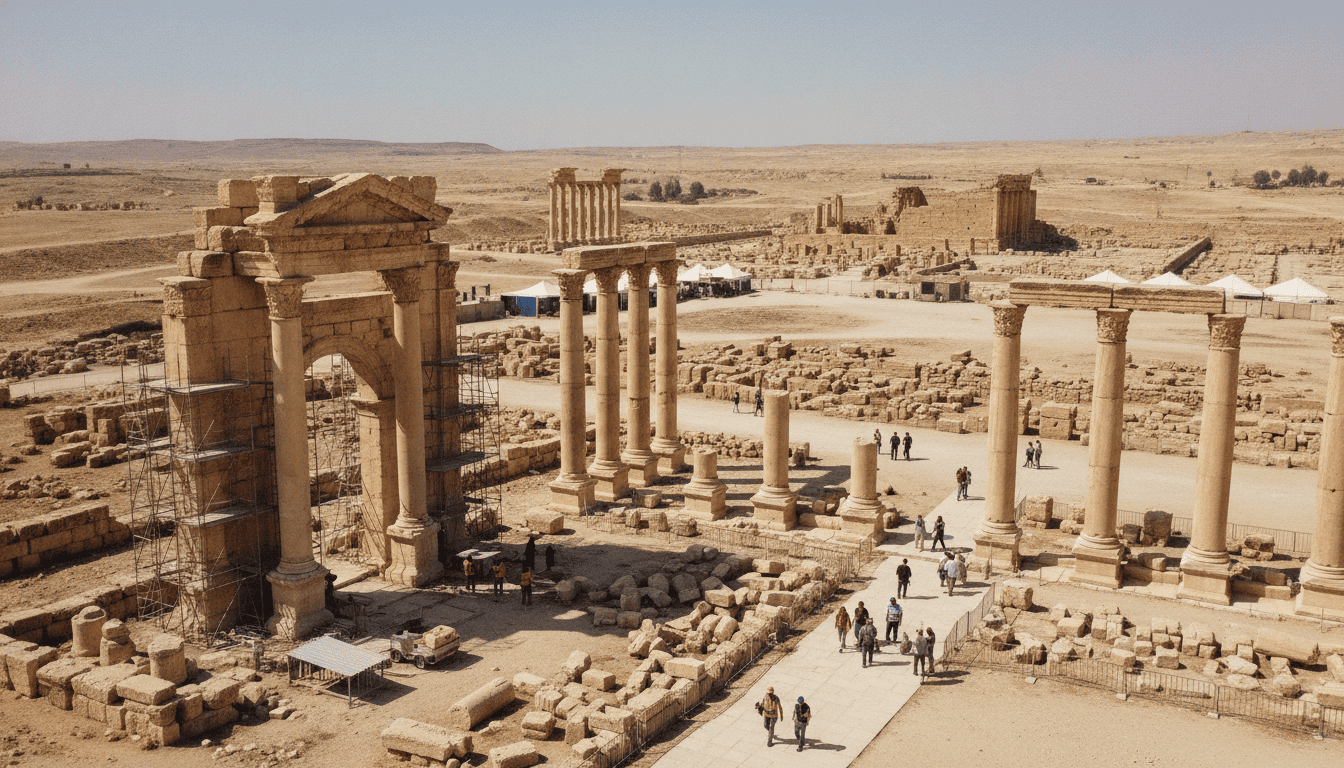
Palmyra’s Fragile Recovery: Ruins, Tourism and the Long Road to Clearing Mines
Palmyra struggles to rebuild after Islamic State attacks and years of conflict, with residents and heritage experts urging tourists and funding to return to restore livelihoods. Palmyra remains a magnet for visitors despite extensive damage to its Roman monuments and the continuing danger of landmines and unexploded ordnance. Local initiatives and limited reopenings offer hope, but officials and aid groups warn that recovery will be slow without sustained international support.
IS Occupation and Cultural Destruction
Palmyra’s archaeological ensemble suffered deliberate, high-profile attacks when the Islamic State seized the city in 2015. Militants staged executions in the Roman amphitheatre and then turned their attention to monuments that symbolised the town’s pre-Islamic history.
Key structures were reduced to rubble or scarred by explosives, with the Arch of Triumph split and the Temple of Bel left severely damaged. Beyond spectacular demolition, organised looting fed illicit antiquities markets that stripped the site of portable heritage and financing for militant networks.
Modern City Devastation and Returnees
The contemporary town that grew beside the ruins was also heavily affected by shifting frontlines and military operations. Homes were looted, buildings shelled, and returning families frequently found properties booby trapped or used as munitions depots.
Residents describe arriving back to find everything taken, from household fittings to structural copper, and in many cases explosive devices hidden inside houses. Those traces of war complicate basic recovery and lengthen the process for households trying to re-establish normal life.
Reconstruction Roadmap and Practical Gaps
UNESCO and partner organisations have set out frameworks for conservation work, visitor infrastructure and livelihood support, but implementation has lagged behind planning. Emergency safeguarding measures have taken place, yet locals and municipal officials say visible, on-the-ground assistance remains limited.
For many stakeholders the immediate priority is not marble columns but functioning roads, hotels and services that allow people to stay and work. Small private investments and community projects have reopened a handful of guesthouses, illustrating what local initiative can achieve when bureaucratic hurdles are eased.
Tourism, Local Livelihoods and the Ethics Debate
Before the conflict tourism underpinned roughly half of Palmyra’s economy and supported thousands of jobs, from guides to hoteliers. Restoring visitor flows is therefore seen by many as an essential step to revive the city’s commerce and household incomes.
The return of visitors raises ethical questions abroad about dark tourism versus economic necessity on the ground. Local guides and entrepreneurs argue that any form of interest can be channelled into respectful encounters that benefit communities and broaden foreign perceptions beyond images of violence.
Landmine Contamination and Clearance Challenges
Clearing explosive hazards is a prerequisite for large scale restoration or safe agricultural use around Palmyra. Multiple armed actors and changing battle lines have left overlapping contamination of landmines, improvised explosive devices and abandoned munitions, increasing both technical complexity and cost.
Mine action organisations working in the region describe painstaking surveys and clearance operations that must adapt to different types of threats. Officials report hundreds of casualties around Palmyra linked to explosives and warn that the desert and farmland remain particularly hazardous for Bedouin communities and livestock.
Local Initiatives and Early Signs of Recovery
Despite the obstacles some businesses and community projects have begun to reopen, signalling cautious optimism. A small lodge welcomed guests recently and a women’s cooperative has trained local artisans to produce traditional crafts for sale to visitors at a tented market near the ruins.
Independent travel creators and returning Syrians have also played a role in promotion where formal campaigns are scarce. Those efforts, coupled with simpler government processes for business reopening, are cited by owners as crucial steps toward rebuilding a tourism economy.
Palmyra’s ancient stones continue to draw people, and the modern town remains a place where families gather despite the scars of war. The future of Palmyra rests on a mix of demining, tangible investment in infrastructure, and the steady return of visitors who can convert cultural heritage into sustainable income for residents.
