
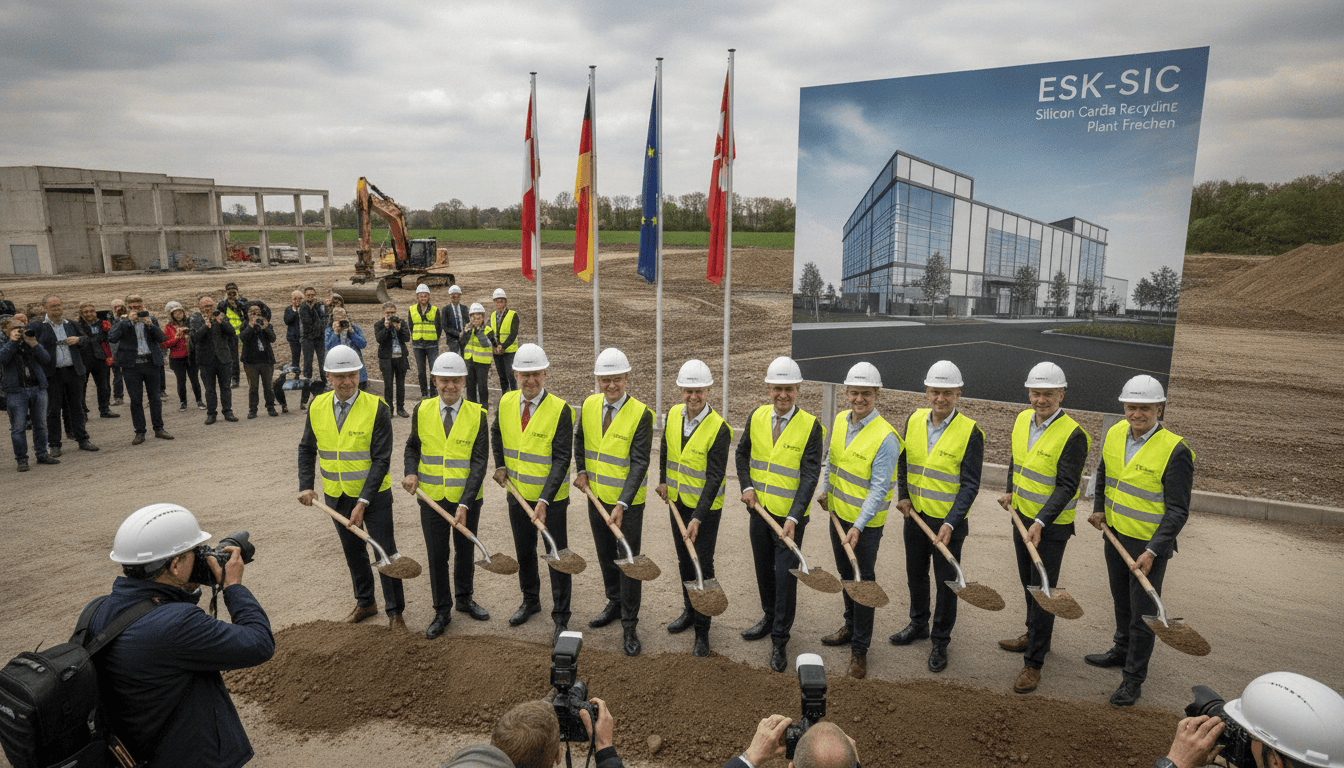
ESK-SIC breaks ground on Europe’s first silicon carbide recycling plant in Frechen
ESK-SIC has begun construction on Europe’s first silicon carbide recycling plant in Frechen, aiming to cut CO2 emissions by 80% and start production in January 2028.
ESK-SIC on Wednesday formally broke ground in Frechen near Cologne for what it calls the world’s first industrial plant dedicated to silicon carbide recycling, a step company leaders say will reshape supply chains for a material critical to electric vehicles and power electronics. The parent company Schunk described the project as its largest investment in over a century, with more than €100 million committed and roughly €30 million of support from the EU and North Rhine-Westphalia. Company executives and regional officials framed the factory as both a sustainability initiative and a move to reduce Europe’s strategic dependence on imports.
Ceremony signals industrial and political backing
A large tent, speeches and applause marked the symbolic start of construction, attended by Schunk executives and state officials who emphasized the project’s economic and geopolitical significance. North Rhine-Westphalia’s minister-president highlighted the plant’s “international reach,” while ESK-SIC’s management characterized the investment as the culmination of more than a decade of development work. The company plans to bring the new facility online in January 2028, with production aimed at serving high-value industrial customers.
New process replaces a 130‑year‑old method
The plant’s core innovation is a process that recycles silicon carbide from industrial waste streams rather than relying solely on fresh production from the traditional Acheson furnace, a roughly 130‑year‑old, energy‑intensive method. ESK-SIC said the feedstock will include unfinished SiC from Acheson production as well as machining dust and other ceramic byproducts. The approach is designed to recover near‑net yields of high‑purity powder suitable for demanding applications in power electronics and specialty ceramics.
Patented technology and emissions reductions
ESK-SIC and its partners have patented the recycling route and claim it can reduce CO2 emissions by about 80% compared with the Acheson process. The company also projects a dramatic drop in energy use, from roughly 7.2 megawatt‑hours per tonne to about 2.0 megawatt‑hours per tonne of silicon carbide. Executives emphasized that the combination of a high recovery rate and lower energy intensity is central to making silicon carbide recycling economically viable at scale.
Market focus on electric vehicles and semiconductors
Company leaders and external experts noted that the most immediate demand for recycled SiC will come from the electrification and semiconductor sectors, where the material is prized for its performance in power devices. Silicon carbide’s adoption in electric vehicle powertrains and in high‑efficiency power electronics has accelerated in recent years, creating a market for high‑purity powders. ESK-SIC intends to target these high‑performance segments first while continuing to supply conventional SiC for refractory and industrial uses through existing channels.
Planned capacity and European supply ambitions
The Frechen facility is set to begin with an annual output of 5,000–6,000 tonnes of SiC powder and is engineered for an eventual expansion to 18,000 tonnes per year. Management described that expansion threshold as a scale at which the company could address a substantial portion of Europe’s demand for advanced, high‑tech SiC materials. While ESK-SIC acknowledges that continental demand runs well into the hundreds of thousands of tonnes annually, executives see the plant as a first step toward building regional resilience and a circular supply chain.
Economic pressures and competition from China
ESK-SIC’s leadership admitted the company has faced recent financial strain, reporting significant losses in 2024 as high energy costs and subsidized Chinese competition squeezed margins. The new recycling route is positioned as a strategic response to these pressures by lowering operational energy needs and reducing dependence on imported feedstock. Company officials caution, however, that recycled material may initially sell at a premium to recover capital expenses, with unit costs expected to fall as the plant achieves scale.
Workforce plans and timeline to production
The project will expand a workforce that today numbers about 160 employees, with roughly 50 additional hires planned by the time the recycling line reaches operation in January 2028. The company described the investment as both a technological bet and an employment boost for the region, with the firm continuing to source certain inputs from its existing supply chain while gradually substituting recycled feedstock. ESK-SIC said the original idea for the recycling approach emerged in January 2016 during discussions with Fraunhofer researchers, and that years of development led to the breakthrough now entering industrial deployment.
The Frechen plant represents a bet on turning industrial waste into strategic material and on making Europe less dependent on external sources of silicon carbide, especially for the fast‑growing electric mobility and semiconductor markets. If successful, the project would not only cut emissions from SiC production but also create a template for circular supply chains in other high‑tech materials.
