
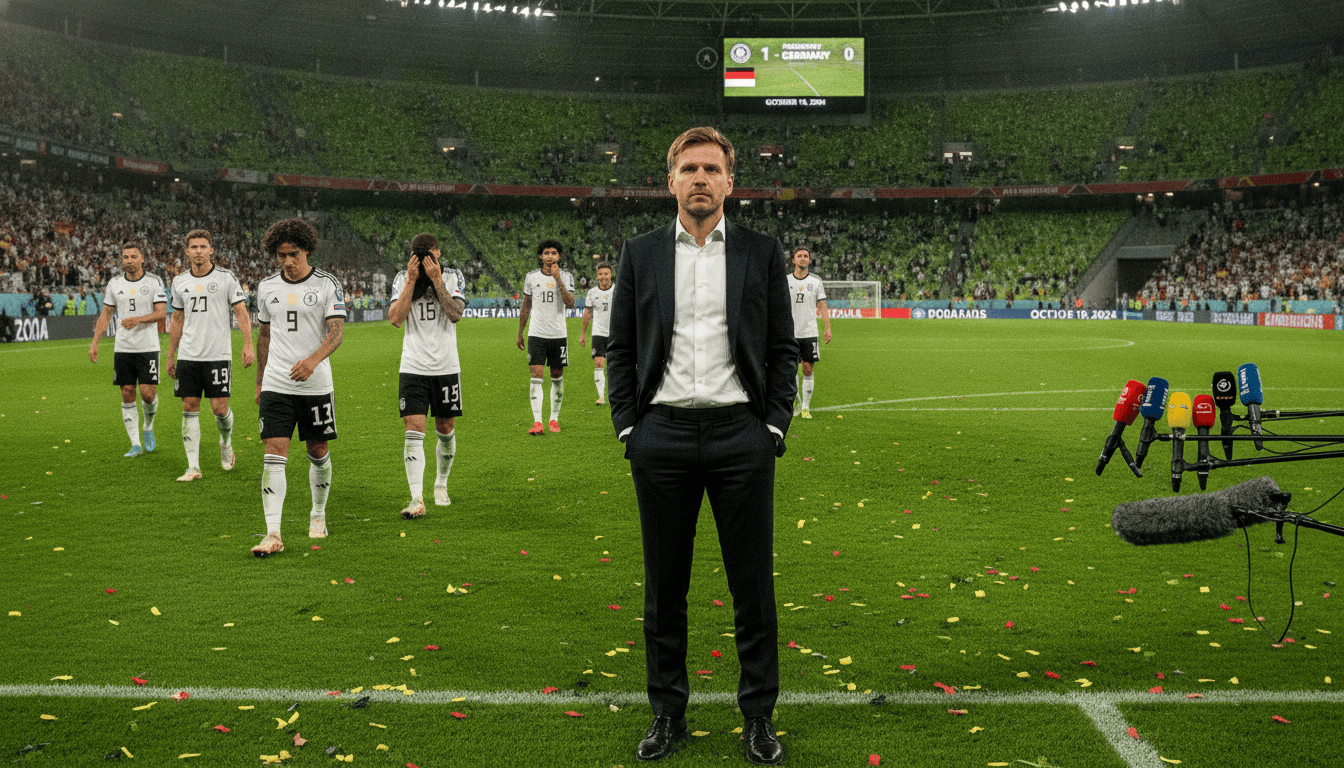
Germany World Cup exit to Paraguay sparks coach debate and deeper questions about German football
Germany World Cup exit to Paraguay has triggered a heated debate over Julian Nagelsmann’s future and shone a spotlight on long-term gaps in player development and creativity.
The Germany World Cup exit to Paraguay has reopened a national conversation about leadership, talent and strategy after a surprising early defeat in Boston. Jürgen Klopp’s offhand use of the word “noch” — still — in a television remark amplified public doubt and set the tone for a debate that moved faster than any official statement. Julian Nagelsmann said he would remain in the role if the German Football Association (DFB) wanted him to, but the result left supporters and pundits asking whether the issue lies with coaching or with the players themselves.
Klopp’s “noch” became a focal point
A brief on-air comment from Jürgen Klopp — calling Nagelsmann the manager “for now” — provoked instant scrutiny and apology that followed soon after. That single word crystallized uncertainty and fed a media cycle keen to assign blame after an unexpected exit. The reaction illustrated how quickly narratives form in modern football, where remarks by prominent figures are parsed as verdicts on broader structures.
Nagelsmann’s position and the DFB’s dilemma
Julian Nagelsmann publicly indicated he wanted to continue as head coach if the federation agreed, framing his commitment as conditional rather than indefinite. The DFB now faces a politically charged choice between changing the coach to appease discontent or backing a longer-term reconstruction plan. A decision to replace Nagelsmann would be the quicker, more visible response, but it would not automatically address the deeper questions raised by the loss.
Defeat exposed lack of match-winning individuals
The match against Paraguay highlighted a shortage of difference-makers who can unbalance high-stakes games on their own. Germany fielded a versatile midfield contingent capable of shifting positions, yet none of those players produced the decisive individual moments that turn tight matches. Observers noted that other leading nations possess attacking figures whose presence alone alters opponents’ approaches; Germany’s current crop looks more uniformly competent than game-changing.
How other nations supply star power
France, Spain, England and even Norway have increasingly produced players who exert an outsized influence on results, a trend visible at this World Cup. Nations with smaller populations, like Norway, now consistently manufacture top-tier talents, underscoring structural improvements in scouting and development. Germany’s relative decline in producing such players has left it competing on balance rather than on the distinct edge that defines modern championship sides.
Youth training, creativity and the long game
Voices inside and outside the sport are urging a return to looser, creativity-friendly youth coaching that allows young players to experiment before being systematized. The call is to prioritize technical freedom, inventiveness and risk-taking at early ages rather than rigid tactical instruction from preadolescence. Reforming academies, coaching education and talent identification will take years and requires coordinated commitment from clubs, federations and youth coaches.
Why a coach change is politically easier than reform
Replacing a manager remains the most immediate remedy available to federations under public pressure, because it signals action without the slow timelines reform demands. That expedient route can provide temporary relief but risks repeating a cycle of cosmetic fixes that fail to produce sustainable improvement. True recovery, critics argue, means confronting development pathways, talent pipelines and cultural assumptions about how German football should be taught.
The aftermath of the Germany World Cup exit to Paraguay is less a simple verdict on one man than a mirror held up to an entire system. The debate over Julian Nagelsmann’s job is real and immediate, yet the more consequential conversation should center on producing players who unsettle opponents and restoring a culture that prizes creative risk as much as tactical discipline. The word “noch” captured national unease — Germany is still at a crossroads, and the choices made now will determine whether that “still” becomes a bridge to renewal or a preface to further disappointment.
