
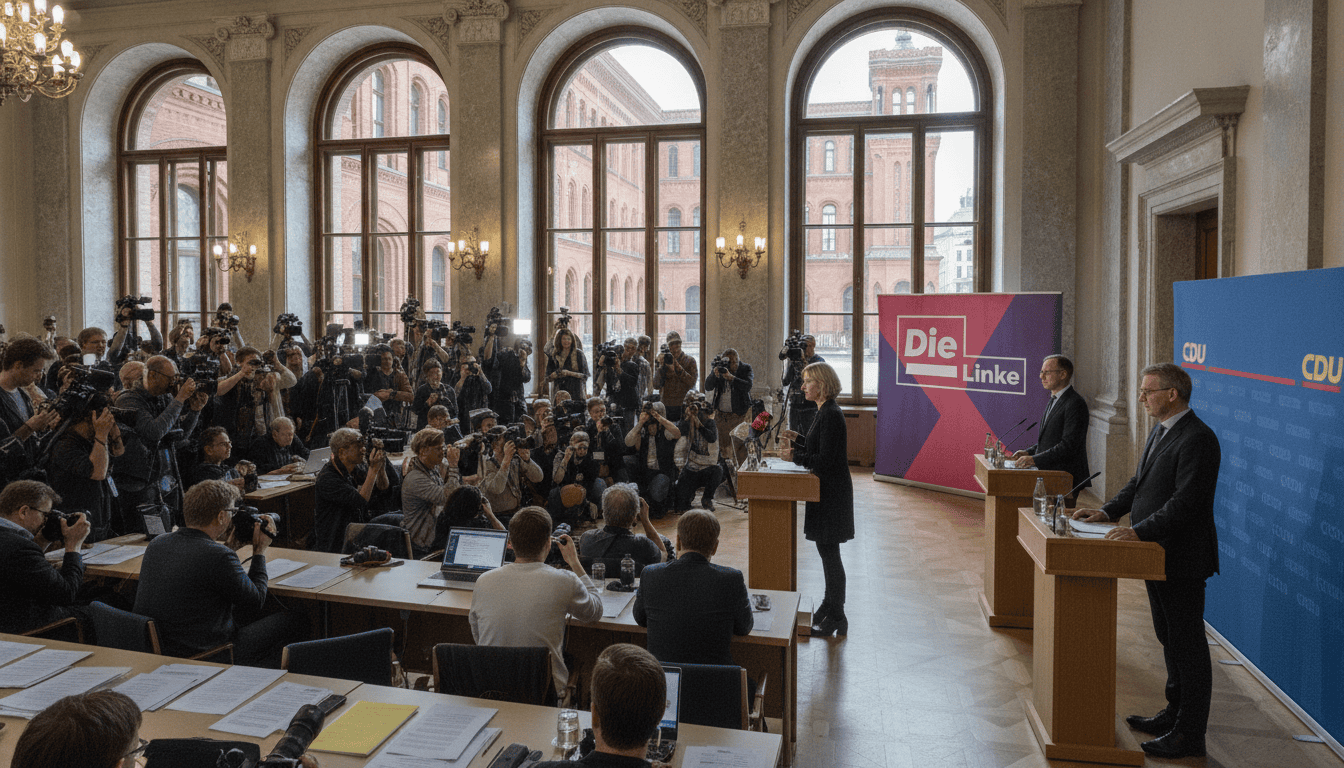
Abgeordnetenhauswahl in Berlin: Left surges to 20% as CDU falls to fourth in new Infratest Dimap poll
Poll shows Die Linke leads at 20% ahead of the Abgeordnetenhauswahl in Berlin on 20 September 2026; Greens 19%, AfD 18%, CDU 17%.
The latest Berlin-Trend poll by Infratest Dimap for the RBB24 Abendschau and RBB 88,8 shows Die Linke in the lead with 20 percent in the run-up to the Abgeordnetenhauswahl in Berlin, a two-point gain since April. The result places the Left ahead of the Greens, who register 19 percent, and the AfD at 18 percent, while the CDU, which currently supplies the governing mayor, slips to fourth with 17 percent. The survey portrays a tightly contested race across the center-left and right and signals shifting voter preferences as parties prepare for the election on 20 September 2026.
Linke rises to prominence under Elif Eralp
Die Linke’s rise in the poll reflects growing momentum behind its Spitzenkandidatin Elif Eralp, according to party sources and campaign activity in recent weeks. The two-point increase compared with April suggests the party has managed to consolidate left-leaning voters and attract those disillusioned with traditional centre parties. Analysts note that the boost gives Die Linke new leverage in post-election coalition negotiations and changes the tactical landscape for parties that previously expected to lead or influence a governing coalition.
Greens and AfD locked in narrow contest
The Greens register 19 percent in the same survey, placing them narrowly behind Die Linke and just ahead of the AfD’s 18 percent, creating a three-way cluster at the top of the table. That proximity indicates a highly volatile electorate where small shifts in turnout or messaging could move parties several places on election night. Both the Greens and the AfD will likely intensify outreach in marginal districts and among undecided voters to convert this near parity into decisive gains.
CDU drop complicates governing plans
The CDU’s fall to 17 percent, its lowest placement in this poll, complicates prospects for the party that currently supplies Berlin’s governing mayor. The slide to fourth place raises questions about the CDU’s ability to defend incumbency and to assemble a viable coalition without significant concessions to partners. Party strategists are now confronting the possibility that the CDU may have to accept junior partner status or seek unconventional alliances to remain influential in city governance.
SPD stagnation and small parties left at the margins
The SPD records 13 percent in the Sonntagsfrage, a result that leaves the former dominant centre-left party struggling to reclaim lost ground in Berlin’s polarized landscape. Smaller parties face even steeper challenges: the FDP and the Bündnis Sahra Wagenknecht (BSW) both register 3 percent, well below the five-percent threshold required to enter the Abgeordnetenhaus. If those numbers hold on election day, the exclusion of smaller factions would compress seats among the larger parties and intensify bargaining over coalition arithmetic.
Coalition arithmetic becomes more complex
With Die Linke, Greens and AfD separated by single-digit margins and the CDU weakened, the possible coalition permutations have multiplied and become more uncertain. Conventional combinations such as a centre-left alliance of SPD and Greens may no longer be sufficient without either the Left or additional partners, while a CDU-led government would need unlikely partners or a broad multi-party pact. Political commentators say the most probable outcome is a negotiation-heavy period after the votes are counted, with parties positioning themselves early to claim credibility for compromise deals.
Poll context and limitations
The figures come from the Berlin-Trend survey conducted by Infratest Dimap on behalf of RBB24 Abendschau and RBB 88,8 and are presented as a Sonntagfrage snapshot of current voting intentions. As with all opinion polls, these numbers reflect a moment in time and can shift as campaigns intensify, new events emerge, or turnout patterns change ahead of the 20 September 2026 election. The survey’s headline changes—the Left’s two-point rise since April and the CDU’s drop—offer indication of trends but do not guarantee final election outcomes.
The coming months will see intensified campaigning, targeted messaging from the major parties, and likely an increased focus on precincts where small swings could determine seat distribution. Polls will continue to be updated and scrutinized as Berlin’s parties seek to translate present support into a governing majority.
