
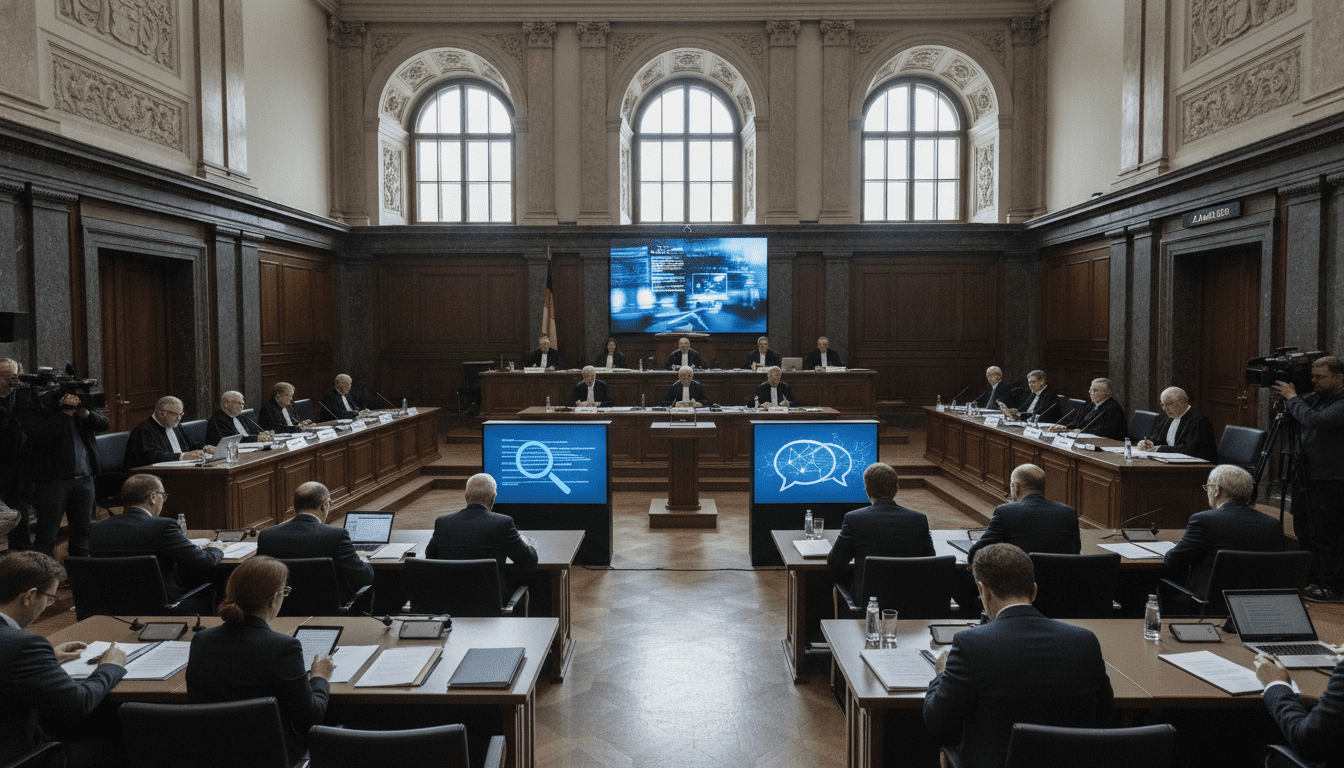
German Courts Tighten Liability for AI-Generated Content After Munich Ruling
German courts rule that operators of AI summaries and chatbots can face liability for false or misleading AI outputs, reshaping liability for AI-generated content across industries.
Munich court closes ‘safe harbor’ for AI summaries
The Landgericht München I held on May 28, 2026 that search-engine “overview” texts produced by AI do not enjoy the traditional safe-harbor protection afforded to mere link aggregators.
A routine search suggestion led to a compact AI-generated summary implying a company engaged in fraudulent practices; the court found those statements were not simple quotations or links but independent assertions.
Because the AI output presented itself as researched and internally consistent without qualifying the reliability of its sources, the court placed responsibility for accuracy squarely on the service presenting the content.
Berlin trademark ruling highlights legal distinctions
Days later, the Landgericht Berlin on June 1, 2026 reached a contrary outcome in a trademark case involving AI-generated product comparisons.
There, a court concluded that the search operator did not adopt the AI text as its own commercial act and therefore was not liable under trademark law for names listed in an AI overview.
Legal practitioners say the pair of decisions illustrates that outcomes turn on the governing legal regime—personality and false-statement claims may trigger liability where intellectual-property claims do not.
Higher courts and foreign tribunals reject a ‘black box’ defense
Regional appellate decisions and international precedents reinforce operator responsibility for AI outputs.
The Oberlandesgericht Hamm found on May 12, 2026 that a clinic had to answer for a website chatbot that falsely claimed staff held specialist medical degrees, rejecting the argument that the system’s internal workings absolved the operator.
Similar logic appeared in Canada’s British Columbia tribunal in February 2024, which ruled that an airline could be held accountable for misinformation issued by a chatbot integrated into its website.
Copyright rulings constrain training on protected works
German courts have also sharpened their scrutiny of how models are trained on copyrighted material.
An earlier ruling from the Landgericht München I in November 2025 held that training an AI model on protected works can amount to a copyright violation under certain conditions, a decision that reverberated through the industry.
The Oberlandesgericht Düsseldorf in April 2026 clarified that use of a protected image as a model template does not automatically violate copyright, but infringement arises when recognizable creative elements of the original reappear in the output.
Courts set limits on authorship and ownership of AI output
Judges are defining when human creators can claim authorship of machine-produced works.
An Amtsgericht München decision in February 2026 rejected claims that extensive prompting alone made a user the author of logos generated by AI, stressing that human creative dominance must be demonstrable.
The Düsseldorf appellate court has reiterated that documentation of decision-making and demonstrable creative input are decisive factors when assessing whether an AI-assisted result attains legal protection.
Business obligations and risk mitigation steps
Taken together, the rulings require companies to treat AI outputs as their own communications and design compliance accordingly.
Operators using chatbots, automated search features, or AI-generated product descriptions should implement editorial and legal review processes to screen outputs for defamatory or misleading statements.
Firms that plan to commercialize AI-created material should document human design choices and prompt history thoroughly, because registration or protection claims hinge on proof of creative contribution.
Companies must also audit training-data sources and secure contractual guarantees that datasets do not include unlicensed copyrighted material.
Legal teams should evaluate risks by subject area, since the same AI function may be harmless under trademark law yet expose the operator under personality or competition law.
Finally, continuous monitoring of what AI systems publish about a company, its employees and its products is essential; swift corrective measures can limit exposure and preserve reputation.
The recent string of decisions makes clear that European courts are unwilling to treat AI as an independent legal actor exempt from responsibility, and operators who present or rely on machine-generated content will increasingly be expected to assume the legal consequences of that content.
