
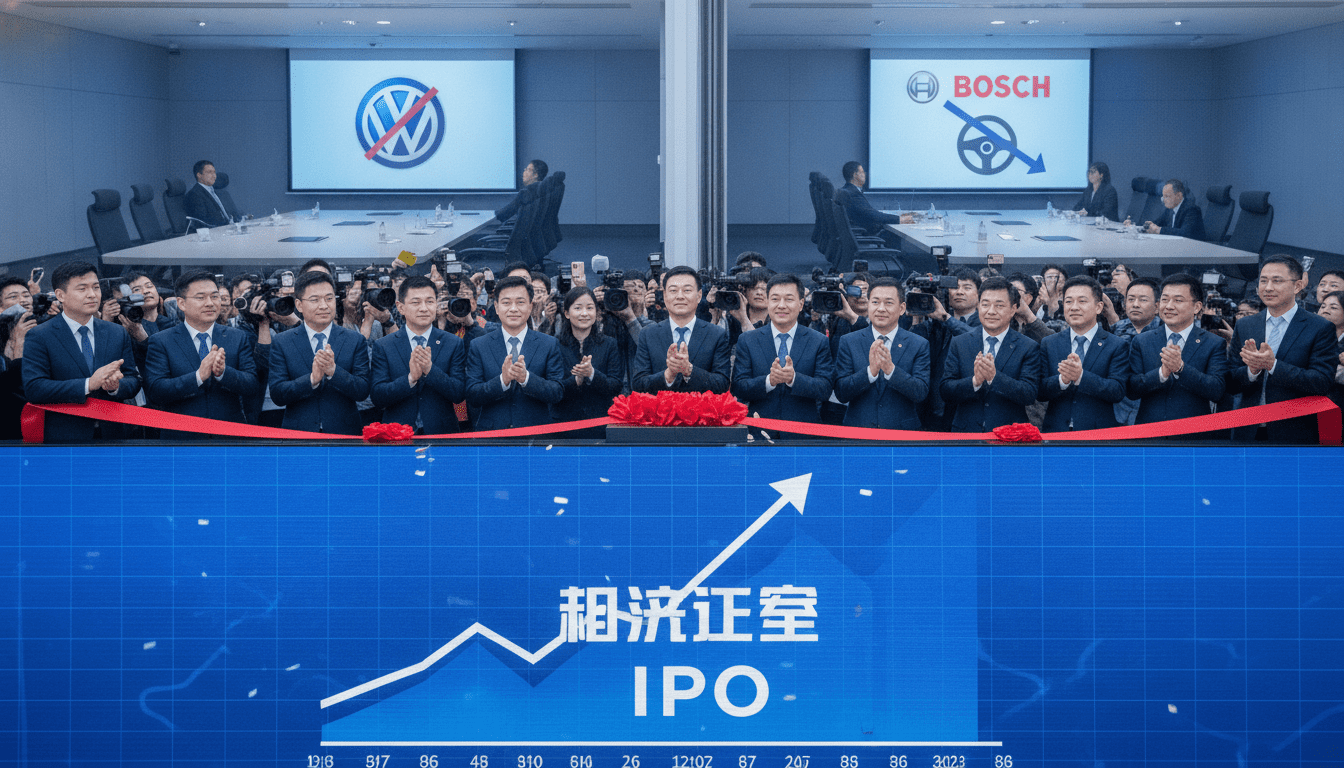
Autonomous driving setback: VW and Bosch abandon joint development as China accelerates
VW and Bosch end their autonomous driving partnership as China surges; Momenta’s Hong Kong IPO and rapid AD adoption reveal strategic strains in German car sector.
The autonomous driving landscape has taken a sharp turn this week as Volkswagen and Bosch announced the end of their joint development effort, while Chinese firms press ahead with rapid deployment and investment in the technology. The collapse of the VW–Bosch alliance exposes widening strategic gaps in Germany’s automotive sector even as Chinese start-ups like Momenta prepare a major public offering. The split highlights competing approaches to autonomous driving and raises fresh questions about who will control the software stack for future vehicles.
VW and Bosch dissolve Level‑3 development pact
Volkswagen and Bosch said their collaboration to develop Level‑3 autonomous driving functions will not continue in its existing form, marking a high‑profile retreat by two established players. The partners had invested heavily in the joint program but concluded that market and technological developments had diverged from initial expectations. VW indicated it will now source and refine key hardware and software externally rather than build the systems in-house with Bosch.
Cariad’s role and internal upheaval at VW
The shift has immediate implications for Cariad, VW’s software division originally created to centralize vehicle software development under former management. Cariad’s future now appears uncertain amid a broader company cost‑cutting and restructuring campaign, which includes factory consolidations and significant job reductions. Management documents under review reportedly consider sweeping changes to VW’s software strategy and the possible downsizing of in‑house autonomy efforts.
German industry under pressure from corporate moves
The announcement comes against a backdrop of deep stress across Germany’s auto sector, with major manufacturers reducing costs and signaling heavy restructuring. Recent company decisions, such as large planned job cuts and executive departures at legacy suppliers, underscore rising competitive pressure from overseas manufacturers. Executives and worker representatives are bracing for further strategic debates about where core vehicle technologies should be developed.
China’s rapid adoption reshapes market dynamics
China has emerged as the dominant market for advanced driver assistance and early autonomous systems, according to industry studies cited by market participants, accounting for the majority of units sold last year. Chinese automakers and suppliers are rapidly integrating AD features into mass‑market vehicles, including low‑priced models, accelerating consumer familiarity and scale economics. That fast adoption curve is shifting the center of gravity for autonomous driving development toward Chinese firms and domestic supply chains.
Momenta’s IPO and Silicon Valley‑style ambitions
Momenta, a Shanghai‑area start‑up, has filed for a Hong Kong initial public offering that aims to raise substantial funds for continued R&D and global expansion. The company reported sharp revenue growth alongside sizable operating losses as it builds a platform for perception, localization and decision‑making software for vehicles. Investors and industry observers see Momenta’s equity bet as emblematic of a broader Chinese push to capture not just vehicle production but the software and data layers that underpin autonomous driving.
Technology disagreements and strategic tradeoffs
Industry insiders say the VW–Bosch split reflects deeper disagreements over technical approach and product economics, particularly the balance between hand‑coded rules, high‑definition mapping and machine‑learning methods. The debate also touches on cost and scalability: technologies that rely heavily on expensive sensors or bespoke high‑precision maps struggle to reach mass‑market price points. Meanwhile, some global chip and software suppliers present alternative routes to outsourcing key components and accelerating deployment.
The unraveling of the German joint project and the parallel surge in Chinese investment amount to more than a single corporate setback; they illustrate a realignment in who defines the roadmap for autonomous driving. For German manufacturers it is a moment of strategic reckoning: retain costly and slow in‑house programs or partner and buy into a rapidly evolving global supply chain dominated increasingly by Chinese platforms and specialized suppliers. The coming months will test whether Germany’s incumbents can forge a coherent response that preserves industrial capability while keeping pace with an accelerating international market.
