
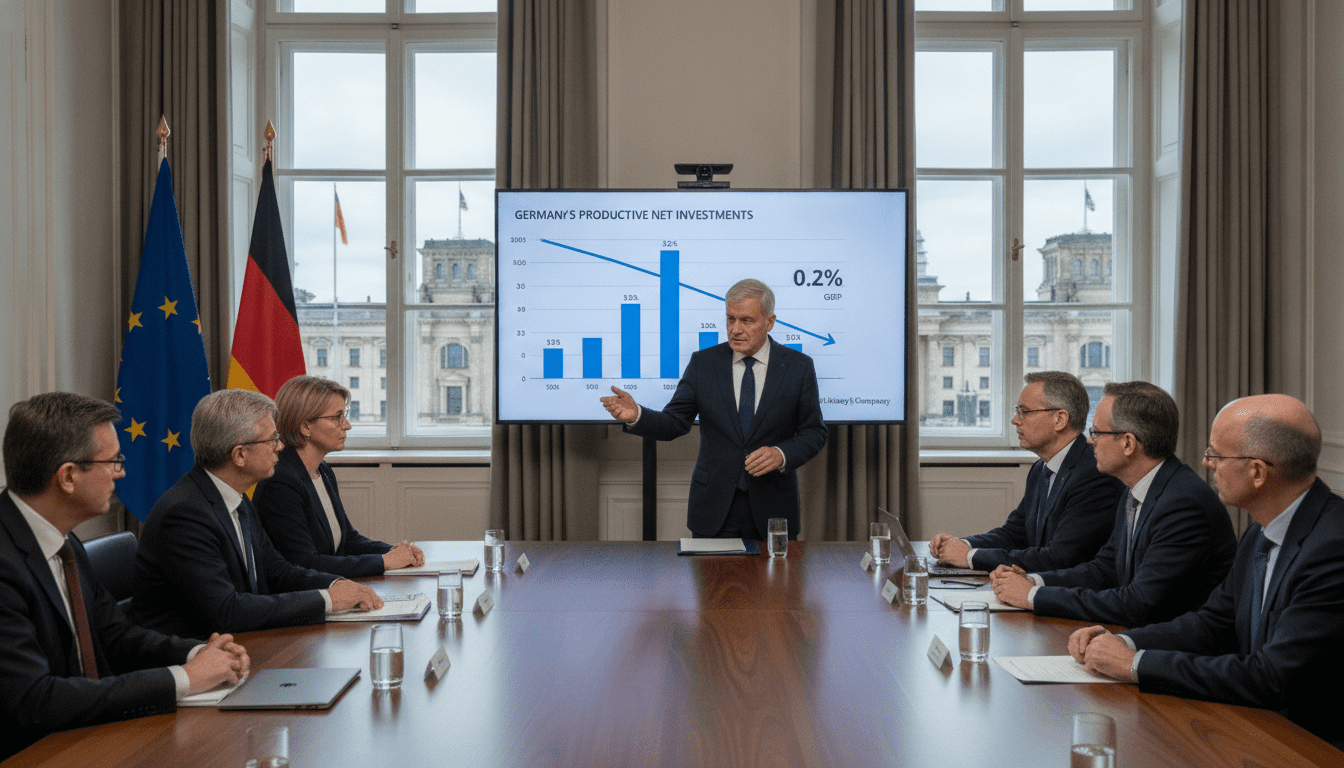
Germany’s productive net investments slump to 0.2% of GDP, McKinsey warns
Germany’s productive net investments fell to just 0.2% of GDP in 2024, putting the country at the bottom of 34 peers and raising alarms about future growth and competitiveness.
Germany’s productive net investments — the portion of spending that expands capacity rather than simply replacing worn-out capital — have collapsed to roughly 0.2% of GDP, according to a new 65‑page McKinsey Global Institute study. The consultancy’s analysis ranks Germany near the bottom of 34 leading industrial and emerging economies and finds that, since the 2008 financial crisis, productive net investment in Germany has declined from about 2% of output to almost zero. The report highlights an economy increasingly focused on maintaining existing capacity rather than building new productive assets, a shift that McKinsey’s authors say threatens future output and living standards.
McKinsey’s measurement and why it matters
Productive net investments measure the share of investment that adds new productive capacity beyond mere replacement of existing machines, buildings or digital infrastructure.
McKinsey emphasizes that this metric is a leading indicator of future growth, productivity and international competitiveness. The consultancy’s partner Jan Mischke, one of the report’s authors, described the decline as practically a standstill in the growth of capital per worker, a dynamic that can erode long‑term growth prospects if not reversed.
How Germany compares internationally
The report places Germany’s 0.2% figure in stark relief against major peers: China’s comparable measure stood near 23% of GDP in 2024, the United States at about 4%, and the European Union overall at roughly 2%.
Those contrasts underline a dramatic reallocation of global investment toward markets that are expanding capacity aggressively. McKinsey’s cross‑country comparison of 34 economies shows Germany consistently lagging, a pattern the authors say is driven by structural cost and regulatory gaps that deter large new projects.
Costs and structural disadvantages behind the decline
McKinsey’s sectoral cost benchmarking across ten industries found a striking pattern: project costs in Germany are between 40% and 250% higher than the most competitive locations over the full project lifecycle.
The consultancy evaluated industries including chemicals, steel, batteries, semiconductors, pharmaceuticals and data centers, as well as investments in new automobiles and biotech development. Across this diverse set of projects, German sites rarely matched the cost efficiency of leading competitors, producing a “through‑the‑board” disadvantage that raises the hurdle rate for greenfield and expansion projects.
Sector examples: electric vehicles and semiconductors
Specific industry comparisons illustrate the scale of the gap. McKinsey estimates that developing a new electric vehicle platform in Germany can cost three to four times what a comparable project costs for a Chinese manufacturer on its home turf.
Semiconductor production is similarly affected: building advanced chip fabs and associated facilities in Germany was estimated to be roughly 40–50% more expensive than in Taiwan or mainland China. Those differences are not limited to capital equipment; they reflect labor costs, energy, and other operational inputs that accumulate across the project lifecycle.
Labor, energy and permits: the drivers of higher costs
The study identifies labor costs as the single largest contributor to Germany’s disadvantage where higher wages are not fully offset by greater productivity. In some cases, German wages in sectors such as automotive are roughly double those in China while productivity measurements do not show corresponding gains.
Beyond wages, McKinsey highlights elevated energy costs, extended development timelines for innovative products, and protracted bureaucratic permitting processes as additional barriers. The consultancy argues that these factors cumulatively slow project execution and inflate total cost of ownership for new investments.
Public investment, the debt brake and policy constraints
McKinsey also points to weak public capital formation as part of the explanation. Government investment and policy settings, including Germany’s fiscal rules referred to in the report as the “debt brake,” have constrained state‑led investment in infrastructure and industrial projects in recent years.
The firm suggests that reversing the investment shortfall will require not only higher private spending but also more active public investment in enabling infrastructure, faster permitting, and policy measures that lower the cost of bringing projects to market.
Germany’s future growth trajectory, the report warns, depends on raising productive net investments, accelerating innovation and improving productivity to make domestic projects internationally competitive.
The findings present a clear policy dilemma: without decisive action to lower effective project costs and speed approvals, Germany risks continued underinvestment in the productive capital needed to sustain employment, innovation and long‑term living standards.
