
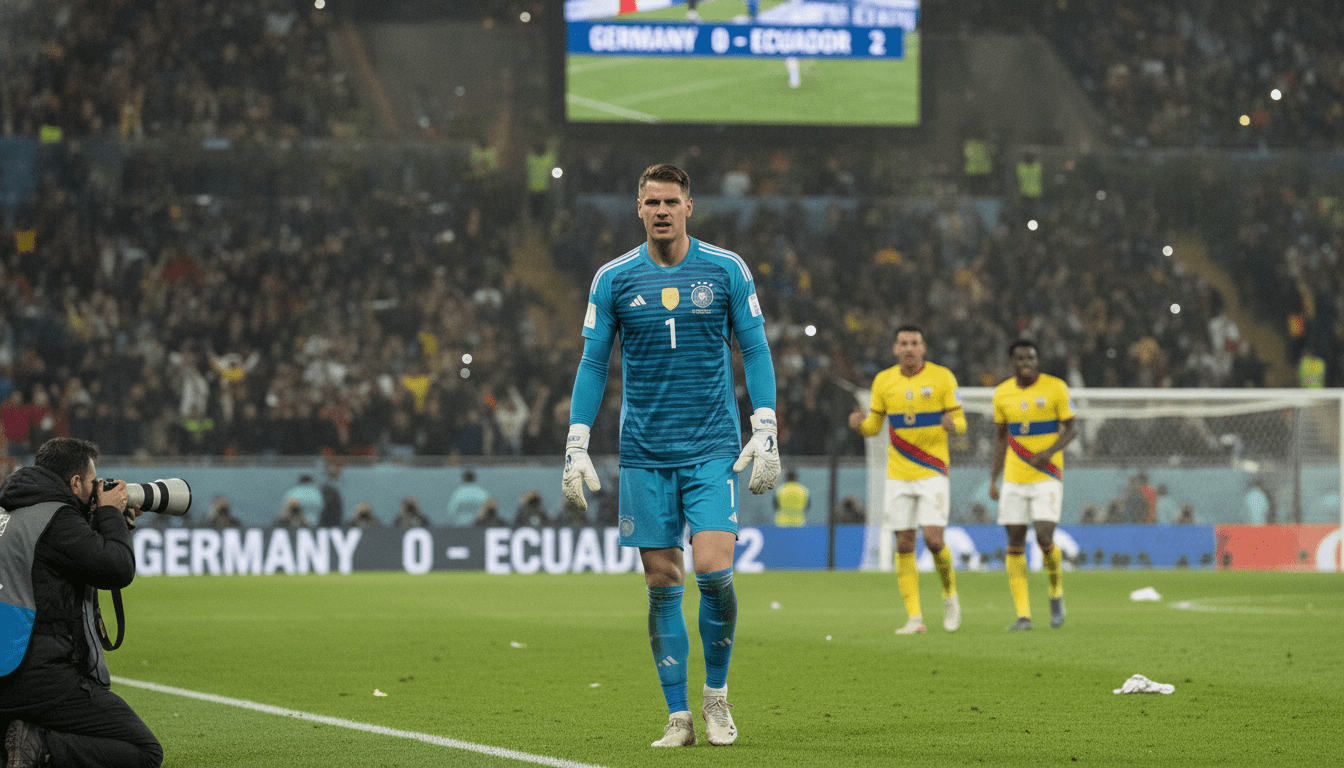
Manuel Neuer recall questioned after Ecuador goals expose defensive breakdown ahead of Philadelphia
Manuel Neuer’s recall for Germany’s World Cup campaign is under scrutiny after Ecuador’s two goals highlighted defensive miscommunication and raised doubts before the Philadelphia tie.
Germany’s decision to recall Manuel Neuer to the national squad has come under renewed examination after a match in which the team conceded twice to Ecuador, through Nilson Angulo and Gonzalo Plata. Neuer attempted to intervene on one occasion but could not secure the ball, and he later described the second goal as not the result of a clear goalkeeper error. The result and the circumstances have prompted debate over whether the recall produced the stability the coaching staff sought ahead of a potential Round of 16 meeting in Philadelphia against France.
Ecuador strikes through Angulo and Plata
Nilson Angulo and Gonzalo Plata were the scorers who capitalized on defensive lapses to put pressure on Germany’s tournament hopes. Both goals arrived in situations that exposed hesitation and gaps in coordination between the goalkeeper and his defenders, leaving questions about on-field communication.
Observers noted that the finish from Plata followed a moment when Neuer moved to collect the ball after a corner and was beaten to it by Plata’s quicker touch with his foot. Neuer has denied that the sequence was a straightforward goalkeeper error, but the goals nevertheless underlined vulnerabilities the side must address.
Miscommunication between Neuer and Jonathan Tah
A defining moment came when Jonathan Tah and Neuer, teammates at club level, converged on a bouncing ball in the penalty area and failed to complete a routine defensive clearance. Tah’s attempt to intervene with his foot when Neuer reached to claim the ball created a brief scramble that might have been avoided with clearer, earlier communication.
That episode illustrated the limits of relying on familiarity alone. Club combinations can help, but national-team defensive cohesion depends on repeated training and shared situational instincts across the backline and midfield as well as between goalkeeper and defenders.
Antonio Rüdiger prevents an immediate catastrophe
When the miscue might have led to a certain goal, it was veteran defender Antonio Rüdiger who intervened with a decisive tackle and clearance to limit the damage. Rüdiger’s recovery play prevented an even more damaging scoreline and highlighted the role individual interventions continue to play for this German side.
His contribution underlined that, for all the questions about structure and communication, experienced defenders remain crucial to keeping games within reach. Rüdiger’s recovery was the sort of situational leadership that can buy time for tactical adjustments but is not a substitute for systemic stability.
Clean-sheet record since 2014 remains unbroken
The match continued a long-running pattern in which Germany, when Manuel Neuer is part of the setup, has not kept a World Cup clean sheet since the 2014 final. That trend feeds into the broader assessment of whether recalling Neuer has delivered the defensive improvement the coaching staff intended.
Coaches and analysts argue that clean sheets are the product of collective organization rather than individual reputation. Neuer’s presence may alter opponents’ approach, yet preventing goals requires compact lines, clear responsibilities and reliable communication from goalkeeper through midfield.
Tactical consequences for the coaching staff
The outcome has placed pressure on the coaching staff to reassess preparation and personnel choices ahead of the next stages of the tournament. If Germany advances to the knockout round scheduled in Philadelphia, the staff will need to decide whether to persist with Neuer as the starting goalkeeper or explore alternatives that may better suit the current defensive shape.
Practical adjustments could include clearer assignment of roles during set-piece situations, altered defensive positioning to reduce one-on-one scrambling, and focused training on goalkeeper-defender interactions. The coaching team must weigh club familiarity against the necessity of robust, repeatable national-team patterns.
Implications for a potential France encounter
A scheduled knockout meeting with France would present a stern test of any adjustments, given the quality of France’s forward line and the presence of players who demand peak concentration from defenders and the goalkeeper. Reports that opponents such as Kylian Mbappé treat Neuer as a factor in their preparation underline the psychological as well as tactical dimension of the matchup.
Whether Germany reaches that Philadelphia fixture with Neuer between the posts, or at all, now depends on immediate corrective measures and the team’s capacity to translate experience into cohesive defensive performances. The coming days of training and selection decisions will determine whether the recall yields the stability the squad needs.
The German side must now turn scrutiny into solutions, addressing the communication breakdowns that allowed the Ecuador goals and ensuring that selection choices are justified by demonstrable, on-field improvement.
