
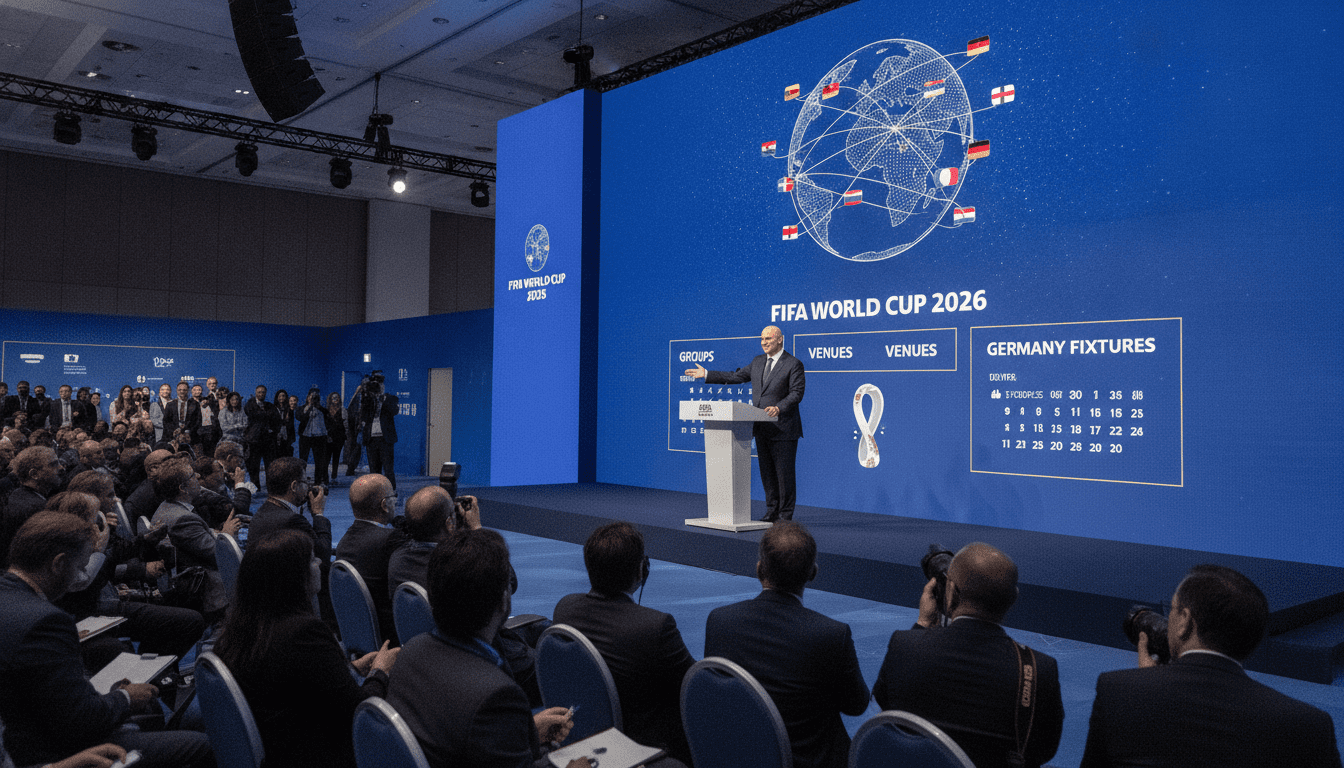
FIFA World Cup 2026 Match Schedule: Full Groups, Key Fixtures and Venues
Complete FIFA World Cup 2026 schedule: groups, key fixtures, match venues and TV coverage across USA, Mexico and Canada from June 11 to July 19, 2026.
The FIFA World Cup 2026 — staged across the United States, Mexico and Canada from June 11 to July 19, 2026 — will feature 48 teams, 104 matches and a record 16 host stadiums. The expanded format places twelve groups of four teams into a group stage that advances 24 sides directly and adds the eight best third-place teams to a new Round of 16. Fans across Europe should note that kick-off times are published in Central European Summer Time and reflect transatlantic time differences of six to nine hours.
Tournament Dates, Hosts and Format
The tournament opens on June 11 and concludes with the final in New York on July 19, 2026. For the first time the World Cup is jointly hosted by three countries, with 11 venues in the United States, three in Mexico and two in Canada sharing the schedule. The competition’s format places first and second from each group into the knockout phase, while the eight best third-placed teams fill out the new Round of 16.
The inclusion of a Round of 16 after the group stage increases fixture volume and scheduling complexity, with the tournament organizers allocating matches across multiple time zones. Tiebreakers follow traditional FIFA rules: goal difference, goals scored, head-to-head results and, if necessary, fair-play points.
Groups and Germany’s Path
The group draw placed defending hopefuls and traditional powers across a wide geographic spread, with some marquee matchups scheduled early in the tournament. Group E includes Germany, Curaçao, Ivory Coast and Ecuador, a pool that has seen Germany progress after convincing opening results. Germany opened with a 7-1 win over Curaçao in Houston on June 14 and followed with a 2-1 victory over Ivory Coast in Toronto on June 20.
Germany secured first place in Group E and will face one of the qualified third-placed teams in the Round of 16 on Monday, June 29, in Boston at 22:30 CEST. The final group match for Germany against Ecuador is set for Thursday, June 25, in New York at 22:00 CEST, a fixture that will determine final group placings and seeding for the knockouts.
Key Group-Stage Fixtures This Week
Several decisive group-stage matches are scheduled in the coming days that could reshape the knockout line-up and determine which third-placed teams advance. On Wednesday, June 24, Switzerland meet Canada in Vancouver at 21:00 CEST while Bosnia and Qatar play in Seattle at the same hour, both Group B contests with regional interest. France’s clash with Norway in Boston on Friday, June 26, is another highlight as both sides contend for top positioning in Group I.
Other notable fixtures include Brazil’s group tests in Group C and Spain’s matchups in Group H, with broadcasters ARD, ZDF and MagentaTV rotating coverage across major markets. Those fixtures will affect the list of potential opponents for seeded teams once the Round of 16 pairings are drawn.
Round of 16 and Knockout Timeline
The new Round of 16 begins on Sunday, June 28, and runs through July 4, setting the stage for a compact knockout phase that culminates in semi-finals on July 14 and 15. Germany’s Round of 16 tie is scheduled for Monday, June 29, in Boston, where the group winner will face a third-placed qualifier. The quarter-finals follow from July 9 to July 12, with venues in Boston, Los Angeles, Miami and Kansas City.
Semi-finals are scheduled for Dallas (July 14) and Atlanta (July 15), with the third-place match in Miami on July 18 and the final in New York on July 19. The tight schedule means teams advancing deep into the tournament will face brisk travel between host cities, testing squad rotation and recovery strategies.
Stadiums, Capacities and Time Zones
Matches are distributed among 16 stadiums with capacities ranging from roughly 45,000 to 94,000 spectators. Major venues include the Azteca in Mexico City, the New York–New Jersey stadium in East Rutherford, the Dallas stadium in Arlington and BC Place in Vancouver. Eleven stadiums are in the United States, three in Mexico and two in Canada, creating a continental footprint that requires careful scheduling across local time zones.
Organizers have listed kick-off times in Central European Summer Time for international audiences; depending on the venue, that equates to a six- to nine-hour difference. Large-capacity venues such as Dallas (about 94,000 seats) and the Azteca (around 83,000) will host high-profile fixtures late in the group stage and during the knockout rounds.
Broadcast Rights and How to Watch
Public broadcasters ARD and ZDF will carry a substantial share of the tournament, transmitting 60 of the 104 matches across television and their streaming platforms. All matches are also available via the pay service MagentaTV, which holds complete streaming rights for the competition. ARD and ZDF will offer live streams through their respective apps and media libraries, while MagentaTV provides a comprehensive paid streaming package.
Viewers in Europe should check local schedules for live coverage and confirm kick-off times in Central European Summer Time to avoid missing late-night fixtures. With multiple matches often occurring simultaneously, broadcasters will provide highlights packages and extended studio analysis between games.
The FIFA World Cup 2026 presents an expanded global showcase with a denser match calendar, new knockout mechanics and travel challenges for competing teams, offering fans a record-setting tournament across North America.
