
Germany’s Commission Backs Swedish-Style Pension Fund to Supplement State System
Federal commission backs a Swedish-style pension fund to supplement Germany’s state pension, proposing a capital-funded add-on and reforms starting 2028.
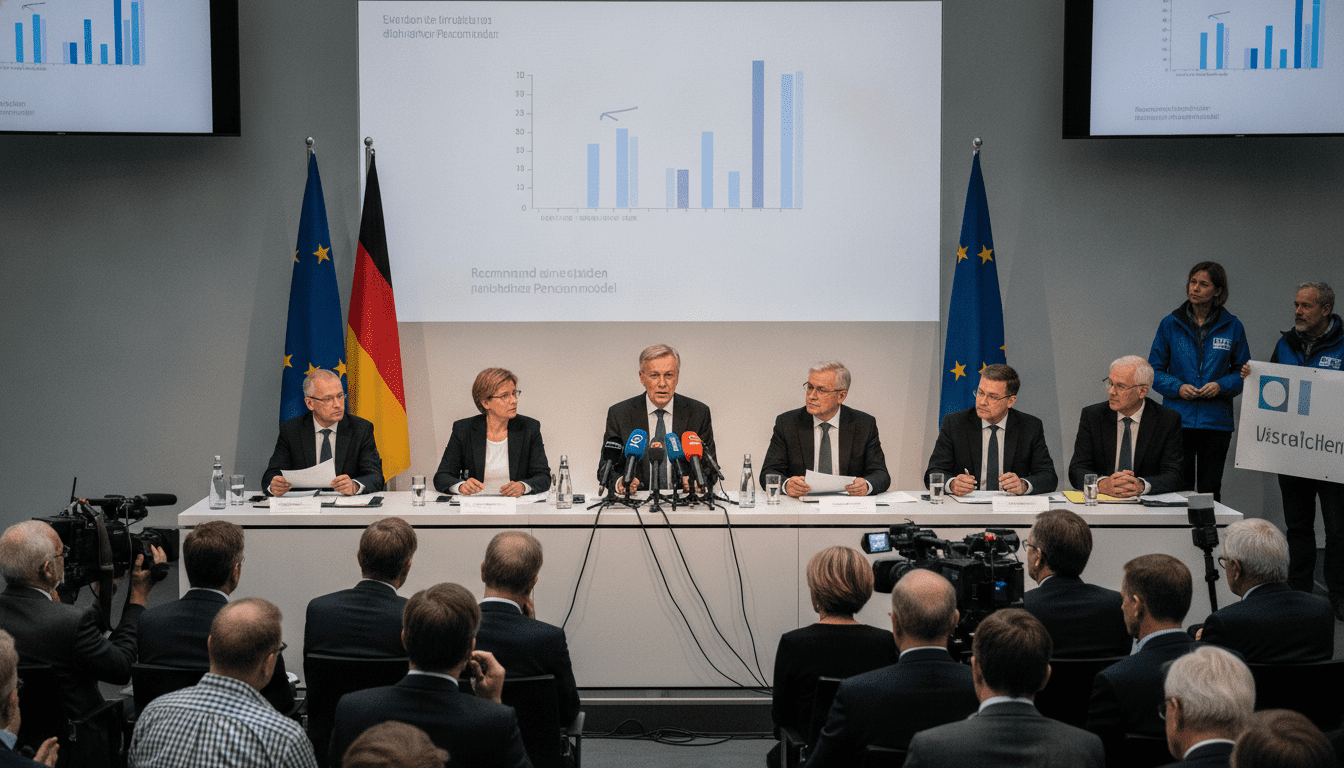
The government’s Pension Commission has recommended a Swedish-style pension to create a capital-funded supplemental retirement pillar alongside Germany’s statutory pay-as-you-go system. The proposal would levy a new supplemental contribution collected with social security payments and route savings into individual capital accounts. The recommendation, and Chancellor Friedrich Merz’s public endorsement of the idea, sets the stage for a contentious political debate over costs, guarantees and institutional design.
Commission majority endorses integrated capital pillar
The Pension Commission (Alterssicherungskommission) presented a package of 33 proposals that would embed a capital-funded supplement within the first pillar of the pension system. Under the plan, a supplemental contribution initially set at 0.5 percent of gross wages would be collected with social contributions and gradually rise to two percent to build individual capital pensions. Supporters argue that integrating the capital component into the statutory architecture avoids the administrative complexity of a mandatory occupational scheme and accelerates roll-out.
The commission proposes two savings routes: a public option modeled on the Swedish national fund and licensed private funds offering alternative investment choices. For a state default vehicle, officials have suggested repurposing an existing fund—Kenfo, which currently manages nuclear decommissioning payments—as the legal and operational backbone for the public offer. The model aims to combine economies of scale and professional management with portability and individual account visibility.
Merz pivots from mandatory company pensions to first-pillar integration
Chancellor Friedrich Merz acknowledged the shift as “a departure from my previous views” and praised the Swedish-style approach as a “brilliant idea” that resolves many practical hurdles. Merz had previously championed an obligatory occupational pension, funded and administered by employers under legal duty, but he said that option would create new bureaucratic layers. By contrast, integrating the capital element into the statutory framework would avoid building separate collection and oversight infrastructures for small employers.
Merz and several Union commission members, including Pascal Reddig (CDU) and Florian Dorn (CSU), framed the move as pragmatic: it preserves a central role for the state while introducing funded savings to lift long-term retirement incomes. Their endorsement helped transform what had been a cross-party negotiation into a more cohesive majority for the overall concept, even as disagreements persist on individual measures.
Funding levels, guarantees and timeline for implementation
The commission recommends starting the supplemental contribution in 2028, allowing time for legal drafting and institutional preparation. The target path—0.5 percent rising to two percent of gross wages—intends to make the funded element a meaningful addition to retirement income within a generation. To limit immediate contribution pressure, the plan pairs the new capital levy with measures that slow the rise of the statutory contribution rate, including phasing out certain early-retirement provisions.
To address distributional and retirement-income concerns, the proposals include a guarantee that combined benefits from the pay-as-you-go and the new capital pension will meet today’s legislated baseline—48 percent of average earnings—at the start of retirement. Thereafter, statutory pension increases would be moderated by reinstating a demographic factor in annual adjustments, reactivated after 2031 and planned to have a somewhat stronger dampening effect than previously applied.
Political trade-offs and structural changes proposed
The commission’s package contains politically sensitive trade-offs intended to secure broad coalition support. In return for accepting reductions in the growth rate of statutory benefits, the SPD signalled readiness to embrace the capital supplement because of its potential to raise long-term provision. The reform also contemplates measures the Union would not have chosen willingly, such as phasing out many mini-job arrangements and considering a future inclusion of civil servants in the statutory pension system.
Those concessions are designed to balance the fiscal burden across groups and make the overall package manageable for both employers and the public budget. Proponents portray the mixture of short-term cuts and a funded component as the only durable way to improve replacement rates without unsustainable contribution increases.
Opposition from unions, employers and insurers
The plan has drawn quick and vocal resistance from several organized interests. The Confederation of German Employers’ Associations (BDA) warned that the additional contribution would raise labor costs, while the German Trade Union Confederation (DGB) rejected placing capital-funded savings inside the statutory system and reiterated its call for a compulsory, employer-financed occupational pension. The DGB chair, Yasmin Fahimi, argued for a clear separation between statutory insurance and employer-based schemes anchored in collective bargaining.
The insurance industry also expressed concerns, fearing the loss of market share if a state or quasi-state fund becomes the standard default. Insurers warned that a large public offer could crowd out private providers unless licensing and product rules are carefully designed to preserve competition and consumer choice.
Final legislative decisions will hinge on political negotiations in Berlin and the outcome of stakeholder consultations.
Political and technical work remains to turn the commission’s proposals into law, but the endorsement of a Swedish-style pension mark a significant policy pivot. If implemented as outlined, the reform would reshape how German workers accumulate retirement capital, shift some risk and return dynamics into funded accounts, and force a prolonged public debate over guarantees, governance and distributional effects.
