
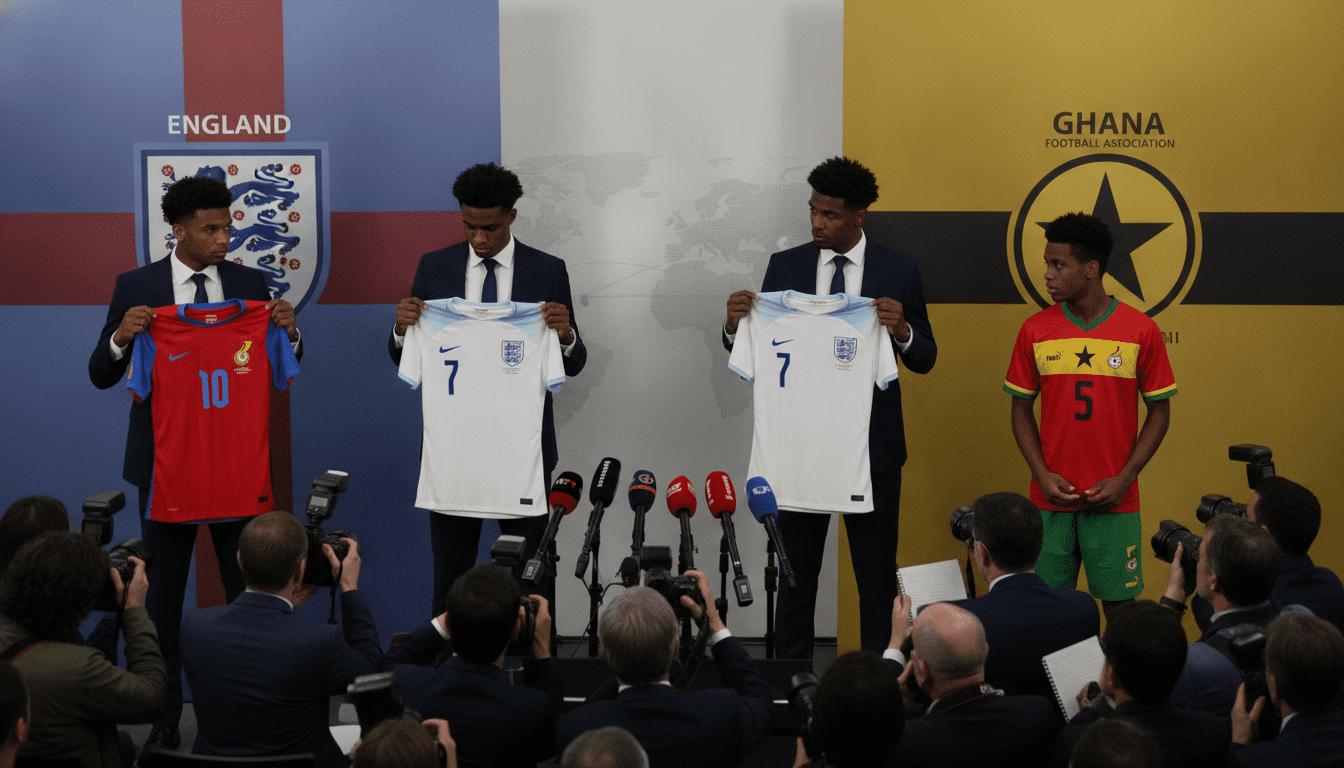
England vs Ghana: How World Cup Lineups Tell a Story of Diaspora, Identity and Eligibility
England vs Ghana at the World Cup spotlights diaspora decisions as academy-trained players raised in Europe choose between pride, opportunity and identity.
As England prepares to face Ghana, the match has become more than a tactical test; it is a display of modern national affiliation shaped by migration and eligibility rules. Players such as Kobbie Boateng Mainoo and Ghana’s Brandon Thomas‑Asante embody a broader phenomenon of footballers born and developed in one country electing to represent another. The England vs Ghana fixture thus offers a window into how heritage, career calculus and personal history intersect on the international stage.
Lineups Reflect Diaspora Choices
Both squads include players whose formative years were spent in top European academies while their family roots lie elsewhere, a dynamic visible across the 2026 tournament. England’s selection contains numerous athletes of Caribbean and African descent, while Ghana’s roster features several London-born talents who opted to represent their ancestral nation. Those choices turn fixtures like England vs Ghana into encounters about identity as much as about tactics.
Eligibility Rules Have Reshaped National Teams
Recent FIFA eligibility adjustments and relaxed switching rules have expanded options for dual‑national players and widened talent pools for many federations. Research from the Migration Observatory at the University of Oxford finds that nearly a quarter of players at this World Cup will represent countries other than their birthplaces, a significant rise from less than 9 percent in 2006. The rules change has enabled national teams in Africa, the Caribbean and elsewhere to recruit players developed in elite European systems.
Player Decisions Combine Practical and Emotional Factors
Individual choices to play for England or for a country like Ghana often mix sentimental ties with pragmatic considerations, including playing time, infrastructure and federation support. For some, the prestige and stability of a larger association can be decisive; for others, representing a parents’ homeland is a way to connect with family history and community. Players such as Kobbie Mainoo, Jerome Opoku, Antoine Semenyo and Brandon Thomas‑Asante illustrate how similar backgrounds can produce different international paths.
Media Coverage and Public Expectations Shape Belonging
How national media and fan narratives treat dual‑heritage players influences perceptions of inclusion and acceptance, and can weigh on athletes’ decisions and mental wellbeing. Cases involving players who faced harsh public scrutiny after high-profile moments have highlighted disparities in treatment and the conditional nature of belonging for some Black footballers. Those patterns feed into broader debates about who is embraced as a national symbol and who remains marginalised despite sporting success.
African Federations and Tournaments Are Increasingly Attractive
National associations across Africa have invested in scouting diaspora talent and in domestic development, while tournaments such as the Africa Cup of Nations have grown in competitiveness and prestige. The success of countries that blended local and diasporic players at recent global tournaments has encouraged other talents to consider switching allegiance. That momentum means fixtures like England vs Ghana no longer feature a clear imbalance of pedigree; they are increasingly contested affairs.
The Match as a Mirror of Colonial and Diaspora Legacies
England vs Ghana carries historical resonance rooted in colonial connections and post‑war migration, and the teams on the pitch are living embodiments of those ties. For many fans with multiple national identities, the game confronts complex loyalties and prompts reflection on representation, pride and historical memory. Matches between former colonial powers and their diasporic communities often become stages where sport and social history intersect.
The England vs Ghana game will be watched for goals and tactics, but its significance reaches further: it is a microcosm of how modern football navigates heritage, opportunity and belonging. As more players raised in one country choose to represent another, international football continues to evolve into a contest shaped by global migration and personal choice, with every lineup telling a story beyond the ninety minutes.
