
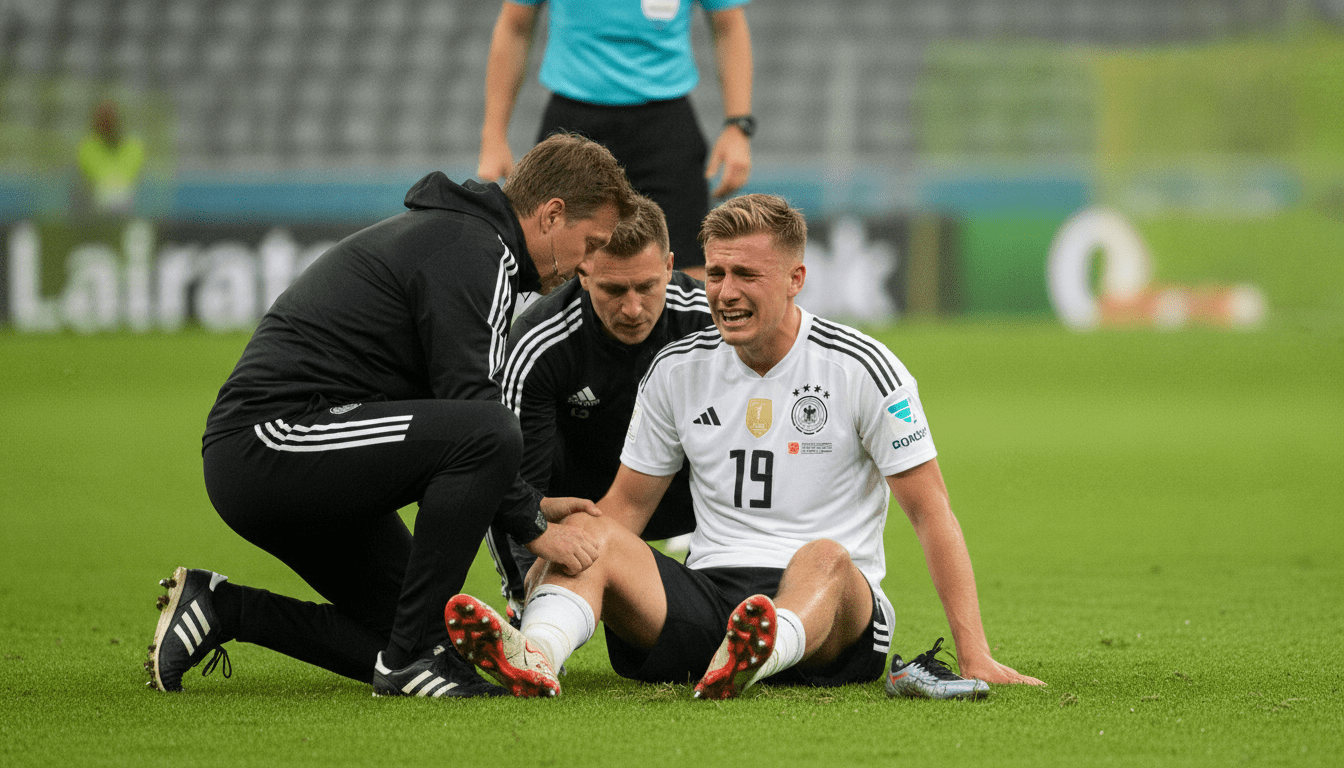
Nico Schlotterbeck injury leaves Germany without key ball-playing centre-back at World Cup
Germany’s centre-back Nico Schlotterbeck has been ruled out of the World Cup after a torn ligament in his left ankle, an injury that ends his tournament and forces a defensive reshuffle.
Nico Schlotterbeck injury has been confirmed by the German Football Association (DFB) as a ruptured ligament in the left ankle that will sideline the 26-year-old for roughly eight weeks. The diagnosis effectively ends Schlotterbeck’s World Cup campaign and removes a leading ball-playing option from Julian Nagelsmann’s starting lineup. The injury occurred early in Germany’s match against Ivory Coast and has already prompted tactical re-evaluations ahead of the knockout rounds.
DFB confirms torn ligament and eight-week prognosis
The German Football Association announced the diagnosis on Monday, confirming a ligament rupture in Schlotterbeck’s left ankle that will require an extended recovery period. Medical staff recommended an absence of about eight weeks, a timeline that puts any chance of his return during the tournament beyond reach. The DFB emphasized that the decision followed scans and specialist consultations carried out after the match.
Injury occurred in 14th minute after challenge with Amad Diallo
Schlotterbeck slipped and twisted his ankle in the 14th minute of the game in Toronto while contesting the ball with Ivory Coast’s Amad Diallo. Stadium medical personnel rushed onto the pitch and he received treatment on the field before returning to the sidelines for an assessment by team doctor Jochen Hahne. Despite taking a painkiller and continuing until halftime, the subsequent imaging confirmed significant ligament damage rather than a simple sprain.
Nagelsmann expresses disappointment over loss of a playmaker
Bundestrainer Julian Nagelsmann said the team will miss Schlotterbeck’s composure and build-up ability, noting the defender’s role in initiating attacks from the back. Nagelsmann acknowledged that Schlotterbeck’s tournament had been shaping up well for the player and that the injury was a heavy blow for both the squad and the individual. The coach also stressed the team’s need to adapt quickly and maintain the tactical identity that Schlotterbeck had helped establish.
Immediate lineup questions and Rüdiger’s role
Antonio Rüdiger, who had earlier praised Schlotterbeck’s left foot, was among the first to warm up on the sideline during the match and later featured after the break to steady the defense. Rüdiger’s return shifts the balance toward greater defensive solidity but, according to coaching staff assessments, may reduce the forward-driving impetus Schlotterbeck provided. The squad also retains Waldemar Anton and Malick Thiaw as experienced alternatives in central defence, leaving Nagelsmann to choose between preserving defensive caution and preserving the team’s vertical passing game.
FIFA rules block late squad replacements
Under FIFA regulations, national teams could only replace injured players up to 24 hours before their first group match, a deadline that has now passed for Germany. That restriction means the squad must cope with the present roster and cannot call in additional players to replace Schlotterbeck for the remainder of the tournament. The DFB and coaching staff must therefore manage match minutes and recovery plans internally to preserve depth across the knockout phase.
Schlotterbeck’s form and partnership with Jonathan Tah
Schlotterbeck arrived at the tournament having delivered one of the best spells of his career with Borussia Dortmund and carrying strong momentum into the national team. He and Jonathan Tah had developed a complementary central-defence partnership, blending Schlotterbeck’s passing range and forward impulses with Tah’s vocal leadership and positional command. Teammates and analysts noted that Schlotterbeck’s willingness to step into midfield with measured long passes had become a distinctive strength for Germany’s approach play.
Schlotterbeck posted a message on social media urging fans to back the team through good and difficult moments, closing with a heartfelt emoji that underscored his emotional investment in the campaign. The squad, having secured progression from the group, must now integrate tactical changes quickly while honoring the morale and standards the injured defender helped set.
