
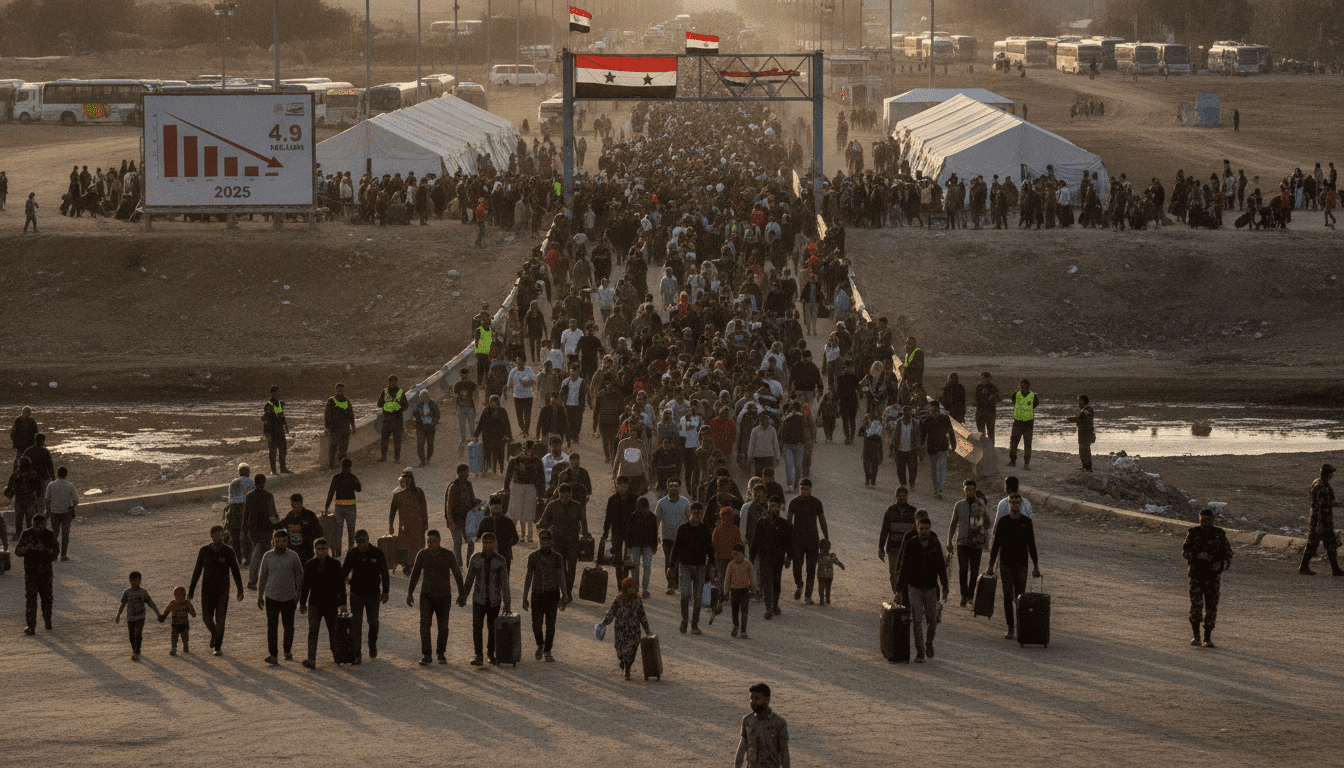
Syrian refugee returns accelerate as 1.3 million go back in 2025
Syrian refugee returns surged in 2025, with 1.3 million returning from abroad and two million internally displaced returning home, cutting the global refugee count to 4.9 million.
The pace of Syrian refugee returns intensified in 2025, with roughly 1.3 million people leaving host countries to go back to Syria and around two million internally displaced people resettling inside the country. Those movements reduced the recorded global Syrian refugee population from about 6 million to 4.9 million, according to humanitarian figures released this year. The return trend has continued into 2026, driven by changing security dynamics and worsening economic conditions in some host states.
1.3 million Syrians returned from abroad in 2025
Returns from neighbouring states made up the largest share of cross-border movements in 2025, with UNHCR tallies indicating a substantial uptick compared with the previous year. The figure of 1.3 million represents nearly a threefold increase from the prior year and is the principal driver of the decline in the global registered refugee population.
These mass returns were concentrated in months following political and military changes inside Syria that altered perceptions of safety for many displaced people. Humanitarian agencies warn that rapid return flows can outpace the delivery of essential services and shelter, complicating relief operations on the ground.
Two million internally displaced people went back inside Syria
Alongside cross-border returns, approximately two million internally displaced Syrians returned to their areas of origin during 2025. The movement of internal populations contributed roughly half of the overall reduction in the number of people recorded as displaced or refugees.
The internal returns reflect a combination of improved local security in some areas, economic necessity, and informal arrangements that have allowed families to reclaim land or homes. Aid groups say that while returnees report better freedom of movement in many places, their access to jobs, healthcare and housing remains uneven.
Regional return patterns show Turkiye, Lebanon and Jordan largest contributors
Neighbouring Turkiye accounted for the largest portion of cross-border returns in 2025, with about 556,000 people recorded as returning from there. Lebanon and Jordan also recorded significant outflows, with roughly 465,000 and 256,000 returnees respectively.
These three countries together accounted for the majority of returns from abroad and had hosted the largest Syrian refugee populations during earlier phases of the displacement crisis. Shifts in economic conditions, legal status and public policy in host countries have been cited by analysts as important factors influencing decisions to return.
Political change and economic pressure cited as key drivers
Observers point to the removal of the al-Assad dynasty in December 2024 as a major political event that altered the calculations of many displaced Syrians. The regime change, which took place on December 8, 2024, altered security dynamics and created opportunities for some to return. At the same time, deteriorating living conditions in several host countries — notably Lebanon — pushed further movements in 2026, with returns reaching roughly 549,800 by mid-May of this year.
For many families, the decision to return combined hopes for improved security with urgent economic pressures at home and abroad. Humanitarian assessments stress that intentions to return do not always translate into durable reintegration unless accompanied by basic services and legal safeguards.
UNHCR surveys show perceptions of improved security and future intentions
UNHCR surveys among returnees indicate that more than seven in ten reported improvements in security and freedom of movement after returning. The agency also found that nearly three-quarters of Syrians remaining abroad expressed a desire to return home at some point, highlighting enduring ties to place despite prolonged displacement.
While these perception metrics signal shifting attitudes, humanitarian actors caution that reported improvements are not uniform across the country. Variations in local governance, infrastructure damage and access to livelihoods mean that experiences of returnees differ markedly from one governorate to another.
Humanitarian needs and reintegration challenges remain acute
Returnees consistently describe immediate challenges on arrival, including damaged or destroyed housing, limited access to utilities and constrained employment opportunities. One returnee interviewed by a regional outlet said the family returned after more than a decade abroad because of the high cost of living in the host country and described initial difficulties finding shelter and coping with changed conditions.
Aid agencies say that meeting shelter, health and education needs will be essential to stabilizing returns and preventing secondary displacement. They also stress the importance of documentation, property restitution mechanisms and mine-clearance efforts for safe, sustainable reintegration.
The scale of returns in 2025 and early 2026 marks a significant inflection point in a displacement crisis that reached its peak in 2021, when roughly 6.8 million Syrians were recorded as having fled the country. Humanitarian actors and regional governments now face the dual tasks of responding to urgent needs among returnees while coordinating longer-term recovery and governance arrangements that can support durable solutions for millions of people.
