
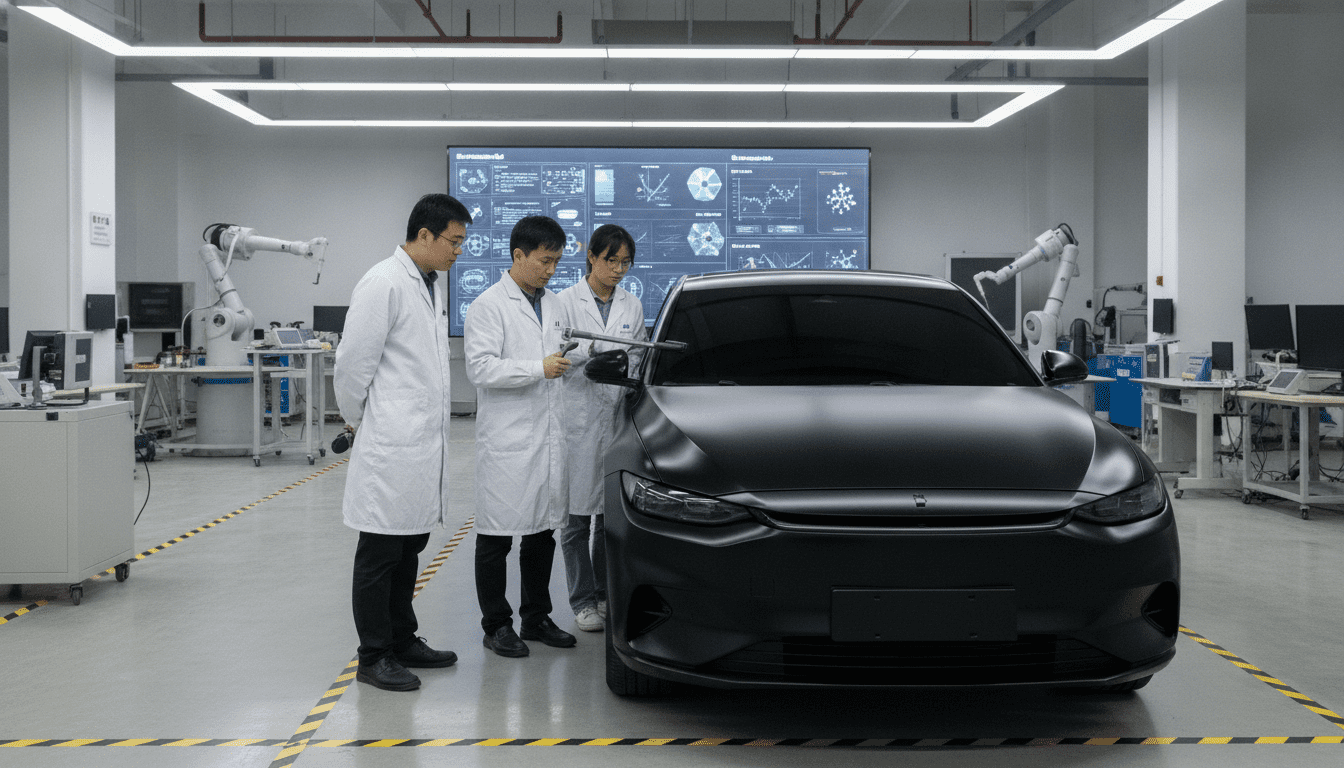
Ultra-black paint developed in China absorbs 99.9% of light, promising deeper car finishes
A newly developed ultra-black paint that soaks up 99.9% of incoming light could redefine automotive finishes and make deeper, lustrous blacks widely available for vehicles and industrial use.
Researchers in Shanghai led by Zhiwei Liu at the Nippon Paint Company report an ultra-black paint that captures nearly all visible light, a property that gives surfaces an exceptionally deep, matte black appearance. The team combined traditional carbon-based pigment with arrays of tiny carbon nanotubes to create both absorption and internal scattering, producing a coating that appears almost void-like because very little light is reflected back to the eye. The study, published this week in the journal Matter & Light, frames the work as part of a broader pursuit of extreme-black coatings in the automotive coatings industry.
New coating absorbs 99.9% of incoming light
The coating measured by the researchers reportedly absorbs about 99.9 percent of incident light, a rate far above typical automotive blacks. This level of light capture is achieved not only through pigment but through engineered nanostructures that trap photons and redirect them into the material. The result is a surface that minimizes specular reflection and visual cues, making contours and reflections harder to detect.
Material design combines soot pigment and carbon nanotubes
According to the Shanghai team, the formulation blends conventional carbon black pigment with densely packed carbon nanotubes at the nanoscale. Those nanotubes form a textured surface that increases the path length of light within the coating, enhancing absorption through repeated scattering. The combination means the paint does not simply absorb light in a single pass; it captures and disperses photons within the microstructure until they are converted to heat.
Automotive applications and luxury aesthetics
Deep, velvety black finishes have long been associated with premium vehicles, and the researchers highlight automotive paint as a primary application for the ultra-black coating. Zhiwei Liu described deep-black lacquers as a premium and defining choice for luxury cars, noting their strong visual impact. Carmakers may find the color appealing for concept models and limited production runs where a dramatic visual signature is sought.
Industry origins trace back to concept vehicles
The push for near-absolute black finishes is not new. German automaker BMW drew attention in 2019 with a concept car finished in an exceptionally deep black, which helped spur interest in coatings that approach the light-absorbing properties of materials like Vantablack. That demonstration and subsequent industry attention helped set off a research focus within paint manufacturers and academic groups seeking commercially viable ultra-black coatings.
Technical challenges to commercial rollout
Despite the dramatic optical properties, several hurdles remain before ultra-black paint reaches wide automotive use. Durability under UV exposure, adhesion to metal and clearcoats, resistance to abrasion and environmental contaminants are all engineering challenges that must be addressed. Manufacturers will also need to ensure that the nanotube-containing formulations can be produced at scale and meet regulatory and occupational safety requirements for handling nanomaterials.
Potential safety and regulatory considerations
Extremely matte black surfaces can alter how light and reflections behave around a vehicle, raising potential safety questions for road visibility and sensor calibration on modern driver assistance systems. Regulators and testing agencies may require additional evaluation of how ultra-black finishes interact with lidar, radar and camera systems used in advanced driver-assistance and autonomous features. Environmental and workplace exposure limits for nanomaterials will also shape how easily the coatings can be manufactured and applied.
Market outlook and next development steps
The researchers and industry observers expect incremental steps toward commercialization, beginning with concept-run applications and specialty vehicles before broader adoption. Improvements in formulation to boost weathering resistance, development of compatible clearcoats and large-scale roll-out of safe production methods will be necessary milestones. If those are met, the distinctive aesthetic offered by ultra-black paint could become a visible trend among premium and bespoke vehicle lines.
The development highlights a broader trend in materials science where nanostructured surfaces are engineered to control light at extremely small scales, producing effects that were once the preserve of laboratory curiosities. As research moves into applied engineering, automakers and suppliers will weigh the aesthetic payoff against technical, regulatory and cost barriers before this near-total light-absorbing paint appears on everyday roads.
