
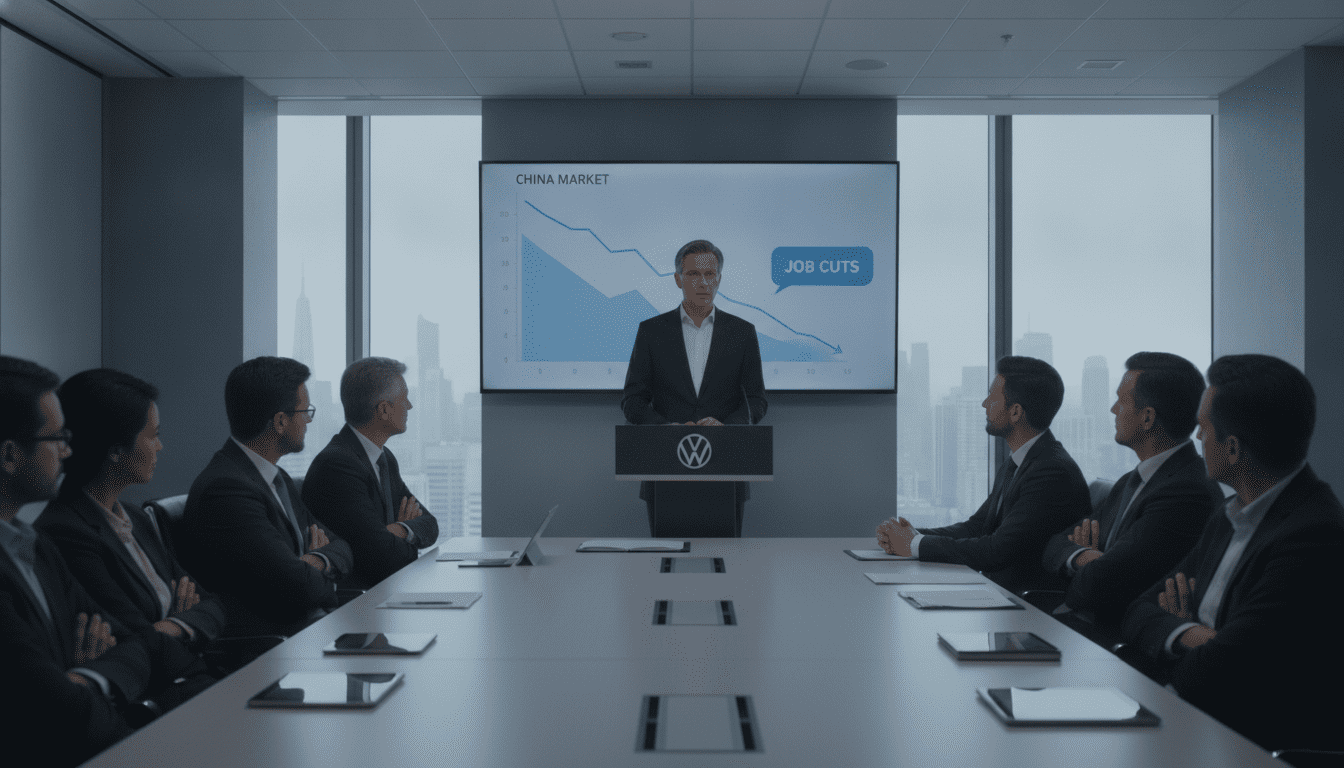
Volkswagen shareholders confront governance failures and sweeping job cuts at virtual AGM
Volkswagen shareholders pressed executives at the virtual June 18, 2026 AGM, demanding answers on governance shortcomings, mass job cuts and a sliding share price. The meeting, held remotely, saw vocal criticism from retail investors and fund managers as the company outlined extensive restructuring plans and worsening market pressures.
Investor outrage at remote annual meeting
Participants in the virtual annual general meeting expressed palpable anger as representatives logged in from home and offices across Europe. Ulrich Hocker of the Deutsche Schutzvereinigung für Wertpapierbesitz and fund managers including Tanja Bauer of Deka Investment warned that the share price and market confidence have eroded. The digital format eliminated the physical confrontations seen in past years but did little to reduce the sharp tone of investor questions.
Internal probe raises existential concerns
An internal survey that has become public amplified investor unease by reporting that several board members described the company as “existence-threatening.” That assessment, revealed shortly before the AGM, intensified scrutiny of management strategy and execution. Executives acknowledged the gravity of the challenges but maintained that ongoing measures aim to stabilise the business.
Supervisory board independence under fire
Critics highlighted structural weaknesses in Volkswagen’s corporate governance, pointing to a supervisory board dominated by the Porsche and Piëch families, the state of Lower Saxony, Qatar and trade union representation. Governance expert Christian Strenger warned that continued shortcomings could even jeopardise the company’s standing in the DAX index. Calls for greater independence and clearer accountability resonated across both retail and institutional investors.
Sudden departure of an independent voice
The board’s credibility was further dented when Susanne Wiegand, who was viewed by some as a rare independent voice, resigned after just one year. Her exit raised questions about the supervisory board’s internal dynamics and the ability of non-aligned members to influence decisions. Shareholders said the loss underscored the absence of robust checks on management at a sensitive moment for the group.
Massive job cuts and uncertain plant futures
Management confirmed a large-scale workforce reduction as part of a sweeping restructuring effort, with plans to cut 19,000 positions within the Volkswagen AG organisational umbrella this year. Executives said 28,000 voluntary departures have been agreed through 2030 and that the group expects 35,000 cuts inside Volkswagen AG and roughly 50,000 including affiliates such as Audi, Porsche and software unit Cariad. Employees at sites including Emden, Hannover, Zwickau and Neckarsulm voiced fear for local jobs while unions insisted plant closures would not be accepted without negotiation.
Share price slump, China setbacks and tariff risks
The stimmrechtslose Volkswagen preference share fell further during the meeting, sliding about three percent to roughly €84, a level that alarmed investors and activists alike. Management cited a confluence of pressures — weakening demand in China, new tariffs and geopolitical disruptions — that are compressing margins and complicating recovery. Attendees pointed to a recent earnings downgrade at a rival manufacturer as a market signal that the industry’s recovery remains fragile.
Controversial moves: arms production and legacy liabilities
Plans to introduce defence-related production at the Osnabrück plant via a cooperation with an Israeli firm sparked ethical and political debate among shareholders and activists. Environmental group representatives raised historical sensitivities linked to Volkswagen’s origins, while questions about the deal’s implications for relations with key shareholders were left unresolved. At the same time, the AGM revisited long-running diesel-era liability settlements after a court decision required a new shareholder vote, a proposal management is expected to carry given the concentrated voting power of major stakeholders.
Investor interventions at the AGM repeatedly stressed the need for simplification, faster cross-brand integration and clearer strategic priorities, with fund managers urging the company to harness synergies across Škoda, Audi, Porsche and other marques. Executives defended the restructuring as necessary to reduce complexity and restore competitiveness, and they signalled that supervisory board deliberations scheduled in early July will be pivotal. The coming weeks will test whether Volkswagen can translate the pressure from its shareholders into decisive action that stabilises the share price and restores investor confidence.
