
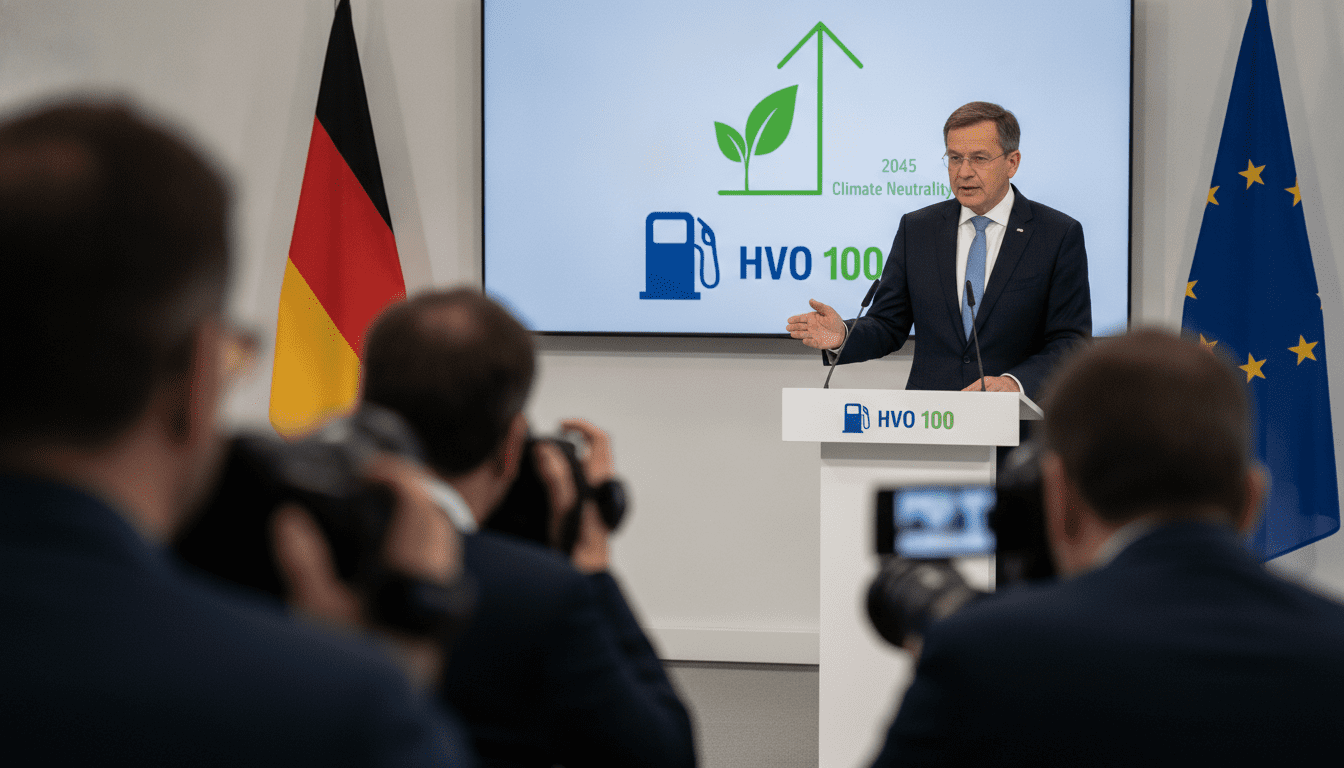
HVO 100 Choice: German State Secretary Says Renewable Diesel Can Reduce CO2 by 90%
State secretary says HVO 100 in his official diesel can cut CO2, cites BMW pilot and urges renewable fuels count toward Germany’s 2045 ambitious climate goal.
Christian Hirte, the federal transport state secretary, has defended his decision to use HVO 100 — a hydrotreated vegetable oil made from biogenic waste and residues — in his official diesel car, arguing the fuel can deliver immediate CO2 savings while Germany advances toward climate neutrality by 2045. Hirte told reporters he is participating in a BMW pilot that will measure the vehicle’s full lifecycle carbon footprint and compare it with electric and other powertrain variants of the same model. The announcement has reopened debate in Berlin and Brussels over whether vehicles running exclusively on renewable fuels should be credited as zero-emission within fleet regulations.
State Secretary Explains Official-Car Decision
Hirte said his choice was pragmatic: his role requires extensive travel, sometimes 80,000 to 100,000 kilometres per year, and he selected a leased diesel that can be filled only with HVO 100 for a twelve-month trial. He cited industry and scientific studies suggesting that, when accounting for production processes, HVO can reduce CO2 emissions by roughly 90 percent compared with fossil diesel. The BMW pilot will produce an end-of-year accounting of the car’s CO2 footprint and provide a direct comparison with electric and other drivetrains.
Hirte emphasized he is not closing the door on electric vehicles and said he will reassess his choice after the trial, weighing mileage, costs and environmental performance. He framed the decision as a test of immediate climate mitigation options that can be deployed in the existing vehicle fleet, not as a final judgement on the future of vehicle electrification.
Coalition Signals Technology-Neutral Approach to 2045 Target
The new federal coalition has reaffirmed Germany’s legal objective of climate neutrality by 2045, and Hirte said the government intends to approach that target with greater pragmatism and technology neutrality. In his account, the coalition agreement commits ministers to flexibility across sectors, notably in transport, where the existing stock of internal-combustion vehicles remains large. The administration argues that a broader mix of solutions could yield faster emissions reductions in the near term.
Hirte described the coalition’s stance as a shift from a single-minded focus on electric drivetrains toward a portfolio that includes renewable liquid fuels, synthetic e‑fuels and electrification where it is most efficient. He framed the approach as an effort to reconcile ambitious long-term goals with realistic short-term gains.
Push to Recognize Renewable-Fuel Vehicles as Zero-Emission
According to Hirte, the coalition’s April decisions explicitly call for vehicles running exclusively on renewable fuels — including advanced biofuels — to be recognised immediately as zero-emission under fleet regulation. He said Chancellor Friedrich Merz raised the issue with European Commission President Ursula von der Leyen, seeking regulatory flexibility at EU level. Hirte acknowledged there are signs in Brussels of movement, but he judged them insufficient from a German perspective.
Proponents argue that counting renewable-fuel vehicles as zero‑emission could incentivise rapid uptake and reduce CO2 from the in‑service fleet, while opponents caution that such a change could slow the transition to battery electric vehicles and complicate monitoring of real emissions reductions.
Comparing Lifecycle Emissions: HVO 100 and Electric Cars
Hirte offered a direct lifecycle comparison that has become central to the debate: he cited a 90 percent production‑process reduction for HVO 100 and referenced a German emissions factor for grid electricity — 344 grams CO2 per kilowatt-hour in 2025, as used by authorities — to assess electric vehicle footprints. Applying those figures, he said an electric drivetrain would emit about 40 percent less CO2 than a conventional diesel under current conditions, but a diesel powered exclusively with HVO 100 could, in his calculation, cut a further three‑quarters of the EV model’s emissions in comparable tests.
He also noted that battery production remains CO2‑intensive and that BMW’s simultaneous production of multiple drivetrains provides a useful apples‑to‑apples comparison within the same vehicle platform. Hirte underlined that the pilot’s final accounting will be decisive for how credible the claims are in practice.
Feedstock Availability, Costs and the Role of E‑Fuels
Hirte addressed concerns about raw material availability for HVO, saying Germany has substantial potential for feedstocks beyond used cooking oil, including other waste and residue streams identified in studies by the Karlsruhe Institute of Technology. He acknowledged that short‑term imports — notably from markets such as the United States — could help scale supply while domestic capacities grow.
On synthetic, electricity‑based fuels, Hirte acknowledged current production costs are high. He pointed to a government plan to support electro‑kerosene with up to €2 billion to bridge price differentials between producers and buyers. However, he warned that Germany and Europe will likely need to import molecules in the long run, arguing that energy trade will not be satisfied by electricity flows alone.
Implications for Fleet Policy and Consumers
Hirte argued that a key advantage of renewable diesel like HVO 100 is immediate compatibility with many vehicles already on the road; older diesels can typically run on the fuel without modification. That, he said, creates an opportunity for comparatively rapid CO2 reductions across the existing fleet. He contrasted the German and Chinese experiences with electrification, noting Chinese uptake has been propelled by subsidies and low charging costs that are not replicated in Europe.
The state secretary said consumer economics will ultimately shape the transition and that, in time, many buyers are likely to prefer electric vehicles because of lower operating costs. For the present, however, he urged policy that recognises multiple pathways to emissions reductions and that empirically tests the climate benefits of alternatives.
Christian Hirte concluded that his year‑long BMW pilot with HVO 100 is intended to provide concrete data rather than ideological argument, and he said he will publish the comparative lifecycle results once the study is complete.
