
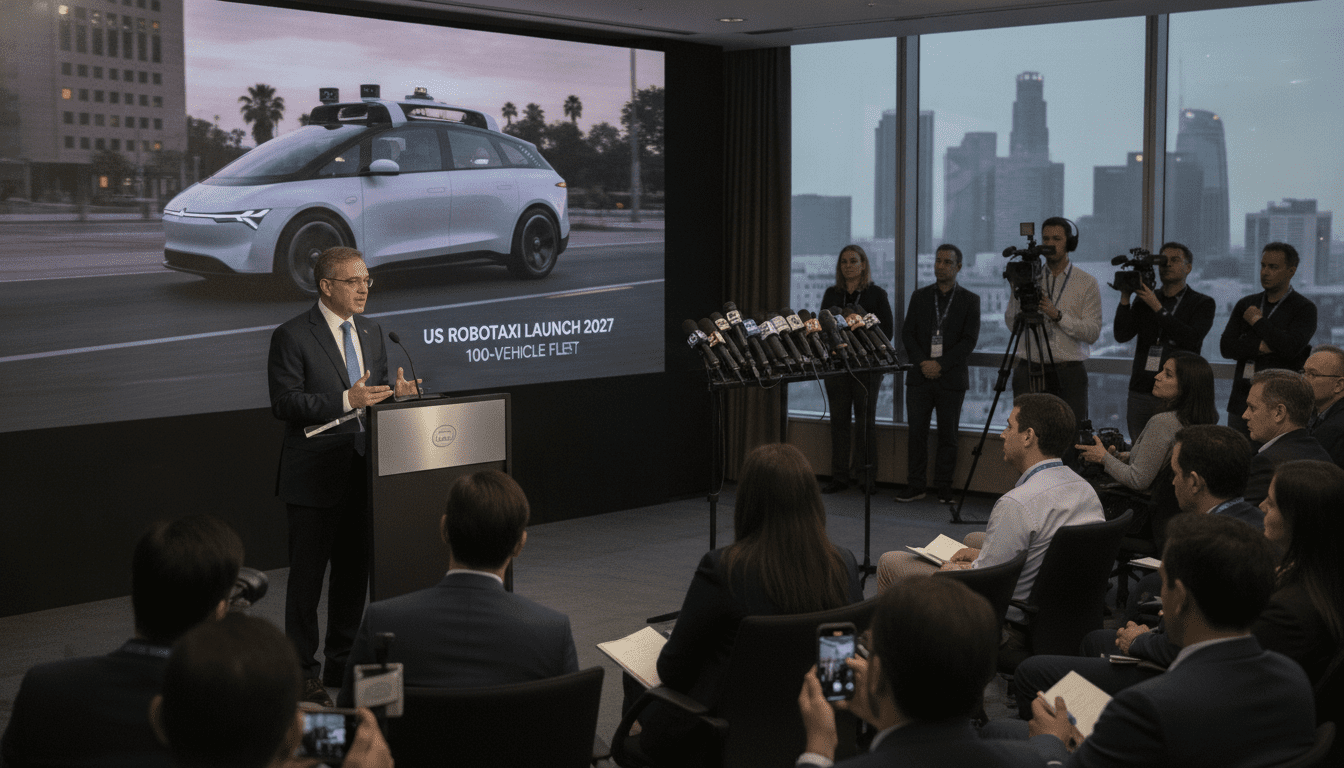
Mobileye robotaxi to launch in a U.S. city in 2027 with 100-vehicle starter fleet
Mobileye robotaxi: Mobileye plans a U.S. rollout in 2027 with 100 initial autonomous vehicles, aiming to scale to about 17,000 robotaxis within five years.
Intel subsidiary Mobileye said Tuesday it will operate a Mobileye robotaxi service in an unnamed U.S. city beginning in 2027, marking a move from pure supplier to operator. The company plans to introduce an initial fleet of 100 autonomous vehicles during 2027 and pursue an aggressive expansion thereafter.
Official launch timeline and initial deployment
Mobileye confirmed the service will begin phased deployments in 2027, though it did not disclose which U.S. city will host the first fleet. The company said the 100 vehicles will be brought online progressively over the year as operational systems and local approvals are secured.
Mobileye described the new business as a separate operating unit that will use its own self-driving stack to manage service operations. The company intends to leverage its existing technology and in-house expertise to control vehicle routing, service quality, and customer experience directly.
Fleet growth target and five-year ambition
Beyond the 2027 pilot, Mobileye set a long-term target to scale its robotaxi fleet to roughly 17,000 vehicles within five years of launch. That ramp-up would represent one of the fastest fleet-growth roadmaps announced in the autonomous mobility sector to date.
Company leadership said the scaling plan is contingent on successful early operations, regulatory approvals, and partnerships with vehicle makers. Mobileye framed the expansion as a measured progression from a concentrated test fleet toward a broader urban deployment.
Strategic pivot from supplier to operator
The decision to run its own robotaxi service marks a notable strategic shift for Mobileye, which rose to prominence as a supplier of vision chips and driver-assistance systems to major automakers. The company has long sold systems designed to enhance safety and support advanced driver assistance, and more recently developed full-stack autonomous driving software.
Mobileye insists the operating business will complement rather than replace its supplier relationships, aiming to both serve automakers and gain direct operational insights. Executives say running a vehicle-for-hire service will accelerate learning about real-world passenger operations and support wider commercial adoption of autonomous technology.
Technology stack and vehicle sourcing
Mobileye said its service will use the company’s self-driving system and that it will partner with “AV-ready vehicle platform manufacturers” to source cars for the fleet. The announcement did not confirm a specific production model, but imagery accompanying the release suggested a modified electric crossover as a demonstration vehicle.
The company also plans to integrate Moovit, the transit and ride-hailing app it owns, as the consumer-facing booking and navigation layer. Mobileye highlighted that combining its Drive autonomous stack with Moovit’s trip-planning and customer interface will enable end-to-end ride management under its operator role.
Competitive landscape and partner implications
Mobileye’s move positions it as both a technology vendor and a direct competitor to some of its customers and partners in the robotaxi market. The company already supplies self-driving systems to automakers and mobility providers, and operating its own service could create tension with clients who plan or already run their own autonomous fleets.
Management framed the dual role as complementary, arguing that showcasing full operational capability will attract further demand for its Drive platform. Industry observers will watch whether automakers view the operator step as collaborative co-development or as competition for urban ride revenue.
Regulatory and operational challenges ahead
Launching a robotaxi service in a U.S. city will require Mobileye to navigate a complex patchwork of state and municipal regulations, along with safety validations and public acceptance hurdles. Local traffic laws, permitting processes, and emergency-response protocols vary widely and will shape the timing and scale of deployments.
Mobileye acknowledged those constraints and emphasized the phased approach as a means to gather operational data and demonstrate safety performance. Regulators and transit agencies will likely demand detailed safety cases and incident reporting as deployment expands beyond pilot zones.
Mobileye’s announcement signals a new phase in the company’s evolution and highlights growing industry momentum toward commercial robotaxi services. The firm’s dual role as supplier and operator will test whether direct operational experience can accelerate broader adoption of autonomous mobility while preserving partner relationships.
