
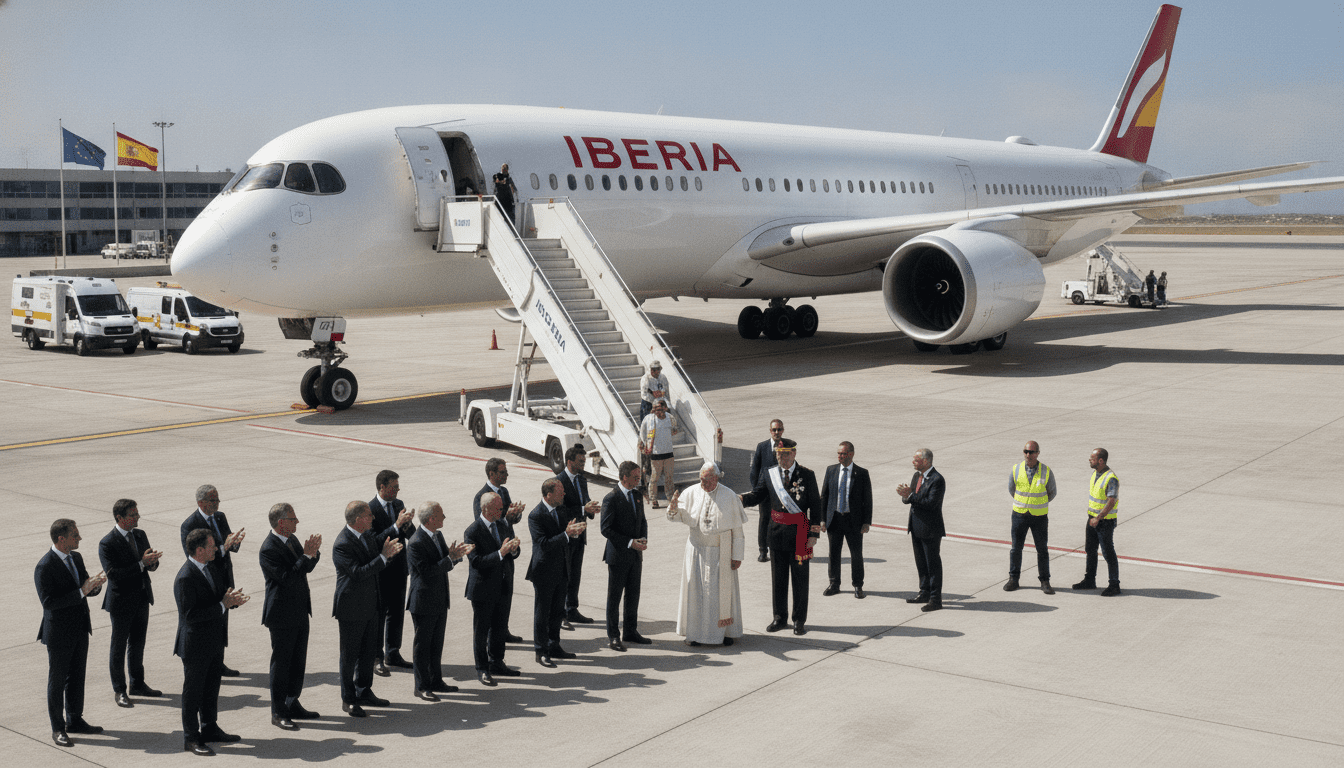
Pope Leo XIV Returns to Tenerife After Engine Fault on Iberia Flight; King Felipe VI Escorts Him
Pope Leo XIV briefly disembarked an Iberia aircraft after an engine fault forced the plane back to Tenerife-North, with King Felipe VI personally accompanying him to the terminal. The interruption delayed the pontiff’s return to Rome by about three hours and drew attention to the island’s challenging wind conditions. Officials say a maintenance team traced the problem to conditions consistent with a strong tailwind, prompting the airline to dispatch a replacement from Madrid. The episode ended with the king offering his government Falcon to the Pope so the papal party could depart without further delay.
Engine problem forces Iberia flight to return to Tenerife
The Iberia Airbus had already taxied and taken off when crew detected an anomaly in one engine, officials said, and the decision was made to return to Tenerife-North. Passengers included a contingent of more than 80 journalists who remained on board while ground crews assessed the situation. The aircraft had earlier landed in Tenerife from Gran Canaria without incident after the Pope’s final Mass at the harbor in Santa Cruz.
Airport operations at Tenerife-North were briefly disrupted as technicians worked with the flight crew to diagnose the issue. A tug vehicle turned the aircraft on the apron in an attempt to facilitate checks, but the maneuver did not resolve the engine concern. Iberia concluded a substitute aircraft would be required and arranged for one to be ferried in from Madrid.
King Felipe VI accompanies Pope back to terminal
King Felipe VI, who had conducted ceremonial farewell duties moments earlier, escorted Pope Leo XIV back into the reception area at the airport when the flight returned. Sources on the ground described the king’s actions as a gesture of immediate courtesy and care for the exhausted papal delegation. The monarch then offered his small government Falcon, already positioned nearby on the tarmac, so the pontiff could continue without further waiting.
Spanish authorities emphasized the symbolic and practical aspects of the king’s intervention, noting that the visit had largely proceeded smoothly before the technical setback. Officials also highlighted the sensitivity of transporting a head of state or church leader during ongoing travel disruptions, and the Falcon’s availability shortened the papal party’s delay.
Maintenance team points to tailwind as likely cause
A correspondent from El País who remained aboard reported that the flight captain told passengers the maintenance team recommended turning the aircraft because the engine issue was likely linked to a strong tailwind. Tenerife’s north airport is known for variable and occasionally severe winds that have affected flight operations in the past. Airline and airport technicians said those conditions can place unusual loads on aircraft systems, complicating early in-flight diagnostics.
Iberia engineers undertook a preliminary inspection after the aircraft returned to the apron, though the carrier opted to bring in a different plane as a precautionary measure. The airline’s decision reflects standard safety protocols when an engine anomaly cannot be cleared quickly on site, particularly during international transfers to sensitive destinations such as the Vatican.
Iberia dispatches replacement while royal Falcon carries papal party
Rather than keep the Pope and his closest aides on the ground while Iberia arranged a relief aircraft from Madrid, King Felipe arranged for the papal party to use the government Falcon. The pontiff and his immediate delegation accepted the offer and departed approximately three hours later than scheduled. The remainder of the Spanish delegation, including officials who had planned to return on the king’s flight, waited for their replacement transport.
Iberia confirmed it had initiated procedures to reposition a substitute aircraft to the Canary Islands, and airport managers said the carrier cooperated closely with Spanish authorities to minimize disruption. The pragmatic solution allowed the Pope to resume his itinerary homeward while maintaining a high level of security and diplomatic protocol.
Operational and diplomatic implications at Tenerife-North
The incident highlighted the logistical complexities of transporting high-profile figures through facilities that can be affected by local weather. Tenerife-North’s susceptibility to gusts has periodically required extra precautions, and the episode served as a reminder of those constraints for both commercial carriers and state operations. Local authorities said contingency plans functioned as intended, enabling a rapid diplomatic response without compromising safety.
Diplomats and aviation officials alike framed the king’s offer as both a courtesy and a practical workaround that prioritized the Pope’s schedule and comfort. Media commentators on the island noted that Spain had successfully managed most of the papal visit and that the quick resolution preserved the overall diplomatic tone of the trip.
The brief disruption concluded without injury or reported safety breaches and the papal party continued toward Rome after the delay. Airport and airline investigations will continue to determine whether additional maintenance or procedural changes are warranted to reduce the likelihood of a repeat occurrence in Tenerife’s variable wind environment.
