
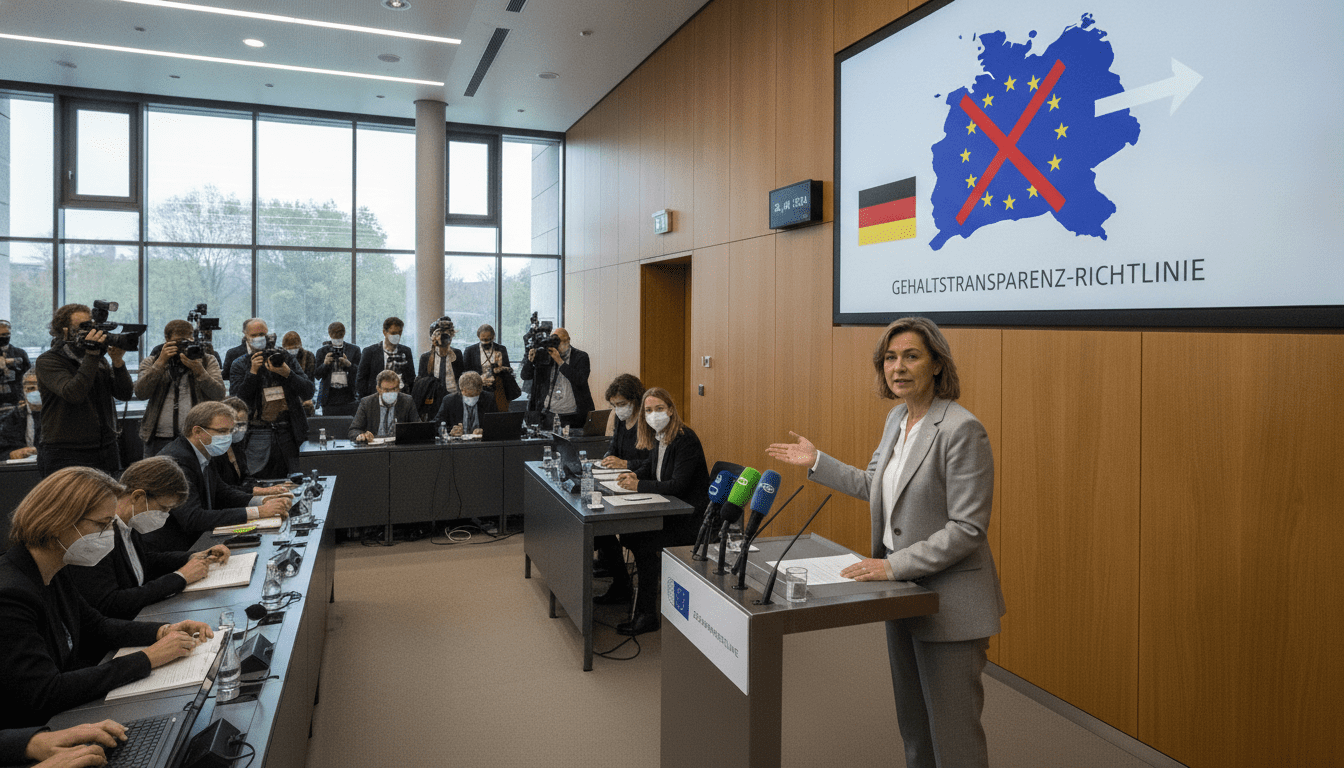
Germany misses EU pay transparency directive deadline as Union spokeswoman Anne König defends non‑implementation
Germany missed the EU pay transparency directive deadline; Union spokeswoman Anne König backs non‑implementation, citing economic burdens and prioritizing education.
Germany has not implemented the EU pay transparency directive, a delay that has become a focal point of political debate as Union spokeswoman Anne König publicly supported the decision not to transpose the measure. König, who chairs the Bundestag working group on education, family, seniors, women and youth and sits on the economic committee, argued that the solution to pay inequality lies in education rather than further regulation. Her statement, made public on June 11, 2026, frames the choice as one of protecting the economy from burdensome side effects while maintaining negotiation freedoms in the labour market.
Germany fails to meet the EU deadline
Germany missed the prescribed deadline to bring the EU pay transparency directive into national law, a development that has set off parliamentary discussion and media scrutiny. The directive aims to strengthen workers’ rights to information on pay and to address the gender pay gap by improving transparency and avenues for redress. By failing to implement the measure on time, Berlin now faces political questions about compliance with EU obligations and the practical impact on employers and employees at home.
Anne König outlines rationale for non‑implementation
Anne König, 40, a former mathematics teacher, presented a clear defence of the choice not to enact the directive immediately, saying that the directive’s requirements would impose significant administrative and economic burdens. König said the primary path to closing pay disparities should be investment in education and skills development rather than additional legal mandates. She also argued that the directive, as she interprets it, does not promise measurable gains for women’s advancement and carries unintended consequences for firms and collective bargaining structures.
König emphasizes education and market freedoms
König framed her position within a broader social market economy perspective, stressing individual negotiation autonomy and the role of education in equalising long‑term opportunities. She suggested that enhanced training and career guidance could address root causes of pay differences more effectively than transparency rules that, in her view, shift costs to employers. Her comments underline a longstanding policy debate in Germany between regulation to enforce equality and measures aimed at structural, educational change.
Voices for transparency question the decision
The decision and König’s defence have prompted immediate pushback from proponents of stronger pay transparency, who argue that information asymmetries perpetuate pay gaps and weaken women’s bargaining power. Advocates contend that transparency provisions provide practical tools for workers to challenge unexplained pay differences and for regulators to monitor systemic patterns. While those reactions were not detailed in König’s remarks, the public response has sharpened political divisions over how best to achieve equal pay for equal work.
Potential impact on employers and compliance costs
König highlighted the compliance costs that businesses could face under the directive’s reporting and documentation rules, suggesting smaller firms could be disproportionately affected. Employers and business associations frequently raise similar concerns about administrative complexity and legal uncertainty when new EU rules are transposed. The debate in Germany now includes assessments of how any late implementation might be designed to limit burdens while still delivering meaningful transparency for employees.
Next steps in the Bundestag and EU context
Parliamentary consideration of the directive’s transposition is expected to continue in the Bundestag as parties weigh the trade‑offs König described against the EU’s expectations. Legal and political options include drafting a law with exemptions or phased implementation, or negotiating compliance mechanisms that reflect national labour market structures. Observers note that EU institutions may follow up on missed deadlines, and Berlin will face choices about timing and the shape of any eventual legislation.
The conversation over the EU pay transparency directive in Germany underscores a broader contest between regulatory approaches and educational or market‑based remedies for gendered pay gaps. König’s position puts the economic implications for employers at the centre of the argument, while supporters of the directive press for clearer routes to accountability and worker information. As the Bundestag debates possible paths forward, businesses, advocacy groups and EU bodies will be watching closely for whether Germany adapts its stance or formalises exemptions in national law.
