
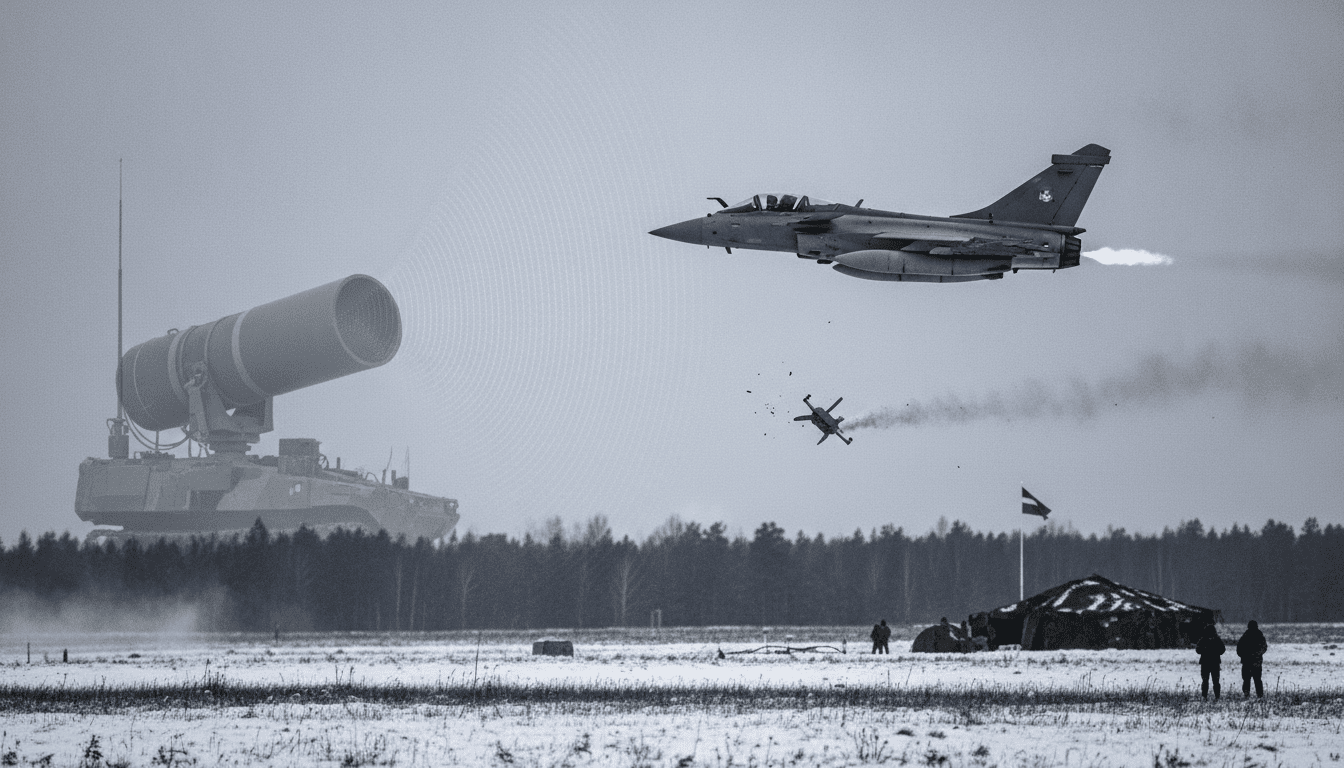
French Jets Shoot Down Drone in Latvian Airspace, Latvia Cites Russian Electronic Warfare
French jets shot down a drone in Latvian airspace on June 8, 2026, amid claims of Russian electronic warfare and growing NATO concerns on the eastern flank.
The Latvian military said French aircraft destroyed a foreign unmanned aerial vehicle that entered Latvian airspace, with officials attributing the incursion to Russian electronic warfare that may have diverted the system. The drone was intercepted just after 9:00 a.m. local time (07:00 GMT) near the village of Berzgale, roughly 30 kilometres from the Russian border. Latvian leaders thanked NATO partners and described the action as swift and professionally executed. No casualties or damage were reported.
Intercept Details and Local Response
The defence minister, Raivis Melnis, told reporters the drone was shot down over an uninhabited area, and authorities briefly warned residents in eastern parts of the country to shelter in place. Prime Minister Andris Kulbergs praised the “swift decision-making and professional action” taken during the incident. Foreign Minister Baiba Braze publicly thanked French forces for their role in neutralising the threat. Local emergency services confirmed there were no injuries and no property affected by debris.
The French military said the jets involved were operating from Šiauliai airbase in northern Lithuania and engaged the unmanned aerial vehicle as part of routine Baltic Air Policing duties. The statement described the strike as occurring over an unpopulated zone and framed the action as part of France’s commitment to eastern European security. NATO’s Baltic Air Policing mission has routinely provided allied quick-reaction fighters to patrol Lithuanian, Latvian and Estonian airspace since those states joined the alliance in 2004.
Claims of Russian Electronic Warfare and Ambiguous Origin
Latvian authorities said the drone entered the country “as a result of Russian electronic warfare,” a characterization that points to jamming or spoofing activity rather than a deliberate cross-border strike. That assessment leaves the platform’s original departure point unclear and highlights the increasing role of electronic interference in modern conflict. Military officials suggested the system could have been operating over Ukraine and displaced by countermeasures, but they stopped short of definitively naming the drone’s operator. The ambiguity underscores the challenge for governments and analysts in attributing incidents that occur amid saturated electromagnetic environments.
Experts note that electronic warfare can disrupt navigation and communications, causing drones to deviate from intended routes and travel into neighbouring airspace. Riga’s description of the incident reflects growing concern that Moscow’s jamming and electronic countermeasures are creating unintended hazards beyond active battlefields. Latvian officials have emphasized caution in public statements, balancing the need to inform citizens with the diplomatic sensitivity of assigning blame.
Regional Pattern of Incursions and Recent Incidents
The Latvian episode comes amid a series of cross-border drone and maritime incidents affecting NATO members and neighbours in recent weeks. On the same day, fragments of a Ukrainian drone were reported in a field in Moldova after an apparent incursion from Ukrainian airspace. Last week a maritime drone exploded in Romania’s Constanța port; Kyiv subsequently said the device was Ukrainian but had been knocked off course by Russian electronic interference. In late May 2026 a Russian drone struck an apartment building in eastern Romania, injuring two people and prompting calls in Bucharest for faster delivery of anti-drone systems.
European Commission President Ursula von der Leyen warned that the war in Ukraine is “increasingly becoming a direct threat to countries on our eastern border,” stressing the need for solidarity with affected states. NATO officials have repeatedly raised alarm about spillover risks as kinetic and non-kinetic tools from the Russia-Ukraine conflict increasingly interact with civilian infrastructure and third-country airspace.
NATO Role and Allied Collaboration
The engagement by French jets reflects NATO’s integrated air policing posture on its eastern flank, where allied quick-reaction forces are on rotational duty to respond to airspace violations and potential threats. The Baltic Air Policing mission has been a visible element of NATO deterrence and reassurance measures for two decades, and this incident reaffirmed the capacity of allied assets to act promptly. France framed the interception as evidence of its commitment to collective defence and to protecting alliance members’ territorial integrity.
Allied governments have accelerated discussions on counter-drone capabilities, electronic warfare resilience and early-warning systems since several recent incidents exposed gaps in detection and response. Latvian leaders and NATO partners are now pressing for more rapid fielding of systems that can identify, track and mitigate unmanned threats before they pose risks to populated areas or critical infrastructure.
Political Fallout and Domestic Implications
Domestically, the heightened frequency of cross-border incursions has intensified political pressure in Latvia and the broader region. The surge in reported incidents contributed to political instability in Riga earlier this year, with Prime Minister Evika Silina resigning in May 2026 amid criticism over government handling of security challenges. The latest interception is likely to deepen debate in Latvia about defence spending, civil preparedness and the pace of acquiring specialised counter-drone equipment.
Latvian officials are urging the public to remain vigilant but calm, while continuing to coordinate closely with allied partners on intelligence sharing and operational support. Political leaders from across the Baltic and Eastern European states are expected to use the incident to press for sustained NATO attention and investment on the alliance’s eastern edge.
As investigations continue, Latvian and allied authorities will seek to establish a clearer chain of events, corroborate technical forensic evidence and determine whether measures can be taken to reduce the likelihood of similar incursions. The incident on June 8, 2026, highlights both the tactical complexities introduced by electronic warfare and the strategic imperative for robust allied cooperation on airspace security and unmanned systems management.
