
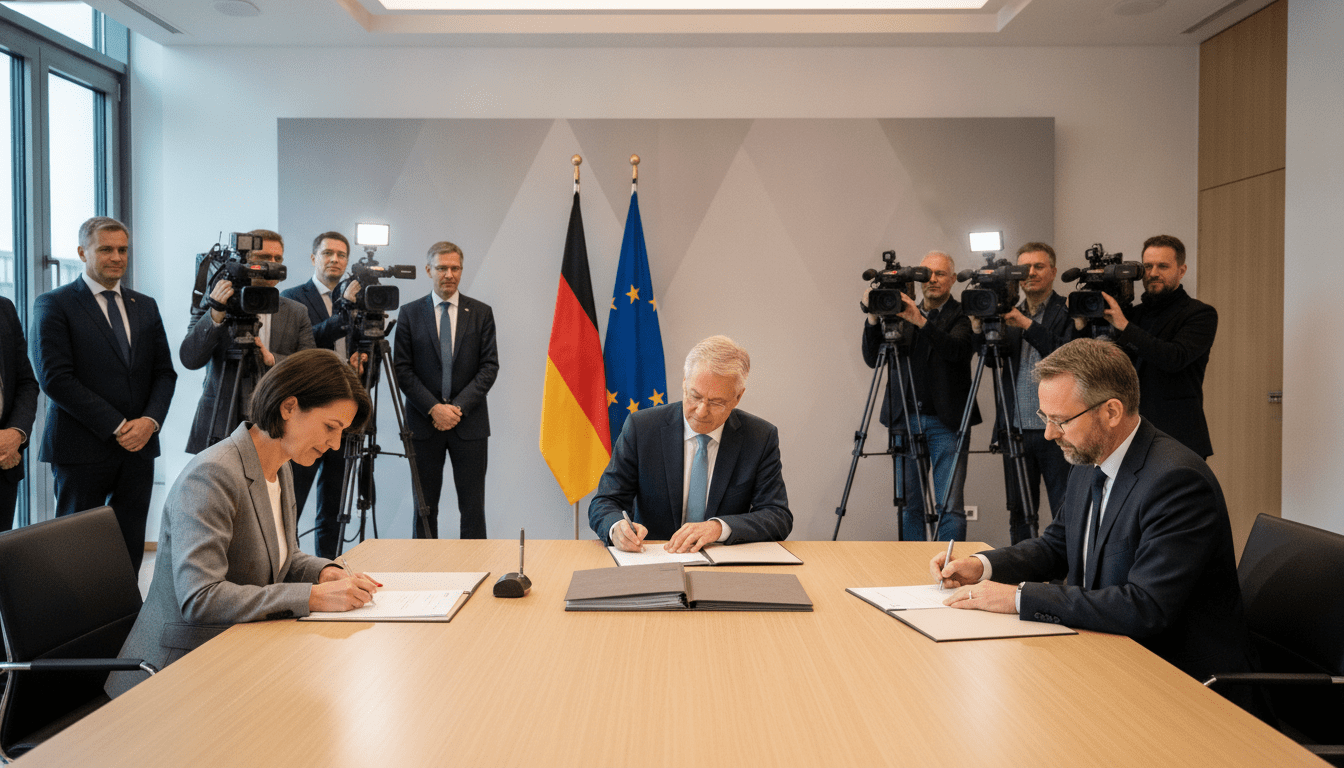
Germany agrees new targets to speed fiber expansion and mobile coverage
Government, operators and municipalities sign “Bestes Netz für Deutschland” to track progress with clear KPIs and boost fiber expansion nationwide.
The federal government, states, municipalities and major telecom operators signed a binding agreement on Monday in Berlin to accelerate fiber expansion and mobile network rollout across Germany. The pact, titled “Bestes Netz für Deutschland,” introduces concrete key performance indicators to measure build progress, permitting times, use of digital procedures and actual investment flows. Officials said the goal is to reduce bureaucracy, increase planning certainty and create clearer incentives for investors to close long-standing gaps in fiber and 5G coverage.
Pact introduces measurable KPIs for network rollout
Under the new agreement, parties will report standardized figures on construction milestones, permit durations and the digitalization of approval workflows. The metrics are intended to make progress transparent and to tie implementation to verifiable benchmarks that all stakeholders can monitor. Federal Digital Minister Karsten Wildberger framed the move as a means to strengthen investor confidence and to hold authorities and companies accountable for delivery. The agreement aims to move conversations from broad targets to quantifiable outcomes.
Permitting bottlenecks and power supply delay mast activation
Industry assessments show that bureaucratic and infrastructural hurdles remain major causes of delay in mobile network deployment. A recent analysis cited by industry groups indicates it can take more than three years on average from planning to a fully operational mobile mast, even though planning typically takes less than a year and physical construction only a few months. Local site searches, extended permitting procedures of around ten months and particularly the time needed to secure electricity for sites — sometimes up to 18 months — were identified as recurring choke points. The new KPIs are intended to highlight these specific delays so that targeted remedies can be applied.
Operators and associations back digitalized approvals
Trade associations and operators broadly welcomed the focus on faster, digital permit processes as a central lever to speed deployment. Bitkom’s leadership emphasized that rollout advances where federal and state authorities remove obstacles and municipalities prioritize projects. Executives from major operators described planned digitalization of approval chains as critical because current paper-heavy procedures often stall deployments. Association leaders also called for harmonized processes to give companies greater planning certainty and reduce legal and administrative friction.
Sector committing billions to fiber and mobile networks
Telecom firms plan substantial capital expenditure this year with industry estimates pointing to roughly €8.5 billion for fiber networks and an additional €2.4 billion for mobile infrastructure. Operators expect to connect about 3.1 million households to fiber this year and report some 5.6 million premises that are already passed by new fiber lines and could be ordered. Despite heavy investment, the gap between premises passed and those actually subscribed to fiber services remains a concern for the sector and for policymakers tracking uptake. Companies have outlined multi-year investment plans that depend on predictable regulatory and permitting frameworks.
Regulatory dispute over network access and market power
Tensions persist over how to regulate access to newly built fiber infrastructure and how to avoid entrenching market power. The incumbent Deutsche Telekom is the largest investor in fiber, and competitors warn that without careful regulation the market could replicate the concentration seen in legacy copper services. Rival operators and industry groups have urged Berlin to support EU-level proposals that favor a prompt transition from copper to fiber while safeguarding fair access. The debate over the Digital Networks Act and upcoming revisions to domestic telecom law centers on third-party access, pricing rules and the balance between promoting competition and preserving investment incentives.
Local obstacles and political will remain decisive
Municipalities will play a decisive role in whether the federal pact achieves its aims, industry representatives stressed. In urban centers the scarcity of suitable rooftop and street furniture sites complicates mast siting, while in rural areas public resistance and limited local capacity can slow projects. Industry leaders said the pact can only succeed if local authorities prioritize digital infrastructure in planning decisions and streamline local permitting. Officials added that federated cooperation — from federal funding to municipal execution — will be monitored through the newly agreed KPIs.
The signatories said the agreement creates a framework for accountability but left open several contested policy details, including precise timelines for phasing out copper networks and the exact regulatory conditions for network access. Implementation will be tracked through periodic reporting against the KPIs, with the aim of identifying where legal or procedural changes are required to sustain the current wave of investment and to close gaps in fiber expansion and mobile coverage.
