
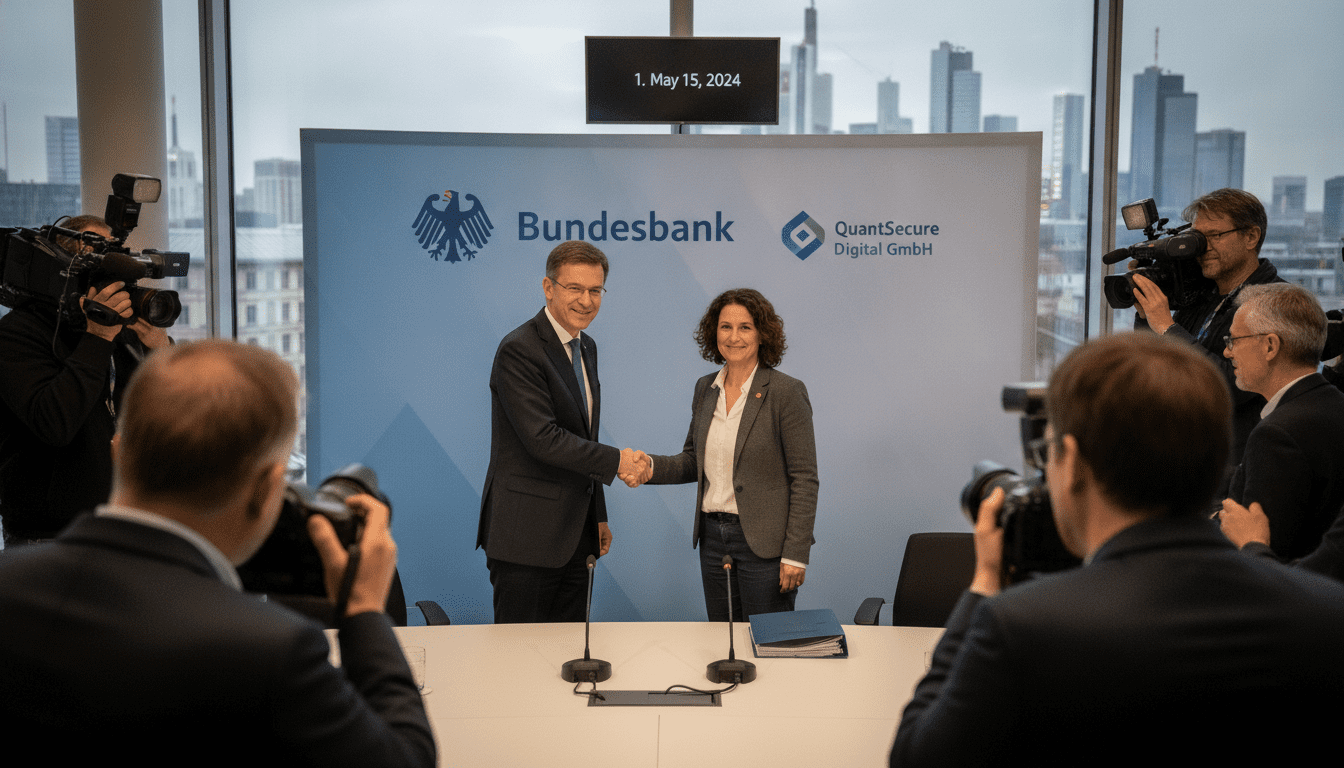
Bundesbank Backs Quantum-Resistant Digital Identity Technology Developed with German Start-up
Bundesbank signs patent-sharing deal with German start-up to deploy quantum-resistant digital identity technology and boost Europe’s AI and quantum capacity.
A novel patent-sharing agreement between the Deutsche Bundesbank and a German start-up will allow a jointly developed, quantum-resistant digital identity technology to be used and commercialized, officials said. The contract formalizes joint ownership and transfer mechanisms for a cryptographic process designed to withstand future quantum-computing attacks. The move underscores growing collaboration between public institutions and private innovators in Europe’s technology sector.
Details of the Bundesbank agreement
The Bundesbank confirmed that three of its employees worked with the start-up to develop the new digital identity method, which has now been submitted for patent protection. The contract sets out how the technology will be shared, licensed and brought to market, signaling an unusual but deliberate partnership between a central bank and a private company. The bank described the arrangement as an example of how public bodies can help translate domestic research into deployable digital infrastructure.
Security designed for a post-quantum future
Engineers say the process is intended to remain secure even against the processing power of future quantum computers, addressing a known vulnerability in current cryptographic standards. That capability is central to digital wallets, identity management and other services that depend on long-lived keys and secure transfers. Experts note that preparing cryptography for quantum resilience is becoming a practical necessity as research and prototype quantum systems advance.
Europe’s data assets as an economic lever
Policy makers and economists point to Europe’s rich, decentralized data holdings—manufacturing, machine and operational datasets—as a competitive advantage when combined with AI and new encryption methods. The Bundesbank has highlighted that digital sectors in Germany showed much faster productivity growth than the rest of the economy over recent decades. Translating those assets into scalable products could expand European firms’ share of global IT markets and support broader economic growth.
Adoption of generative AI and productivity signals
A Bundesbank corporate survey cited by officials finds rapid uptake of generative AI among German firms, with the share planning or already using such tools rising markedly between 2024 and 2026. The bank reported productivity in digital industries grew roughly seven times faster than the general economy from 1996 to 2020, and many companies now expect AI to deliver further gains. These indicators are being used to argue for targeted public and private investment in secure digital infrastructure.
Financing gaps and the case for an EU corporate form
Despite technological advances, stakeholders warn that Europe’s most promising start-ups often relocate abroad at advanced growth stages or before listing. Observers call for easier cross-border scaling within the single market, citing proposals such as a harmonized “EU Inc.” legal form and a so-called 28th Regime to reduce legal fragmentation. Greater access to growth capital and a smoother path to pan‑European customers are seen as essential if homegrown innovations are to become global products.
Frankfurt’s ecosystem and near-term deployments
Frankfurt is cited as a model local ecosystem where finance, technology and research converge, hosting initiatives like a new AI and quantum application center and the “Baby Diamond” quantum computer at Goethe University. Regional government studies on quantum feasibility involve the state digital ministry and institutions such as the Bundesbank, reflecting coordinated local investment. Public procurement and early institutional adoption are being promoted as levers to accelerate market entry for secure European technologies.
The Bundesbank-start-up deal illustrates a broader push to convert Europe’s technical capabilities into commercially viable, sovereign digital infrastructure, with quantum-resistant digital identity technology emerging as a first, visible example of that strategy. Public backing, focused financing and cross-border market access will determine whether this and similar innovations scale from research labs into products used across the EU.
