
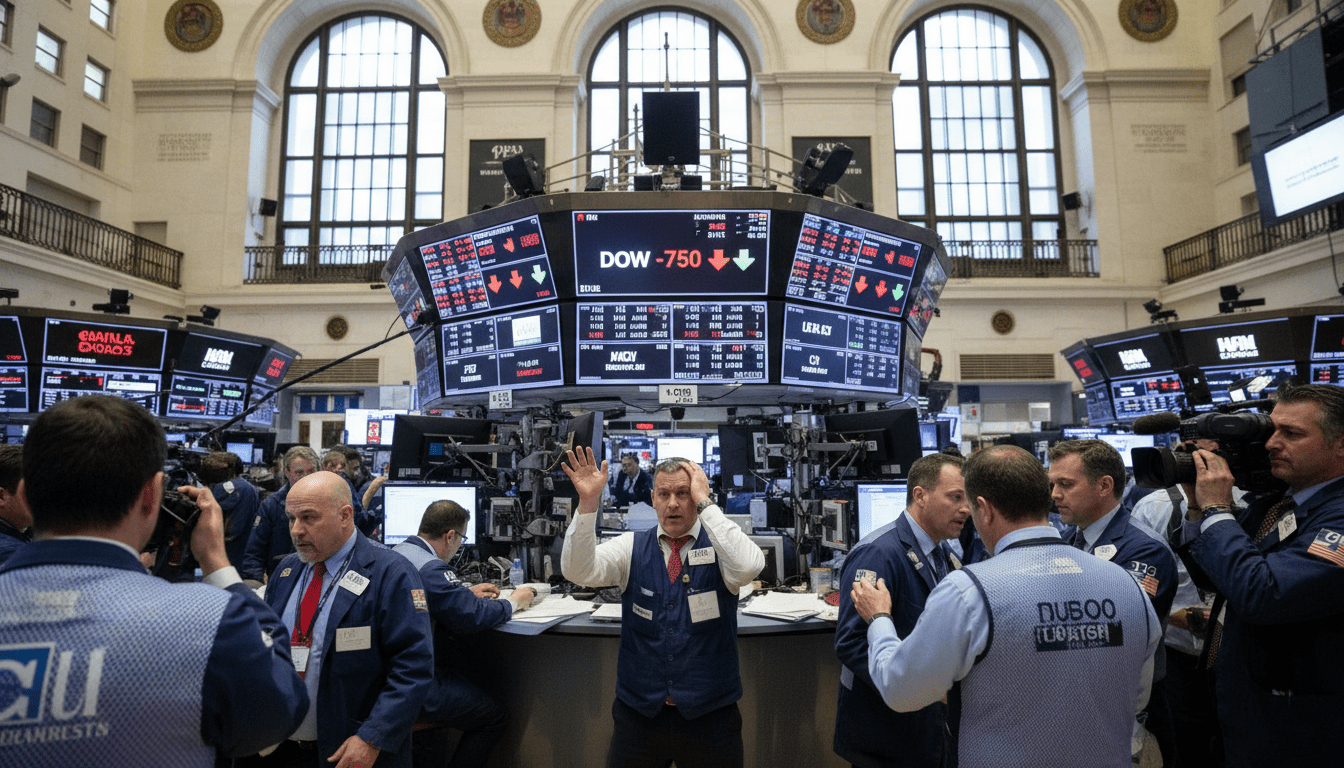
Wall Street sell-off accelerates after stronger-than-expected US jobs report
Robust US jobs data reignites rate fears, sparking a sharp Wall Street sell-off that hits tech and semiconductors hardest while reshaping Fed expectations.
A stronger-than-expected US jobs report on Friday triggered a broad Wall Street sell-off, wiping out a nine-week equity rally and sending the Nasdaq into its steepest one-day drop in months. The Labor Department reported 172,000 new payrolls for May and an unemployment rate steady at 4.3 percent, data market participants said dimmed hopes for near-term Federal Reserve rate cuts and revived concerns about higher interest rates. Investors quickly repriced policy expectations, lifting the perceived odds of a December rate increase and prompting widespread selling across risk assets.
Major indexes slide as investors reassess rate path
The Dow Jones Industrial Average closed down 1.4 percent at 50,867, while the S&P 500 fell 2.6 percent to 7,384, ending its nine-week winning streak. The Nasdaq Composite plunged 4.2 percent to 25,709 as technology shares bore the brunt of the rout. Market participants said the velocity of the sell-off reflected a sudden recalibration of interest-rate expectations rather than a single, new economic shock.
Jobs data cited as catalyst for renewed rate anxiety
Traders and economists pointed to the payrolls report as the primary catalyst for the Wall Street sell-off, noting that the 172,000 gain exceeded consensus forecasts by a wide margin. The steady 4.3 percent unemployment rate reinforced the view of a resilient labor market, which in turn dimmed prospects for near-term Fed easing. As a result, futures markets moved to price in almost a 43 percent chance of a rate increase by December, according to traders’ implied probabilities.
Semiconductor sector suffers deepest losses since 2020
Semiconductor stocks were among the hardest hit, with the Philadelphia Semiconductor Index plunging by its largest margin since March 2020 and erasing more than $1 trillion in market value. Analysts said valuations in chips and related technology had become stretched after weeks of gains, and the surge in yields exposed that vulnerability. The sell-off accelerated declines for major chipmakers and suppliers, amplifying losses across the broader technology complex.
Big tech names and crypto extend market pain
Leading chipmaker Nvidia dropped 6.2 percent, while competitors including Intel, Micron, AMD and Broadcom tumbled between 7.9 and 13.3 percent. The pullback in technology spilled over into cryptocurrencies, with Bitcoin falling 4.1 percent and crypto-related equities such as Coinbase and MicroStrategy each losing roughly seven percent. Market strategists said concentrated positioning in megacap tech and related assets magnified the move lower during the Wall Street sell-off.
Index rules and corporate news add to volatility
S&P Global confirmed it would not change the inclusion criteria for its flagship indices, effectively eliminating the prospect of SpaceX entering the S&P 500 immediately after its planned initial public offering. That decision removed a potential catalyst for additional market reshuffling. Separately, company-specific earnings and guidance contributed to volatile trading, with results and outlooks prompting sharp, isolated moves in individual stocks.
Earnings pressure dents consumer and healthcare names
Retail and consumer names were also affected by earnings updates, exemplified by Lululemon, whose shares plunged 8.6 percent after the company cut its full-year profit forecast and issued weak second-quarter guidance. Conversely, Cooper Companies bucked the trend, rallying 8.6 percent after beating analysts’ estimates for the second quarter. Investors said the juxtaposition of disappointing and reassuring corporate reports intensified intraday swings during the broader Wall Street sell-off.
Market strategists framed the episode as a corrective pause following an extended run-up in equities, particularly in technology and semiconductor sectors. Ryan Detrick, chief market strategist at Carson Group, described the reaction as a release of pressure after weeks of record gains, while Ohsung Kwon of Wells Fargo characterized the moves largely as profit-taking rather than a signal of deteriorating fundamentals.
Liquidity and positioning patterns amplified the move, according to traders, as stops and margin calls fed into downward momentum. Rising Treasury yields accompanying the jobs data added another headwind for high-growth stocks, which are especially sensitive to changes in discount rates. Investors monitoring economic indicators now face a more cautious backdrop as they reassess earnings yields and valuation buffers.
Geopolitical developments also weighed on sentiment, with fading hopes for a swift resolution to tensions in the Iran conflict raising concerns about higher energy prices and sustained inflationary pressures. Market participants warned that a prolonged disruption of shipping lanes such as the Strait of Hormuz could further complicate the inflation outlook and challenge the Fed’s path forward.
Looking ahead, analysts expect volatility to remain elevated as market participants digest incoming economic data and corporate results. The timing and magnitude of any Federal Reserve policy adjustments will be central to market direction, and investors will likely watch payrolls, inflation readings and central-bank commentary for clues. For now, the Wall Street sell-off has interrupted the recent rally and forced a reassessment of risks across equities, bonds and commodities.
Despite the sharp move, many strategists stopped short of declaring a structural market shift, instead suggesting the sell-off represents a reset in expectations that could create selective buying opportunities. Short-term traders may look for technical stabilization, while longer-term investors will weigh valuations against a still-resilient U.S. economy and evolving monetary policy signals.
